Quote by Sidney Dekker Download Open image ““A just culture accepts nobody’s account as “true” or “right” and others wrong.”” — Sidney Dekker ★ ★ ★ ★ ★ 3.1 out of 5 (8 ratings) Copy quoteShare
“The problem with today's culture is that we have too many rights and not enough wrongs.” — Ron Brackin Copy Share Image
“Do not let your assumptions about a culture block your ability to perceive the individual, or you will fail.” — Brandon Sanderson Copy Share Image
“Culture does not exist autonomously; it is set always in the context of social relationships.” — Robert A. Nisbet Copy Share Image
“Someone has said that culture is what remains with you after you have forgotten all you have read, and I believe there is much… — Louis L'Amour Copy Share Image
“Every culture has its typical beliefs, norms and values, but these are in constant flux.” — Yuval Noah Harari Copy Share Image
“One problem with today's culture is that we defend too many rights and ignore too many wrongs.” — Ron Brackin Copy Share Image
“It is often out encounter with culture that first reveals to us our own culture.” — Tim Chester Copy Share Image
“Competence isn’t enough, there has to be the right culture as well.” — Bryan Loritts Copy Share Image
“The epitome of culture is the search for truth, or at least a reasonable approximation of reality, most notably the need to know ourselves… — Eric Chaisson Copy Share Image
“We mistakenly believe our cultural behaviors are the good, right, and respectful behaviors. What convinces us of that misperception? Our Filters.” — Sara Taylor Copy Share Image
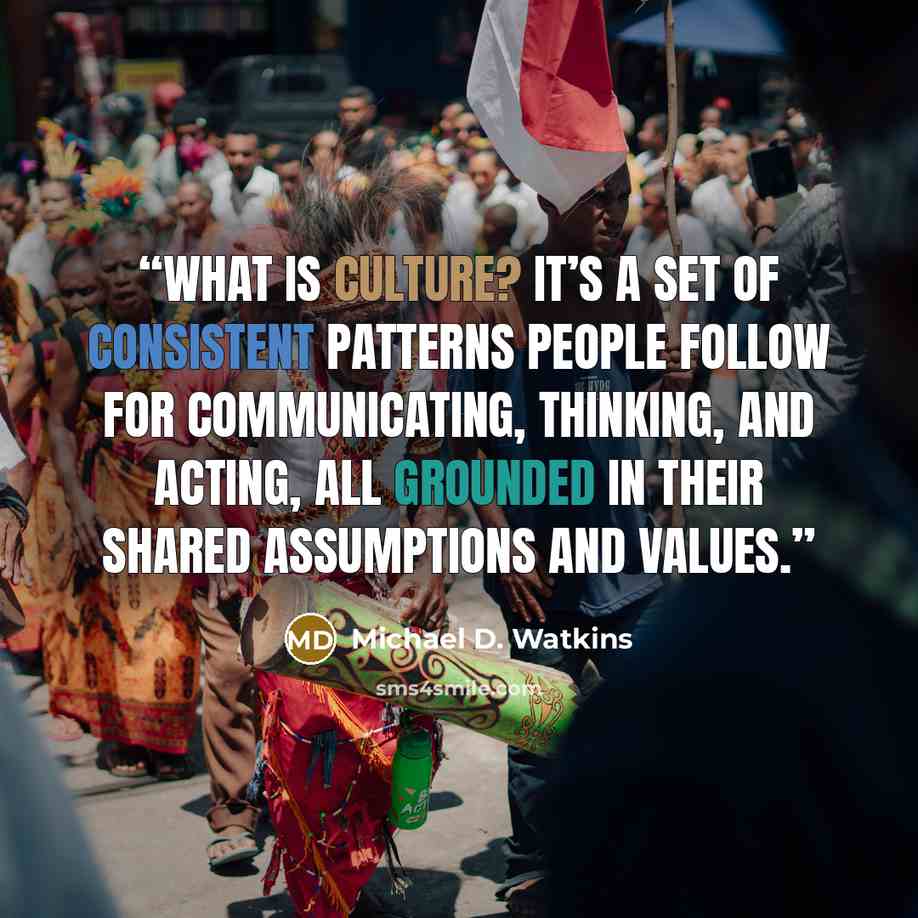
“What is culture? It’s a set of consistent patterns people follow for communicating, thinking, and acting, all grounded in their shared assumptions and values.” — Michael D. Watkins Copy Share Image
“forward-looking accountability.”2 Accountability that is backward-looking (often the kind in trials or lawsuits) tries to find a scapegoat, to blame and shame an individual for messing up. But accountability is about looking ahead. Not only should accountability acknowledge the mistake and the harm resulting from it, it should lay out the opportunities (and responsibilities!) for making changes so that the… — Sidney Dekker Copy Share
“Accidents are no longer accidents at all. They are failures of risk management.” — Sidney Dekker Copy Share Image
“It has to do with being open, with a willingness to share information about safety problems without the fear of being nailed for them.” — Sidney Dekker Copy Share Image
“The main question for a just culture is not about matching consequences with outcome. It is this: Did the assessments and actions of the… — Sidney Dekker Copy Share Image
“There is almost no human action or decision that cannot be made to look flawed and less sensible in the misleading light of hindsight.… — Sidney Dekker Copy Share Image
“Unjust responses to failure are almost never the result of bad performance. They are the result of bad relationships.” — Sidney Dekker Copy Share Image
“Arriving at the edge of chaos is a logical endpoint for drift. At the edge of chaos, systems have tuned themselves to the point… — Sidney Dekker Copy Share Image
“If professionals consider one thing “unjust,” it is often this: Split-second operational decisions that get evaluated, turned over, examined, picked apart, and analyzed for… — Sidney Dekker Copy Share Image
“If we adjudicate an operator’s understanding of an unfolding situation against our own truth, which includes knowledge of hindsight, we may learn little of… — Sidney Dekker Copy Share Image
“In complex systems, after all, it is very hard to foresee or predict the consequences of presumed causes. So it is not the consequences… — Sidney Dekker Copy Share Image
“Creating a climate in which disclosure is possible and acceptable is the organization’s responsibility.” — Sidney Dekker Copy Share Image
“The question that drives safety work in a just culture is not who is responsible for failure, rather, it asks what is responsible for… — Sidney Dekker Copy Share Image