Jazz musician Quote by Sarah Lewis
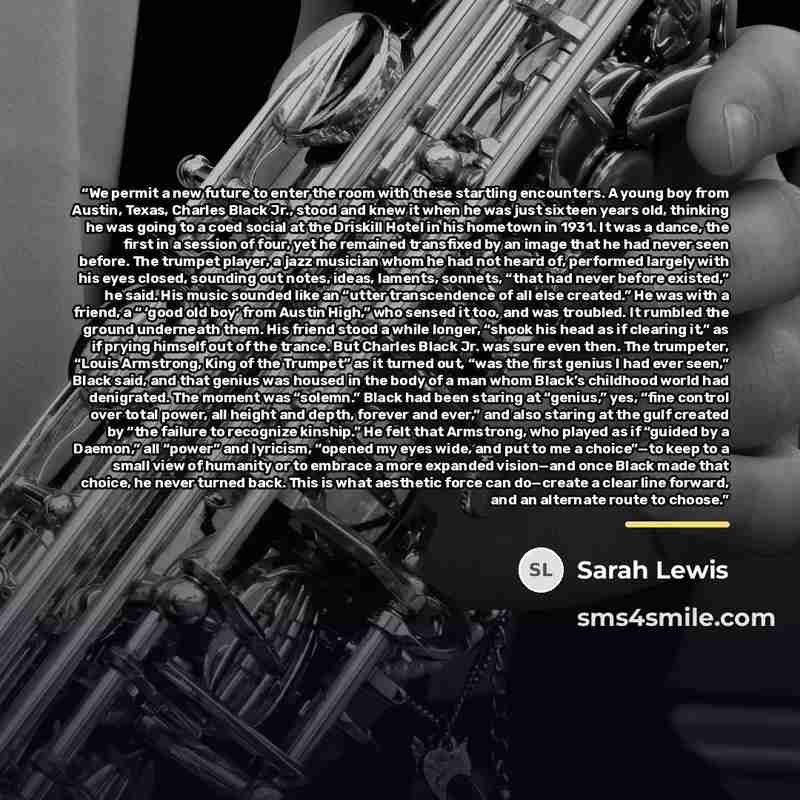
““We permit a new future to enter the room with these startling encounters. A young boy from Austin, Texas, Charles Black Jr., stood and knew it when he was just sixteen years old, thinking he was going to a coed social at the Driskill Hotel in his hometown in 1931. It was a dance, the first in a session of four, yet he remained transfixed by an image that he had never seen before. The trumpet player, a jazz musician whom he had not heard of, performed largely with his eyes closed, sounding out notes, ideas, laments, sonnets, “that had never before existed,” he said. His music sounded like an “utter transcendence of all else created.” He was with a friend, a “ ‘good old boy’ from Austin High,” who sensed it too, and was troubled. It rumbled the ground underneath them. His friend stood a while longer, “shook his head as if clearing it,” as if prying himself out of the trance. But Charles Black Jr. was sure even then. The trumpeter, “Louis Armstrong, King of the Trumpet” as it turned out, “was the first genius I had ever seen,” Black said, and that genius was housed in the body of a man whom Black’s childhood world had denigrated. The moment was “solemn.” Black had been staring at “genius,” yes, “fine control over total power, all height and depth, forever and ever,” and also staring at the gulf created by “the failure to recognize kinship.” He felt that Armstrong, who played as if “guided by a Daemon,” all “power” and lyricism, “opened my eyes wide, and put to me a choice”—to keep to a small view of humanity or to embrace a more expanded vision—and once Black made that choice, he never turned back. This is what aesthetic force can do—create a clear line forward, and an alternate route to choose.””
About This Quote
A teenage encounter with Louis Armstrong's transcendent jazz revealed how aesthetic experience can expand one's worldview, confronting racial prejudice and prompting a lifelong commitment to broader human empathy.
In simple terms: Art can reshape perception and moral choices.
Key Takeaway
Aesthetic revelation expands empathy.
Themes
Art and perception
Racial identity
Transformation
Music as transcendence
Choice and agency
Mood
Amazement
Reflective
Type
Narrative anecdote
Philosophical insight
When to use this quote
- Encountering a groundbreaking performance
- Confronting societal bias
- Choosing a broader worldview
Key Concepts
Aesthetic experience
Racial prejudice
Personal awakening
Practical Applications
- Use music to challenge preconceptions
- Leverage artistic moments for social change
Questions to Reflect On
- How can a single artistic encounter alter deeply held biases?
- What responsibilities arise when art reveals uncomfortable truths?

![“I do not know much about this man [Jesus], but I do know that his whole life conveys one message: 'anyone at any moment can start a new future.” quote by Roger Garaudy](https://sms4smile.com/quotes/img-quotes/9f9/roger-garaudy-51039_jesus_i-do-not-know-much-about-this-man-jesus_822630.jpg)











![“I'm a jazz musician by education and vocation, but I don't think jazz should [ dictate] what I want to do.” quote by Dave Douglas](https://sms4smile.com/quotes/img-quotes/f17/dave-douglas-58135_career_i-m-a-jazz-musician-by-education-and-voc_58930.jpg)