Historical fiction Quote by Sarah Dunant
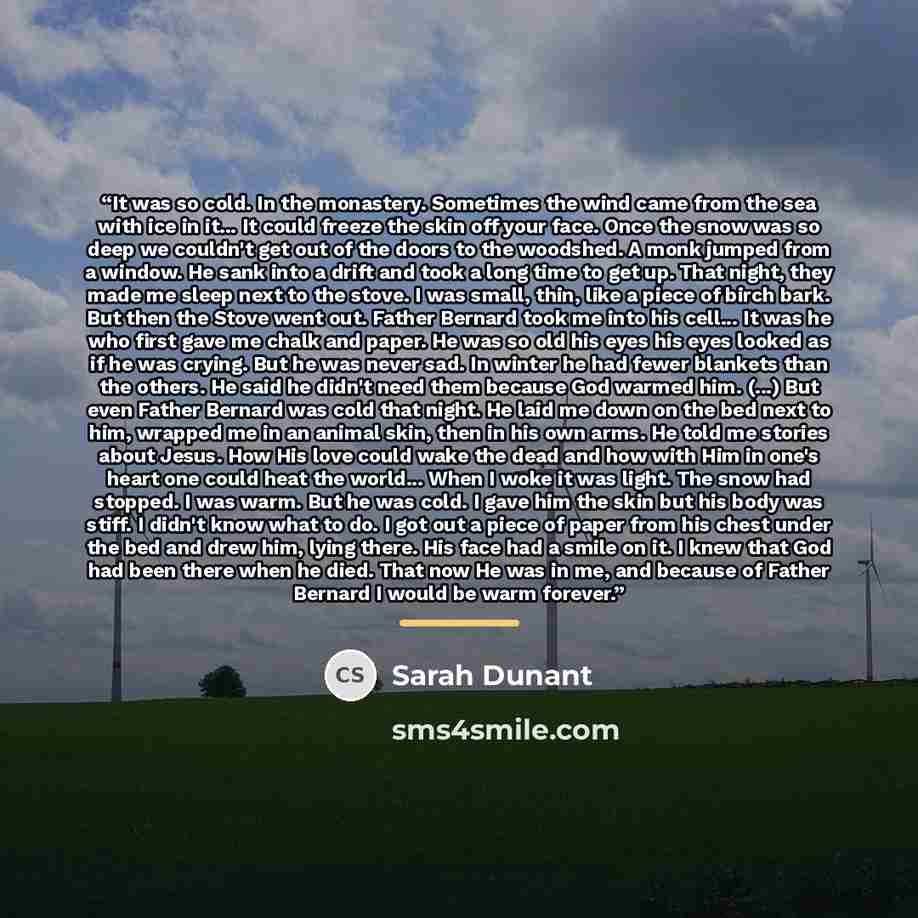
““It was so cold. In the monastery. Sometimes the wind came from the sea with ice in it... It could freeze the skin off your face. Once the snow was so deep we couldn't get out of the doors to the woodshed. A monk jumped from a window. He sank into a drift and took a long time to get up. That night, they made me sleep next to the stove. I was small, thin, like a piece of birch bark. But then the Stove went out. Father Bernard took me into his cell... It was he who first gave me chalk and paper. He was so old his eyes his eyes looked as if he was crying. But he was never sad. In winter he had fewer blankets than the others. He said he didn't need them because God warmed him. (...) But even Father Bernard was cold that night. He laid me down on the bed next to him, wrapped me in an animal skin, then in his own arms. He told me stories about Jesus. How His love could wake the dead and how with Him in one's heart one could heat the world... When I woke it was light. The snow had stopped. I was warm. But he was cold. I gave him the skin but his body was stiff. I didn't know what to do. I got out a piece of paper from his chest under the bed and drew him, lying there. His face had a smile on it. I knew that God had been there when he died. That now He was in me, and because of Father Bernard I would be warm forever.””
About This Quote
Source Novel: The Birth of Venus by Sarah Dunant, 2003
A monk's selfless love and faith provide warmth and spiritual comfort amidst harsh physical cold, illustrating how compassion can transcend suffering.
In simple terms: Compassion and faith give inner warmth despite external cold.
Key Takeaway
Seek to give and receive compassionate support.
Themes
compassion
faith
sacrifice
spirituality
Mood
reflective
hopeful
somber
Type
narrative
inspirational
philosophical
When to use this quote
- winter hardship
- caregiving
- spiritual mentorship
- personal loss
- healing
Key Concepts
selflessness
redemption
human connection
Questions to Reflect On
- How can we embody compassionate care in our own lives?
- What limits exist when relying solely on personal sacrifice?
A Different Perspective
The narrative may idealize suffering, overlooking systemic neglect.






![“Together he [Girolamo Savonarola] and his archenemy Lorenzo [de' Medici] would have been the stuff of gargoyles. One could almost imagine the diptych in which their profiles confronted each other, their noses as powerful as their personalities.” quote by Sarah Dunant](https://sms4smile.com/quotes/img-quotes/c90/sarah-dunant-22065_gargoyles_together-he-girolamo-savonarola-and-his_5490.jpg)








![“Any man in love with Cesare is already half in love with his sister. Now, when [Pedro Calderon] shuts his eyes, he cannot see anything else.” quote by Sarah Dunant](https://sms4smile.com/quotes/img-quotes/3de/sarah-dunant-22065_love_any-man-in-love-with-cesare-is-already-h_1829478.jpg)









![“Most of [her ashes] fell into the river in a long gray curtain. But some was caught by the wind and blown upward toward the blue spring sky where it swirled a moment in the air, before dissolving into sunlight.” quote by Kimberly Cutter](https://sms4smile.com/quotes/img-quotes/3df/kimberly-cutter-68038_ashes_most-of-her-ashes-fell-into-the-river-in_75347.jpg)