Einstein Quote by Samuel R. Delany
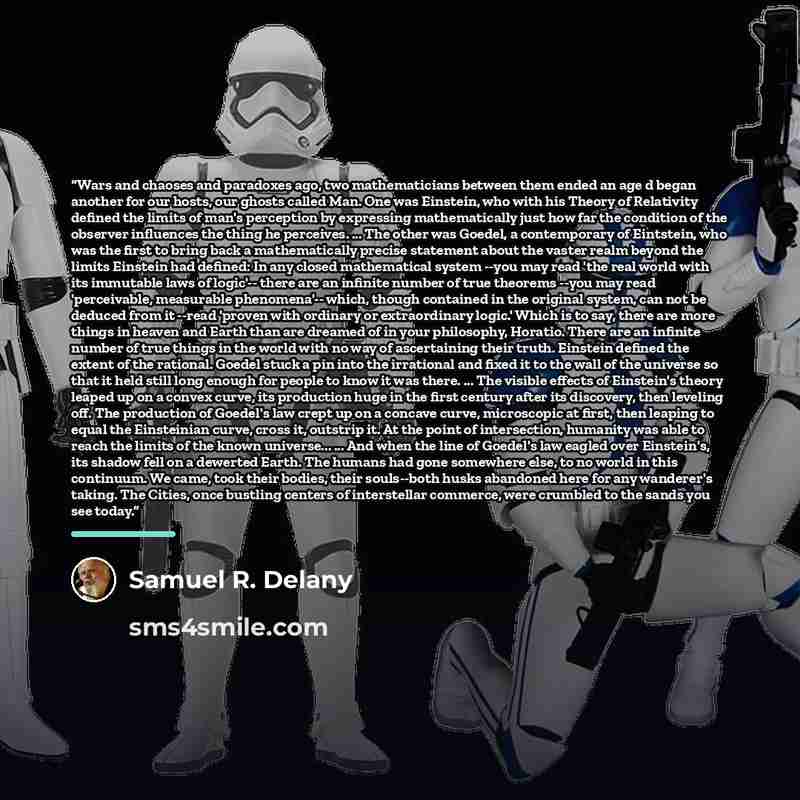
““Wars and chaoses and paradoxes ago, two mathematicians between them ended an age d began another for our hosts, our ghosts called Man. One was Einstein, who with his Theory of Relativity defined the limits of man's perception by expressing mathematically just how far the condition of the observer influences the thing he perceives. ... The other was Goedel, a contemporary of Eintstein, who was the first to bring back a mathematically precise statement about the vaster realm beyond the limits Einstein had defined: In any closed mathematical system --you may read 'the real world with its immutable laws of logic'-- there are an infinite number of true theorems --you may read 'perceivable, measurable phenomena'-- which, though contained in the original system, can not be deduced from it --read 'proven with ordinary or extraordinary logic.' Which is to say, there are more things in heaven and Earth than are dreamed of in your philosophy, Horatio. There are an infinite number of true things in the world with no way of ascertaining their truth. Einstein defined the extent of the rational. Goedel stuck a pin into the irrational and fixed it to the wall of the universe so that it held still long enough for people to know it was there. ... The visible effects of Einstein's theory leaped up on a convex curve, its production huge in the first century after its discovery, then leveling off. The production of Goedel's law crept up on a concave curve, microscopic at first, then leaping to equal the Einsteinian curve, cross it, outstrip it. At the point of intersection, humanity was able to reach the limits of the known universe... ... And when the line of Goedel's law eagled over Einstein's, its shadow fell on a dewerted Earth. The humans had gone somewhere else, to no world in this continuum. We came, took their bodies, their souls--both husks abandoned here for any wanderer's taking. The Cities, once bustling centers of interstellar commerce, were crumbled to the sands you see today.””
About This Quote
Source Novel: The Einstein Intersection by Samuel R. Delany, 1967
The passage contrasts Einstein’s bounded, observable physics with Gödel’s proof of true statements beyond formal systems, suggesting humanity’s progress eventually outpaces known limits, leading to existential displacement.
In simple terms: Science defines limits; mathematics reveals unprovable truths; humanity may outgrow its world.
Key Takeaway
Recognize that knowledge has boundaries and some truths remain inaccessible.
Themes
science
philosophy
existentialism
progress
limits
humanity
Mood
thoughtful
reflective
cautious
Type
analytical
philosophical
speculative
When to use this quote
- academic research
- technological development
- space exploration
- philosophical debate
- cultural reflection
Key Concepts
relativity
incompleteness
metaphysics
cosmology
paradox
Questions to Reflect On
- How do we act when faced with truths we cannot verify?
- What responsibilities arise from surpassing our own limits?
A Different Perspective
Human experience is limited by perception; Gödel’s incompleteness shows some truths are forever beyond proof.