Genetic engineering Quote by Sam Harris
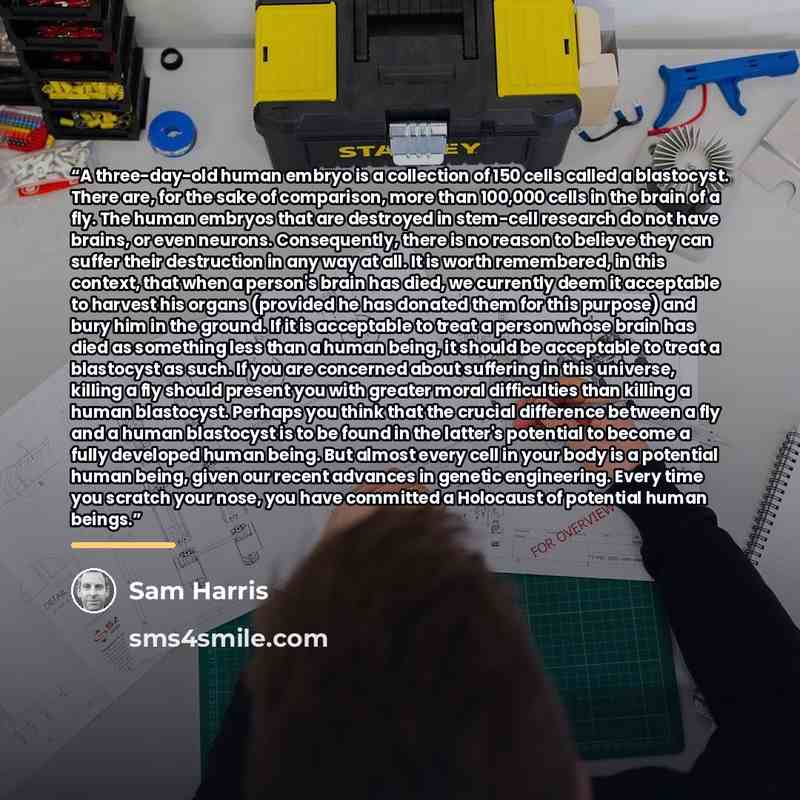
““A three-day-old human embryo is a collection of 150 cells called a blastocyst. There are, for the sake of comparison, more than 100,000 cells in the brain of a fly. The human embryos that are destroyed in stem-cell research do not have brains, or even neurons. Consequently, there is no reason to believe they can suffer their destruction in any way at all. It is worth remembered, in this context, that when a person's brain has died, we currently deem it acceptable to harvest his organs (provided he has donated them for this purpose) and bury him in the ground. If it is acceptable to treat a person whose brain has died as something less than a human being, it should be acceptable to treat a blastocyst as such. If you are concerned about suffering in this universe, killing a fly should present you with greater moral difficulties than killing a human blastocyst. Perhaps you think that the crucial difference between a fly and a human blastocyst is to be found in the latter's potential to become a fully developed human being. But almost every cell in your body is a potential human being, given our recent advances in genetic engineering. Every time you scratch your nose, you have committed a Holocaust of potential human beings.””
About This Quote
Source Book: "The Moral Landscape" (Chapter on bioethics), 2010
He argues early embryos lack consciousness, so destroying them lacks moral weight comparable to killing sentient beings; potentiality alone isn’t sufficient for moral status.
In simple terms: Embryos lack consciousness, so destroying them isn’t morally like killing sentient life.
Key Takeaway
Consider consciousness over potential when judging moral status.
Themes
ethics
consciousness
potential
bioethics
Mood
thoughtful
analytical
Type
ethical
philosophical
When to use this quote
- organ donation policy
- stem cell research
- genetic engineering debates
Key Concepts
Moral status
potentiality
sentience
Questions to Reflect On
- Is potential alone enough for moral protection?
- How should we weigh consciousness vs. potential?
A Different Perspective
Potentiality arguments can overlook future capacities.





![“Moderates in every faith are obliged to loosely interpret (or simply ignore) much of their canons in the interests of living in the modern world. [...] The first thing to observe about the moderate’s retreat from scriptural literalism is that it draws its inspiration not from scripture but from…” quote by Sam Harris](https://sms4smile.com/quotes/img-quotes/b44/sam-harris-457_bible_moderates-in-every-faith-are-obliged-to_6967.jpg)













![“The time to talk about it [genetic engineering to improve a baby's genes] in schools and churches and magazines and debate societies is now. If you wait, five years from now the gene doctor will be hanging out the MAKE A SMARTER BABY sign down the street.” quote by Arthur Caplan](https://sms4smile.com/quotes/img-quotes/de9/arthur-caplan-37880_baby_the-time-to-talk-about-it-genetic-engine_204728.jpg)