Day life Quote by Roger Scruton
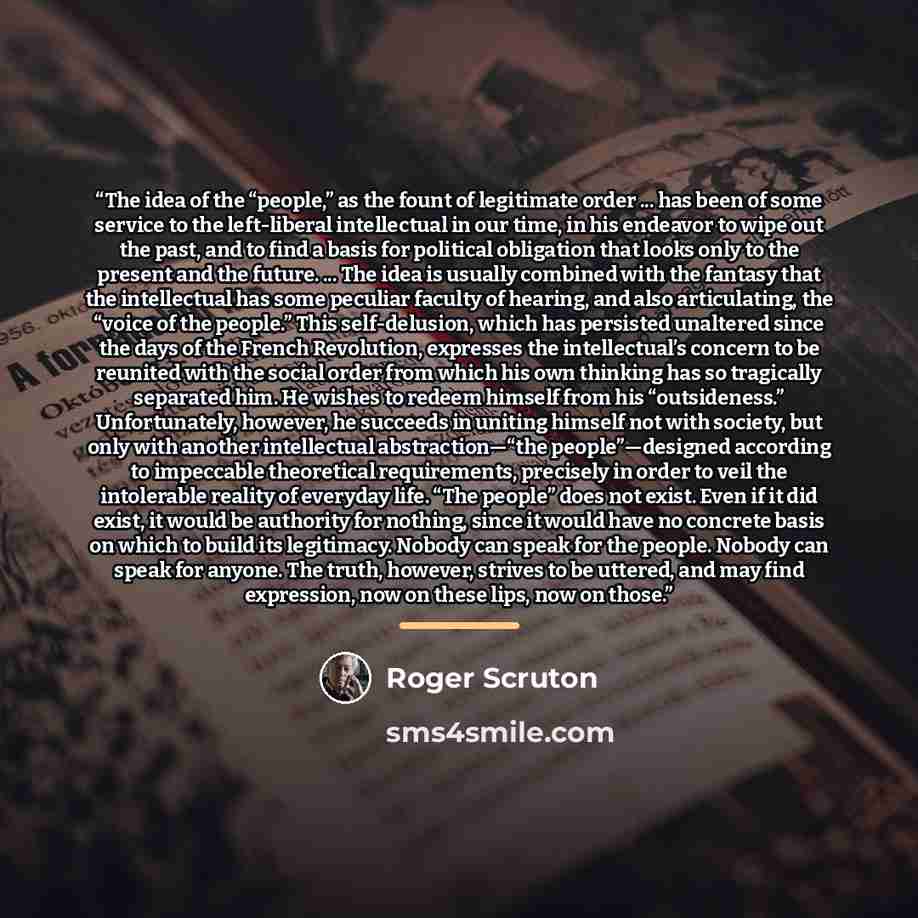
““The idea of the “people,” as the fount of legitimate order ... has been of some service to the left-liberal intellectual in our time, in his endeavor to wipe out the past, and to find a basis for political obligation that looks only to the present and the future. ... The idea is usually combined with the fantasy that the intellectual has some peculiar faculty of hearing, and also articulating, the “voice of the people.” This self-delusion, which has persisted unaltered since the days of the French Revolution, expresses the intellectual’s concern to be reunited with the social order from which his own thinking has so tragically separated him. He wishes to redeem himself from his “outsideness.” Unfortunately, however, he succeeds in uniting himself not with society, but only with another intellectual abstraction—“the people”—designed according to impeccable theoretical requirements, precisely in order to veil the intolerable reality of everyday life. “The people” does not exist. Even if it did exist, it would be authority for nothing, since it would have no concrete basis on which to build its legitimacy. Nobody can speak for the people. Nobody can speak for anyone. The truth, however, strives to be uttered, and may find expression, now on these lips, now on those.””
About This Quote
Source Book: The Meaning of Conservatism, Roger Scruton, 1980
Scruton critiques the notion that “the people” can serve as a legitimate political foundation, arguing it is an abstract fantasy that obscures real social conditions and prevents genuine accountability.
In simple terms: The idea of “the people” is a useful fantasy that hides reality.
Key Takeaway
Question abstract concepts and engage with concrete social realities.
Themes
political theory
conservatism
social critique
identity
legitimacy
Mood
critical
skeptical
analytical
Type
philosophical
political
critical
When to use this quote
- policy analysis
- public discourse
- community organizing
- academic research
- media commentary
Key Concepts
social abstraction
political legitimacy
intellectual self‑delusion
Questions to Reflect On
- How can societies ensure representation without resorting to vague abstractions?
- What alternatives exist to the “voice of the people” narrative?
A Different Perspective
Relying on an imagined “people” can legitimize policies that ignore actual needs.
























![“This is the industry that wants [music], the rap industry. You have to be on deck all the time, but you do not have the time to do the album. It is an energy, it must be present in everyday life.” quote by Young Thug](https://sms4smile.com/quotes/img-quotes/273/young-thug-15422_albums_this-is-the-industry-that-wants-music-th_23567.jpg)