Art Quote by Roger Scruton

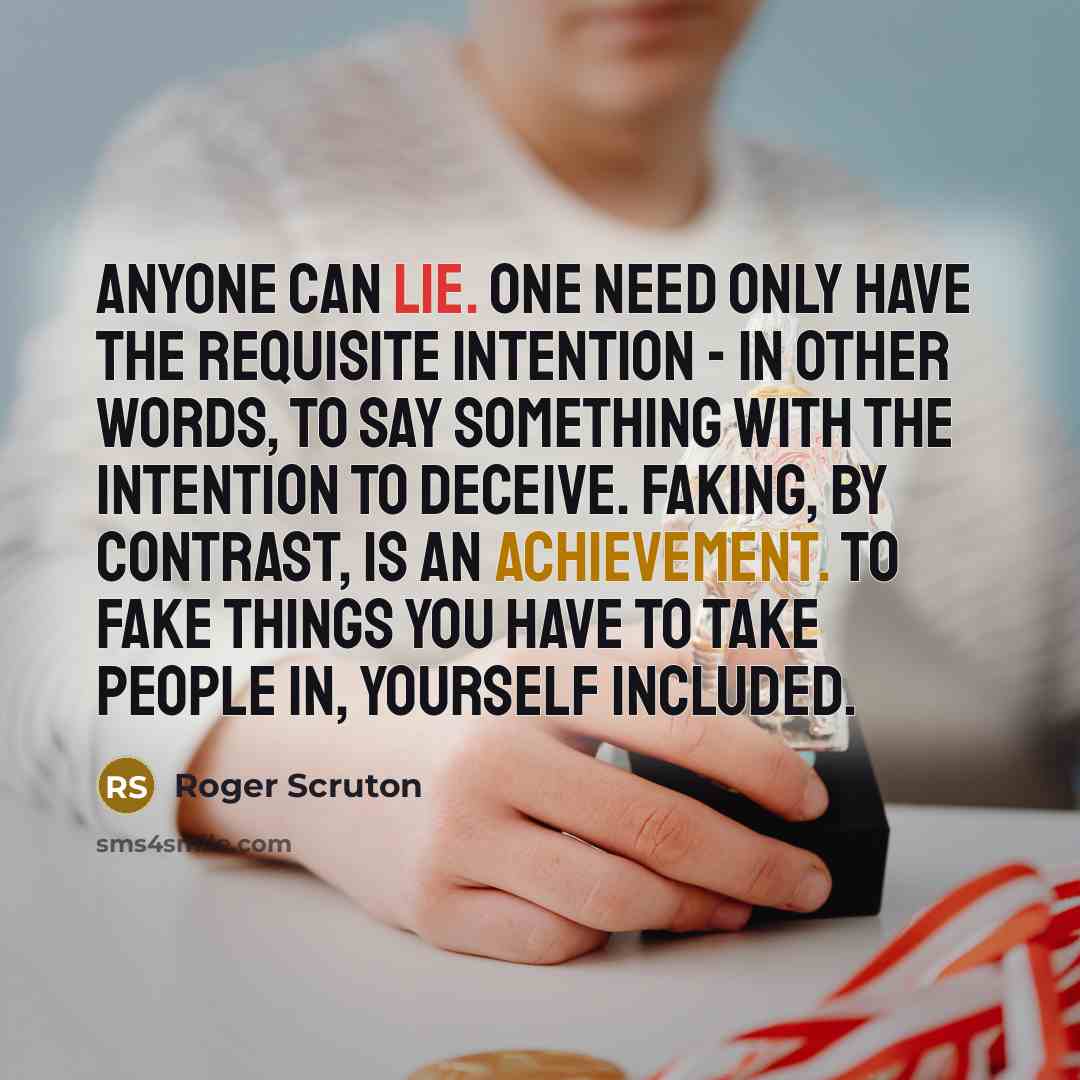
““Faking depends on a measure of complicity between the perpetrator and the victim, who together conspire to believe what they don’t believe and to feel what they are incapable of feeling. There are fake beliefs, fake opinions, fake kinds of expertise. There is also fake emotion, which comes about when people debase the forms and the language in which true feeling can take root, so that they are no longer fully aware of the difference between the true and the false. Kitsch is one very important example of this. The kitsch work of art is not a response to the real world, but a fabrication designed to replace it. Yet both producer and consumer conspire to persuade each other that what they feel in and through the kitsch work of art is something deep, important and real. Anyone can lie. One need only have the requisite intention — in other words, to say something with the intention to deceive. Faking, by contrast, is an achievement. To fake things you have to take people in, yourself included. In an important sense, therefore, faking is not something that can be intended, even though it comes about through intentional actions. The liar can pretend to be shocked when his lies are exposed, but his pretence is merely a continuation of his lying strategy. The fake really is shocked when he is exposed, since he had created around himself a community of trust, of which he himself was a member. Understanding this phenomenon is, it seems to me, integral to understanding how a high culture works, and how it can become corrupted.””
About This Quote
Source Book: The Aesthetics of Architecture, Roger Scruton, 1999
Faking involves mutual complicity where both creator and audience accept false emotions and meanings, often through kitsch, blurring truth and falsehood.
In simple terms: People and together to believe and feel things that aren't real, especially via kitsch.
Key Takeaway
Recognize and question shared false narratives.
Themes
authenticity
deception
culture
art
truth
Mood
critical
reflective
skeptical
Type
philosophical
critical analysis
When to use this quote
- political propaganda
- advertising
- art criticism
- personal relationships
- media consumption
Key Concepts
kitsch
aesthetic theory
social complicity
psychology of belief
Questions to Reflect On
- How do you tell if your emotions are genuine or influenced by external narratives?
- What role does kitsch play in shaping cultural values?
A Different Perspective
Faking can be self‑deceptive, making it hard to distinguish genuine belief from performance.