Day to day Quote by Robert Musil
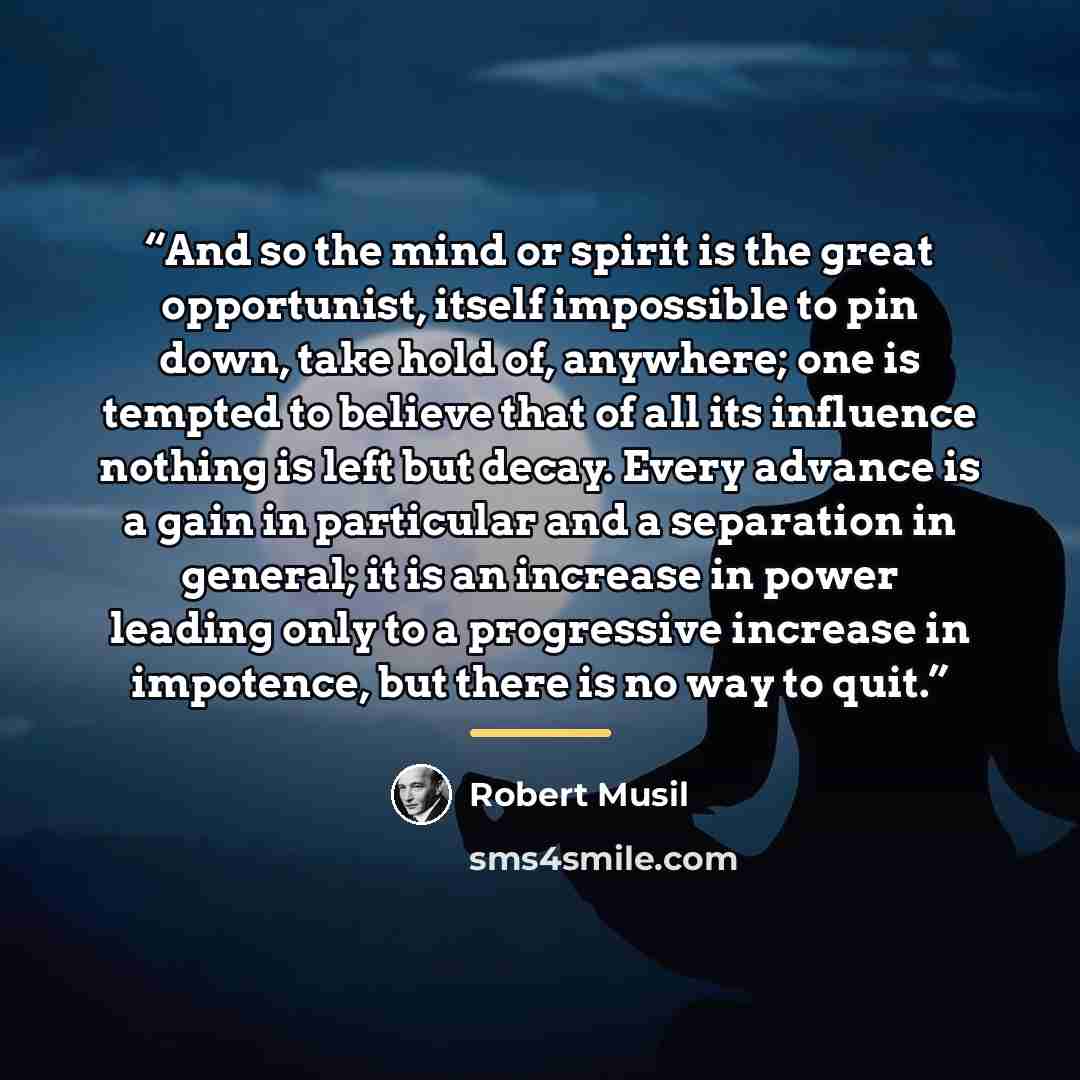
““To the mind (Geist), good and evil, above and below, are not skeptical, relative concepts, but terms of a function, values that depend on the context they find themselves in…. It regards nothing as fixed, no personality, no order of things: because our knowledge may change from day to day, it regards nothing as binding: everything has the value it has only until the next act of creation, as a face changes with the words we are speaking to it. And so the mind or spirit is the great opportunist, itself impossible to pin down, take hold of, anywhere: on is tempted to believe that of all its influence nothing is left but decay. Every advance is a gain in particular and a separation in general; it is an increase in power leading only to a progressive increase in impotence, but there is no way to quit. Ulrich thought of that body of facts and discoveries, growing almost by the hour, out of which the mind must peer today if it wishes to scrutinize any given problem closely. This body grows away from its inner life. Countless views, opinions, systems of ideas from every age and latitude, from all sorts of sick and sound, waking and dreaming brains run through it like thousands of small sensitive nerve strands, but the central nodal point tying them all together is missing. Man feels dangerously close to repeating the fate of those gigantic primeval species that perished because of their size; but he cannot stop himself.””
About This Quote
Source Book: The Man Without Qualities, Robert Musil, 1930-1943
The mind is fluid, shaping values by context, never fixed, leading to continual change and growing impotence despite gaining power.
In simple terms: Mind adapts to context, never static, causing constant change.
Key Takeaway
Accept fluidity, avoid rigid certainty.
Themes
philosophy
psychology
change
impermanence
Mood
thoughtful
critical
Type
philosophical
reflective
When to use this quote
- academic research
- personal decision-making
- ethical debates
- creative problem solving
Key Concepts
relativism
opportunism
knowledge dynamics
Questions to Reflect On
- How do you find stability in a fluid worldview?
- Can flexibility be a strength rather than weakness?
A Different Perspective
It may lead to nihilism if one sees all values as temporary.