Ability Quote by Robert Kanigel
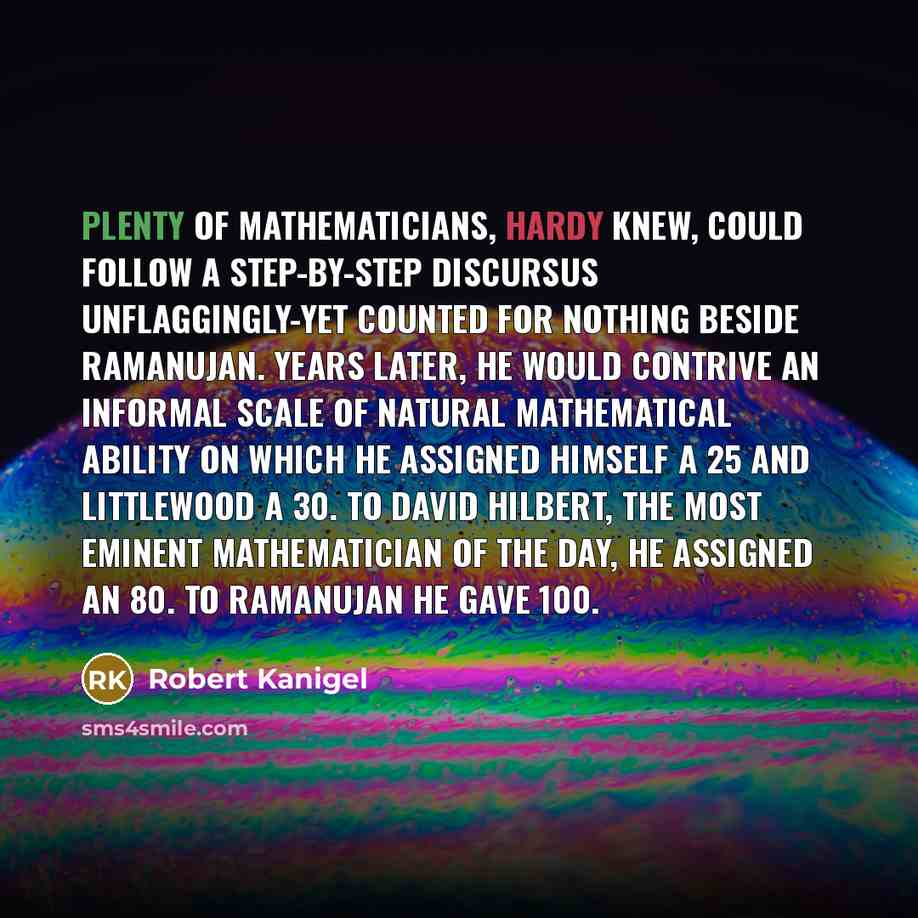
“Plenty of mathematicians, Hardy knew, could follow a step-by-step discursus unflaggingly-yet counted for nothing beside Ramanujan. Years later, he would contrive an informal scale of natural mathematical ability on which he assigned himself a 25 and Littlewood a 30. To David Hilbert, the most eminent mathematician of the day, he assigned an 80. To Ramanujan he gave 100.”
About This Quote
Source Book: "The Man Who Knew Infinity", 1991
Hardy’s self‑assessment of mathematical talent shows a wide gap between his own view and those of peers, highlighting subjective measures of ability.
In simple terms: Hardy rated his and low and others high, showing personal bias in talent scales.
Key Takeaway
Question and reflect on your own self‑assessment.
Themes
mathematics
self‑assessment
bias
talent measurement
historical perspective
Mood
thoughtful
critical
Type
analytical
educational
When to use this quote
- academic mentorship
- career counseling
- performance reviews
- educational policy
Key Concepts
psychology of self‑evaluation
comparative ranking
Questions to Reflect On
- How might your own self‑ratings differ from peers’?
- What factors influence how we judge talent?
A Different Perspective
Self‑ratings can be overly modest or inflated, affecting confidence.

![“Sometimes in studying Ramanujan's work, [George Andrews] said at another time, "I have wondered how much Ramanujan could have done if he had had MACSYMA or SCRATCHPAD or some other symbolic algebra package."” quote by Robert Kanigel](https://sms4smile.com/quotes/img-quotes/22d/robert-kanigel-68458_algebra_sometimes-in-studying-ramanujan-s-work-g_3178632.jpg)

![“The seeds from Ramanujan's garden have been blowing on the wind and have been sprouting all over the landscape. [On the stimulating effects of Ramanujan's mathematical legacy.]” quote by Freeman Dyson](https://sms4smile.com/quotes/img-quotes/795/freeman-dyson-1435_effects_the-seeds-from-ramanujan-s-garden-have-b_2638980.jpg)

![“There is great exhilaration in breaking one of these things. ... Ramanujan gives no hints, no proof of his formulas, so everything you do you feel is your own.[About verifying Ramanujan's equations in a newly found manuscript.]” quote by George Andrews](https://sms4smile.com/quotes/img-quotes/f2f/george-andrews-53805_equations_there-is-great-exhilaration-in-breaking_1640159.jpg)
![“In the simplest array of digits [Ramanujan] detected wonderful properties: congruences, symmetries and relationships which had escaped the notice of even the outstandingly gifted theoreticians.” quote by James R Newman](https://sms4smile.com/quotes/img-quotes/217/james-r-newman-42796_congruence_in-the-simplest-array-of-digits-ramanuja_1442063.jpg)
![“I remember once going to see him [Ramanujan] when he was lying ill at Putney. I had ridden in taxi-cab No. 1729, and remarked that the number seemed to me rather a dull one, and that I hoped it was not an unfavourable omen. "No," he replied, "it is a very interesting number; it is the smallest…” quote by G. H. Hardy](https://sms4smile.com/quotes/img-quotes/af7/g-h-hardy-8763_cab_i-remember-once-going-to-see-him-ramanuj_1278943.jpg)
![“No mathematician should ever allow him to forget that mathematics, more than any other art or science, is a young man's game. ... Galois died at twenty-one, Abel at twenty-seven, Ramanujan at thirty-three, Riemann at forty. There have been men who have done great work later; ... [but] I do not…” quote by Anonymous](https://sms4smile.com/quotes/img-quotes/876/anonymous-1_abel_no-mathematician-should-ever-allow-him-t_651008.jpg)