Aaron Quote by Robert G. Ingersoll
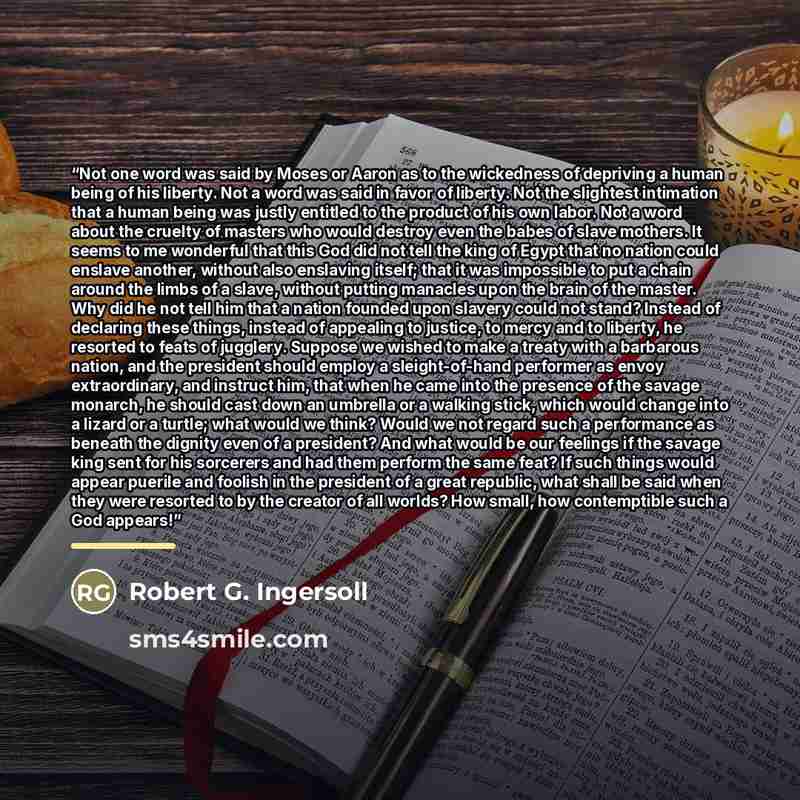
““Not one word was said by Moses or Aaron as to the wickedness of depriving a human being of his liberty. Not a word was said in favor of liberty. Not the slightest intimation that a human being was justly entitled to the product of his own labor. Not a word about the cruelty of masters who would destroy even the babes of slave mothers. It seems to me wonderful that this God did not tell the king of Egypt that no nation could enslave another, without also enslaving itself; that it was impossible to put a chain around the limbs of a slave, without putting manacles upon the brain of the master. Why did he not tell him that a nation founded upon slavery could not stand? Instead of declaring these things, instead of appealing to justice, to mercy and to liberty, he resorted to feats of jugglery. Suppose we wished to make a treaty with a barbarous nation, and the president should employ a sleight-of-hand performer as envoy extraordinary, and instruct him, that when he came into the presence of the savage monarch, he should cast down an umbrella or a walking stick, which would change into a lizard or a turtle; what would we think? Would we not regard such a performance as beneath the dignity even of a president? And what would be our feelings if the savage king sent for his sorcerers and had them perform the same feat? If such things would appear puerile and foolish in the president of a great republic, what shall be said when they were resorted to by the creator of all worlds? How small, how contemptible such a God appears!””
About This Quote
Source Essay: “The Gods of the Ancient World” by Robert G. Ingersoll, 1885
The passage criticizes the silence of divine narratives on human liberty and the moral hypocrisy of using miracles instead of justice.
In simple terms: God’s silence on slavery shows moral failure.
Key Takeaway
Demand justice over spectacle.
Themes
justice
morality
religion
hypocrisy
power
Mood
critical
ironic
thoughtful
Type
philosophical
satirical
When to use this quote
- human rights activism
- theological debate
- political satire
- education on slavery
- public policy critique
Key Concepts
theodicy
ethical responsibility
political philosophy
Questions to Reflect On
- How does silence on oppression affect moral authority?
- Can miracles ever replace ethical action?
A Different Perspective
The critique assumes all societies value liberty equally, which may not hold.




![“He [Alexander von Humboldt] was to science what Shakespeare was to the drama.” quote by Robert G. Ingersoll](https://sms4smile.com/quotes/img-quotes/fb5/robert-g-ingersoll-4527_admiration_he-alexander-von-humboldt-was-to-science_233200.jpg)