Art Quote by Richard M. Rorty
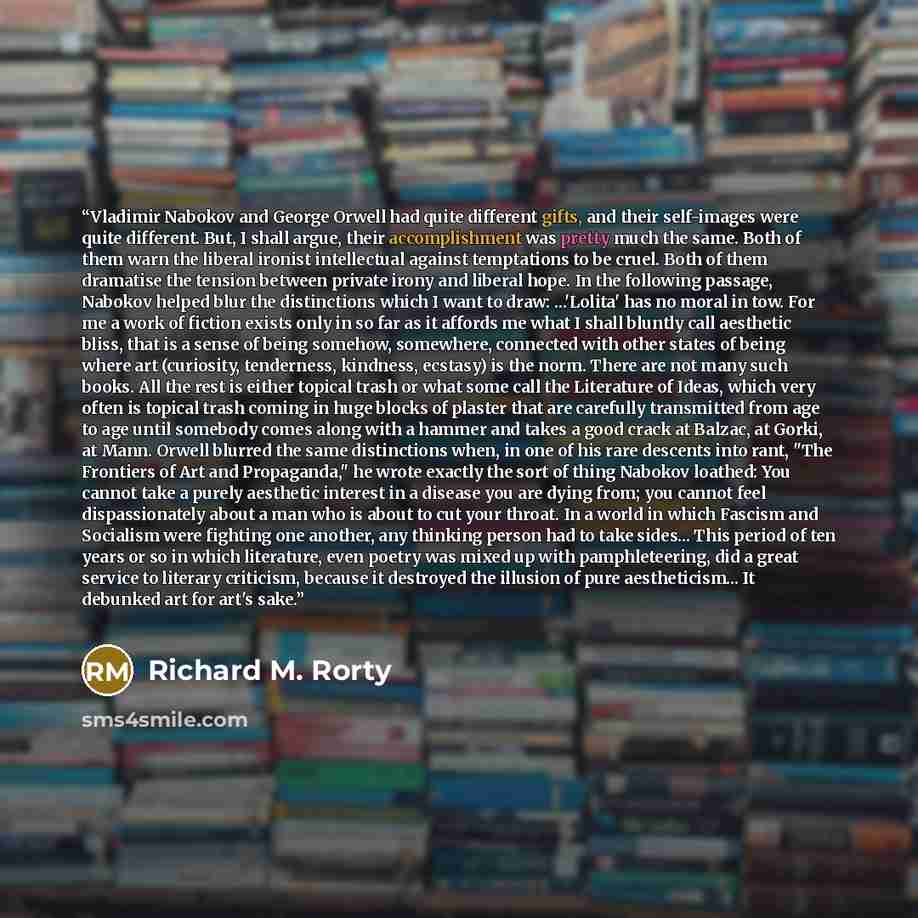
““Vladimir Nabokov and George Orwell had quite different gifts, and their self-images were quite different. But, I shall argue, their accomplishment was pretty much the same. Both of them warn the liberal ironist intellectual against temptations to be cruel. Both of them dramatise the tension between private irony and liberal hope. In the following passage, Nabokov helped blur the distinctions which I want to draw: ...'Lolita' has no moral in tow. For me a work of fiction exists only in so far as it affords me what I shall bluntly call aesthetic bliss, that is a sense of being somehow, somewhere, connected with other states of being where art (curiosity, tenderness, kindness, ecstasy) is the norm. There are not many such books. All the rest is either topical trash or what some call the Literature of Ideas, which very often is topical trash coming in huge blocks of plaster that are carefully transmitted from age to age until somebody comes along with a hammer and takes a good crack at Balzac, at Gorki, at Mann. Orwell blurred the same distinctions when, in one of his rare descents into rant, "The Frontiers of Art and Propaganda," he wrote exactly the sort of thing Nabokov loathed: You cannot take a purely aesthetic interest in a disease you are dying from; you cannot feel dispassionately about a man who is about to cut your throat. In a world in which Fascism and Socialism were fighting one another, any thinking person had to take sides... This period of ten years or so in which literature, even poetry was mixed up with pamphleteering, did a great service to literary criticism, because it destroyed the illusion of pure aestheticism... It debunked art for art's sake.””
About This Quote
Source Essay: “The Pragmatic Turn in Literary Criticism,” 1995, Richard M. Rorty
Discusses how Nabokov and Orwell, despite different styles, both warn liberal intellectuals against cruelty and highlight tension between irony and hope, critiquing aestheticism detached from moral stakes.
In simple terms: Nabokov and Orwell both caution against pure aestheticism and cruelty.
Key Takeaway
Balance aesthetic pleasure with moral responsibility.
Themes
literary criticism
ethical aesthetics
political responsibility
Mood
thoughtful
critical
Type
philosophical
literary
When to use this quote
- academic seminars
- book clubs
- creative writing workshops
Key Concepts
aestheticism
liberal hope
irony
cruelty
Questions to Reflect On
- Can art be both beautiful and morally engaged?
- What responsibilities do artists have to society?
A Different Perspective
Pure aestheticism can ignore real suffering.