Change Quote by Rachel Naomi Remen
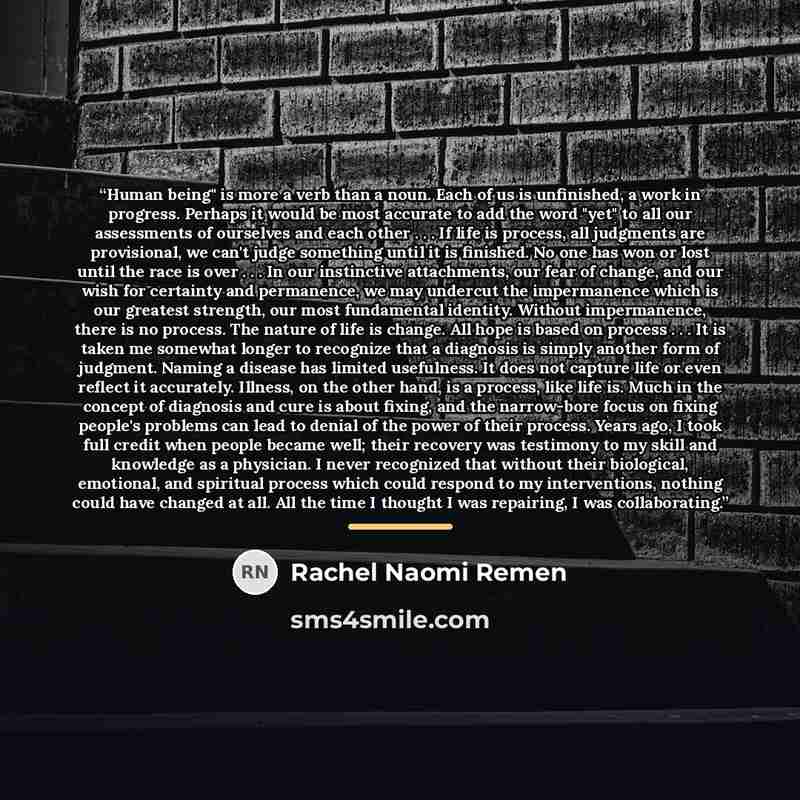
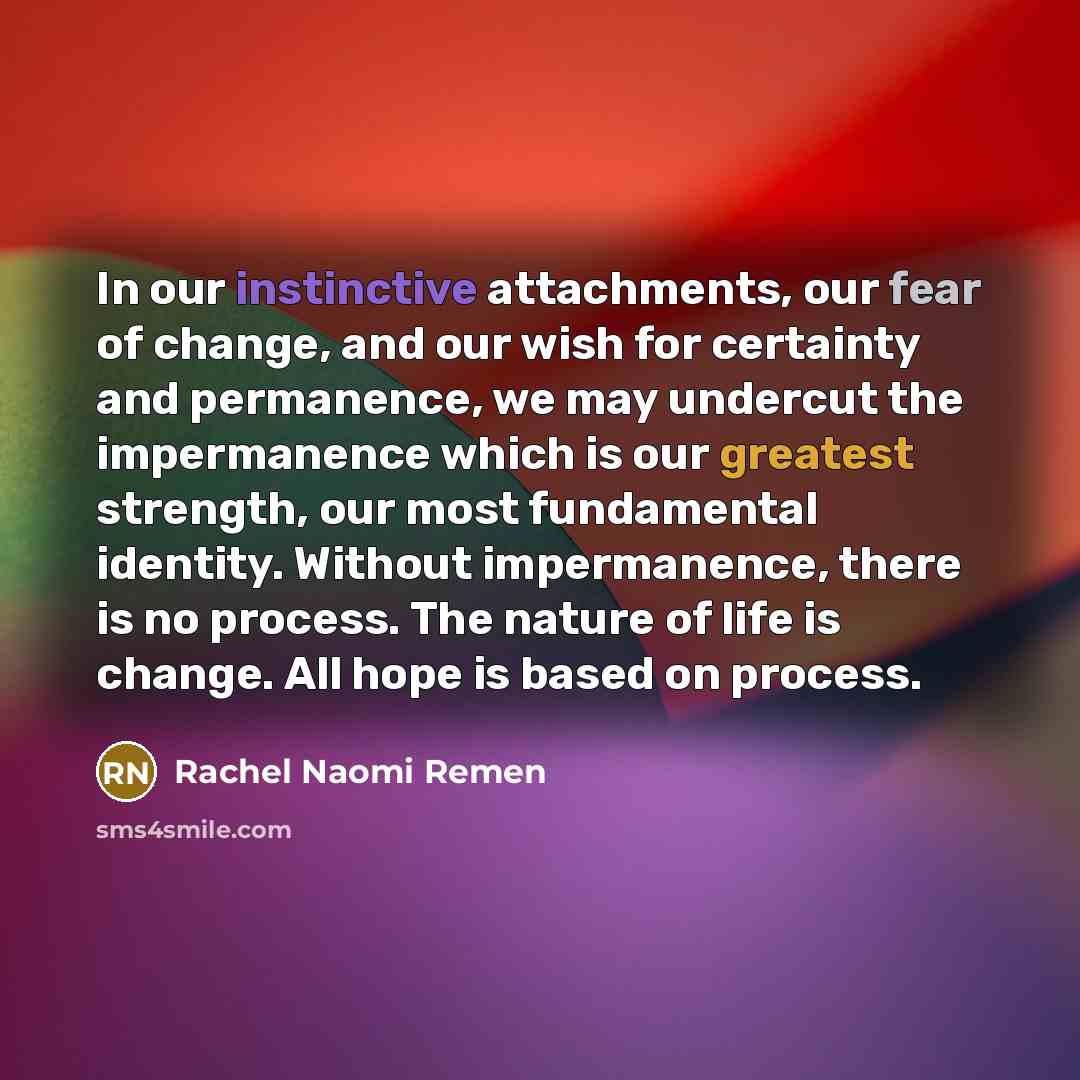
““Human being" is more a verb than a noun. Each of us is unfinished, a work in progress. Perhaps it would be most accurate to add the word "yet" to all our assessments of ourselves and each other . . . If life is process, all judgments are provisional, we can't judge something until it is finished. No one has won or lost until the race is over . . . In our instinctive attachments, our fear of change, and our wish for certainty and permanence, we may undercut the impermanence which is our greatest strength, our most fundamental identity. Without impermanence, there is no process. The nature of life is change. All hope is based on process . . . It is taken me somewhat longer to recognize that a diagnosis is simply another form of judgment. Naming a disease has limited usefulness. It does not capture life or even reflect it accurately. Illness, on the other hand, is a process, like life is. Much in the concept of diagnosis and cure is about fixing, and the narrow-bore focus on fixing people's problems can lead to denial of the power of their process. Years ago, I took full credit when people became well; their recovery was testimony to my skill and knowledge as a physician. I never recognized that without their biological, emotional, and spiritual process which could respond to my interventions, nothing could have changed at all. All the time I thought I was repairing, I was collaborating.””
About This Quote
Source Speech: Lecture on Healing and Impermanence, Rachel Naomi Remen, 2005
Human identity is a continuous process, not a fixed state; we are always evolving and judgments are provisional.
In simple terms: We are always changing and unfinished.
Key Takeaway
Embrace change and view life as a process.
Themes
growth
impermanence
identity
healing
process
Mood
reflective
hopeful
inspirational
Type
philosophical
inspirational
When to use this quote
- patient care
- personal development
- medical practice
- psychotherapy
- life coaching
Key Concepts
process philosophy
psychology
medicine
spirituality
Questions to Reflect On
- How can you incorporate the concept of “yet” into self‑assessment?
- What does viewing illness as a process change treatment?
A Different Perspective
Judgments often ignore the ongoing nature of change, leading to premature conclusions.