Early childhood Quote by Peter Høeg

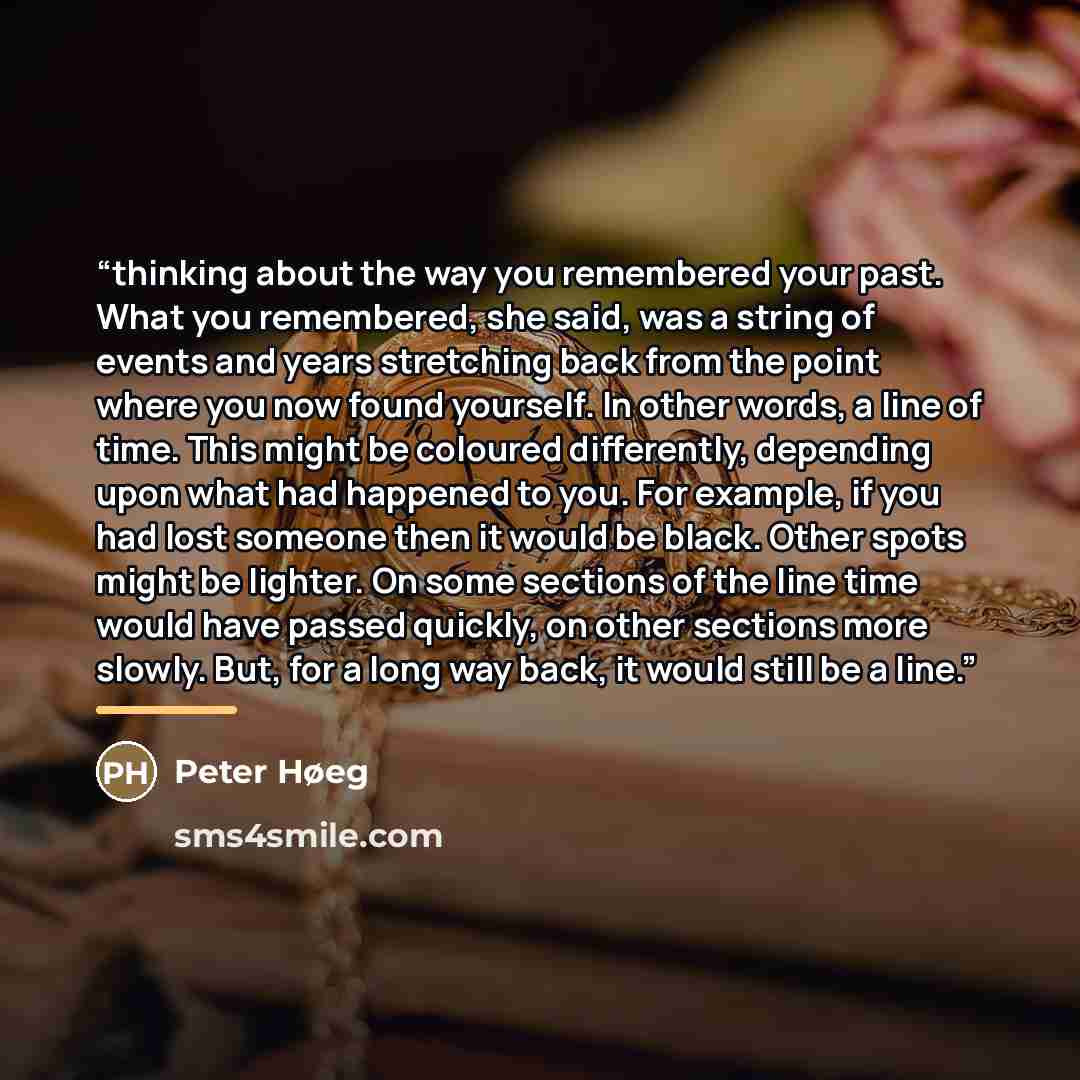
““She said she had been thinking about the way you remembered your past. What you remembered, she said, was a string of events and years stretching back from the point where you now found yourself. In other words, a line of time. This might be coloured differently, depending upon what had happened to you. For example, if you had lost someone then it would be black. Other spots might be lighter. On some sections of the line time would have passed quickly, on other sections more slowly. But, for a long way back, it would still be a line. Though not all the way back – at any rate, not in her case – and what about me? She asked me to think about it. For her, she said, and maybe for everyone, if you went far enough back the line disintegrated. If you went all the way back to your early childhood it was no longer a line. Then there was a sort of landscape of events. You could not remember their sequence, maybe they had none, they just lay scattered about, as if on a plain. She believed that this plain belonged to the days before time had entered your world.””
About This Quote
Source Book: Miss Smilla's Feeling for Snow, Peter Høeg, 1992
Memory is portrayed as a colored timeline that fragments into a landscape when tracing back to early childhood, suggesting that early experiences lack linear order.
In simple terms: Memory is a line that breaks into a plain in early childhood.
Key Takeaway
Recognize that early memories may be non‑linear and fragmented.
Themes
memory
time
identity
psychology
perception
Mood
reflective
melancholic
curious
Type
philosophical
analytical
narrative
When to use this quote
- therapy sessions
- personal reflection
- creative writing
- storytelling
- psychological research
Key Concepts
linear vs non‑linear memory
subjective time
childhood development
Questions to Reflect On
- How do you experience the flow of time in your memories?
- Can early experiences be organized without a timeline?
A Different Perspective
Memory may not be reliable for reconstructing exact sequences of early events.