Years ago Quote by Paul Scott
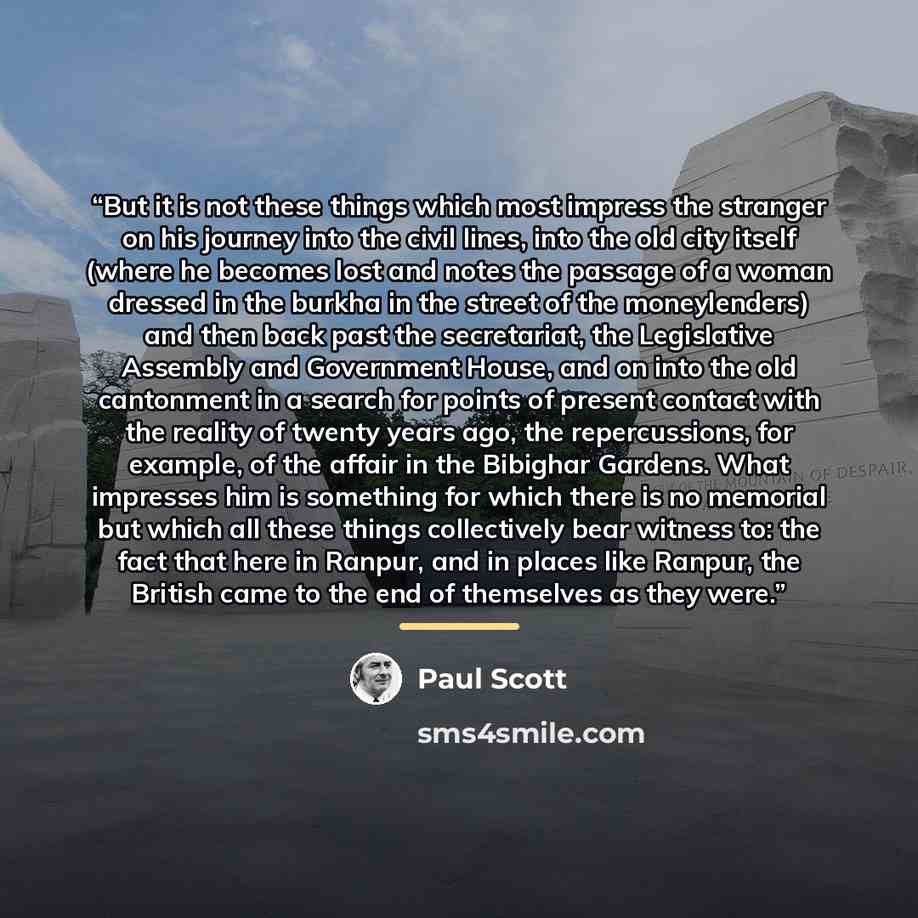
““But it is not these things which most impress the stranger on his journey into the civil lines, into the old city itself (where he becomes lost and notes the passage of a woman dressed in the burkha in the street of the moneylenders) and then back past the secretariat, the Legislative Assembly and Government House, and on into the old cantonment in a search for points of present contact with the reality of twenty years ago, the repercussions, for example, of the affair in the Bibighar Gardens. What impresses him is something for which there is no memorial but which all these things collectively bear witness to: the fact that here in Ranpur, and in places like Ranpur, the British came to the end of themselves as they were.””
About This Quote
Source Novel: The Jewel in the Crown by Paul Scott, 1966
The quote reflects on how a foreign observer is moved more by intangible, historical weight than by visible monuments, noting the decline of colonial power in a specific Indian town.
In simple terms: Colonial decline is felt more than seen.
Key Takeaway
Notice unseen histories.
Themes
history
colonialism
memory
imperial decline
urban change
Mood
reflective
melancholic
thoughtful
Type
observational
historical
critical
When to use this quote
- tourism
- historical research
- urban exploration
- education
- heritage preservation
Key Concepts
postcolonial studies
historical consciousness
cultural memory
Questions to Reflect On
- How do we honor unseen histories?
- What does “end of themselves” imply for colonizers?
A Different Perspective
The narrative may romanticize loss, overlooking present struggles of locals.


















![“[The Dalai Lama] told me some years ago, "I've made every concession to China, and I've been as open and tolerant as I could, and still things get worse in Tibet." If you look at it from one point of view, as he himself says, his monastic position of forbearance and nonviolence hasn't reaped any…” quote by Pico Iyer](https://sms4smile.com/quotes/img-quotes/9fe/pico-iyer-1252_benefits_the-dalai-lama-told-me-some-years-ago-i_678.jpg)