Cuban revolution Quote by Paul Johnson
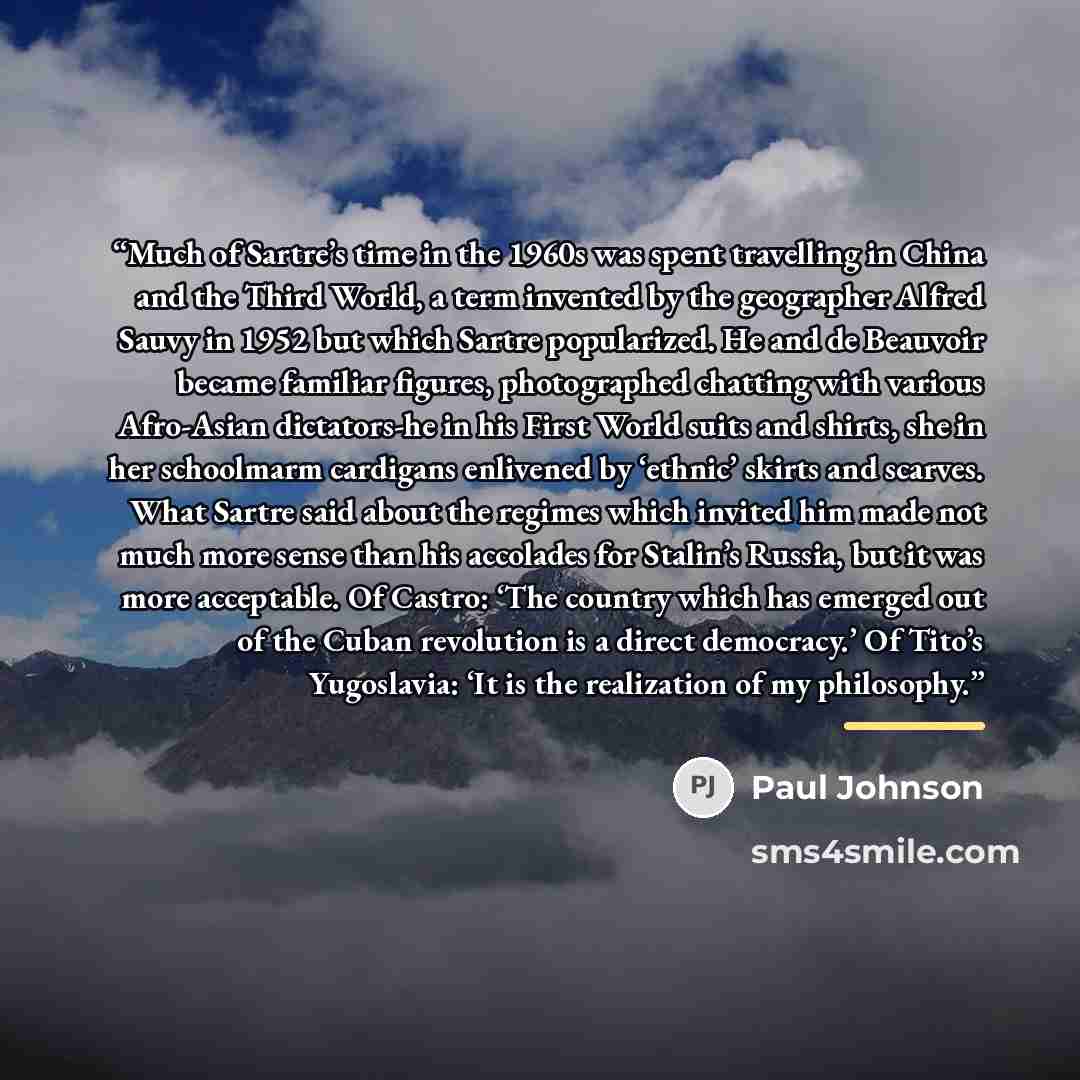
““Much of Sartre’s time in the 1960s was spent travelling in China and the Third World, a term invented by the geographer Alfred Sauvy in 1952 but which Sartre popularized. He and de Beauvoir became familiar figures, photographed chatting with various Afro-Asian dictators-he in his First World suits and shirts, she in her schoolmarm cardigans enlivened by ‘ethnic’ skirts and scarves. What Sartre said about the regimes which invited him made not much more sense than his accolades for Stalin’s Russia, but it was more acceptable. Of Castro: ‘The country which has emerged out of the Cuban revolution is a direct democracy.’ Of Tito’s Yugoslavia: ‘It is the realization of my philosophy.””
About This Quote
Sartre’s political engagements in the 1960s were inconsistent, mixing admiration for dictators with vague democratic ideals.
In simple terms: Sartre’s politics were contradictory and idealistic.
Key Takeaway
Question the consistency of political statements.
Themes
politics
philosophy
history
hypocrisy
Mood
critical
skeptical
Type
historical
analytical
When to use this quote
- academic discourse
- public debates
- media analysis
Key Concepts
existentialism
colonialism
ideology
Questions to Reflect On
- How do personal experiences shape political rhetoric?
- Can intellectuals remain unbiased?
A Different Perspective
His views may be seen as opportunistic.


![“My links with [Mahatma] Gandhi now are very political links because I do not believe there is any other politics available to us in the late twentieth century, a period of a totalitarianism linked with the market. There is really no other way you can do politics and create freedom for people…” quote by Vandana Shiva](https://sms4smile.com/quotes/img-quotes/461/vandana-shiva-2756_available_my-links-with-mahatma-gandhi-now-are-ver_1306949.jpg)







![“The Salem [witch] trials…can be seen as an example of the propensity of the American people to be convulsed by spasms of self-righteous rage against enemies, real or imaginary, of their society and way of living. Hence the parallels later drawn between Salem in 1692 and the “Red Scare” of 1919-20…” quote by Paul Johnson](https://sms4smile.com/quotes/img-quotes/67d/paul-johnson-4585_american-people_the-salem-witch-trials-can-be-seen-as-an_82157.jpg)
![“He [Augustine] admitted: 'I am the sort of man who writes because he has made progress, and who makes progress by writing.'” quote by Paul Johnson](https://sms4smile.com/quotes/img-quotes/24c/paul-johnson-4585_writer_he-augustine-admitted-i-am-the-sort-of-m_146973.jpg)









![“I wanted to leave high school in 1958 and join the Cuban revolution. So the only reason I did not come to join [Fidel] Castro was because my mother would not let me. I was only 16.” quote by Huey Newton](https://sms4smile.com/quotes/img-quotes/51d/huey-newton-8581_castro_i-wanted-to-leave-high-school-in-1958-an_874742.jpg)