Cognition Quote by Orson Scott Card Download Open image ““Then, as Father had trained him, Rigg thought past his feelings.”” — Orson Scott Card ★ ★ ★ ★ ★ 4.9 out of 5 (4 ratings) Copy quoteShare Cognition Difficulty Growing up Parenting Science fiction
“Rigg," said Father, "you're so smart and so dumb at the same time that it almost takes my breath awway” — Orson Scott Card Copy Share Image
“She had always asked him what, exactly, he was training for. Now she knew.” — Terri Blackstock Copy Share Image
“...burying themselves in his arm was more about feeling his love in the confusion, in the difficulty, than it was about having moved past… — Donald Miller Copy Share Image
“he had learned to think coldly so that inescapable memories would not touch any feeling.” — Gabriel García Márquez Copy Share Image
“Soon he would see war. Jis romanticism and inexperience insulated him from the thought that he might feel it, too.” — Humphrey Cobb Copy Share Image
“He felt like his body had a will of its own. Always looking. Preparing for the only fight that would satisfy him.” — Veronica Rossi Copy Share Image
“Roland shook his head slowly. There was a lesson here, he realized, not a shining thing but something that was old and rusty and… — Stephen King Copy Share Image
“He thought he would become accustomed to the idea, not yet understanding that it is useless to become accustomed to the loss of a… — Umberto Eco Copy Share Image
“I felt something I had never felt before, a mixture of fear and pride. I liked it. This was fatherhood. The biggest mistake anyone… — Carl-John X Veraja Copy Share Image
“He was dazed, the soft thoughts sinking slowly in. A son. Even a daughter. His child. Immortality. A chance to make good. Pass on… — Helen Hodgman Copy Share Image
“She stood by the bed and stroked her father's hand, knowing how desperately afraid he must feel at this moment. He'd always prided himself… — Hillary Jordan Copy Share Image
We're like the wicked witch. We promise gingerbread, then eat the little brats alive. — Orson Scott Card Copy Share Image
I think that most of us, anyway, read these stories that we know are not "true" because we're hungry for another kind of truth: the mythic truth about human nature in general, the particular truth about those life-communities that define our own identity, and the most specific truth of all: our own self-story. Fiction, because it is not about someone… — Orson Scott Card Copy Share
“Why did he hesitate? He finally admitted to himself that he was like an American child who was almost completely certain about Santa Claus,… — Orson Scott Card Copy Share Image
“I don't know of a soul who doesn't maintain two separate lists of doctrines - the ones they believe they believe; and the ones… — Orson Scott Card Copy Share Image
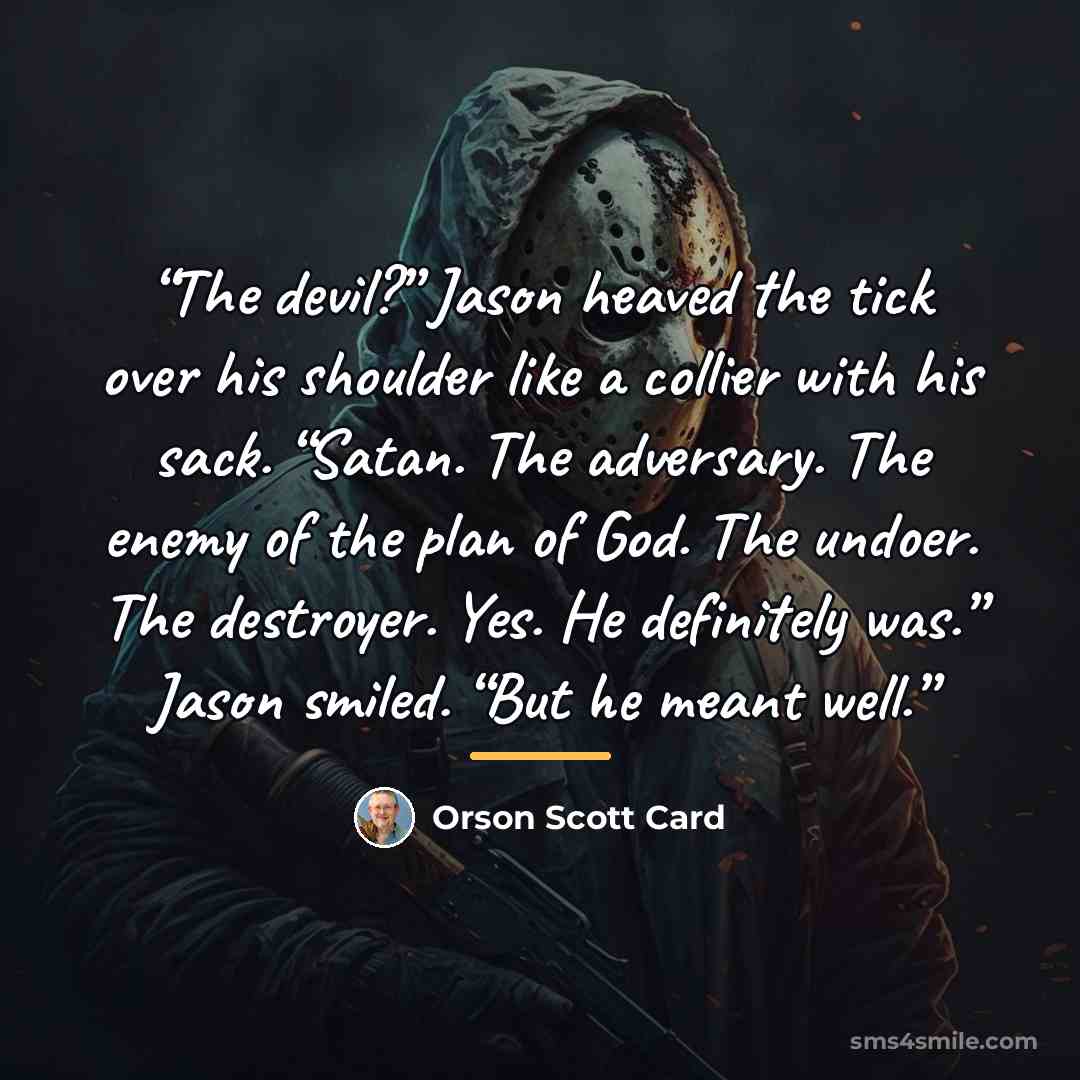
“The devil?” Jason heaved the tick over his shoulder like a collier with his sack. “Satan. The adversary. The enemy of the plan of… — Orson Scott Card Copy Share Image
“What we've done is make the categories of science fiction and fantasy larger, freer, and more inclusive than any other genre of contemporary literature.… — Orson Scott Card Copy Share Image
“Ender, for the past few months you have been the battle commander of our fleets. This was the Third Invasion. There were no games,… — Orson Scott Card Copy Share Image
Science fiction is about what could be but isn't; fantasy is about what couldn't be. — Orson Scott Card Copy Share Image
Many humanists have argued that happiness involves a combination of hedonism and creative moral development; that an exuberant life fuses excellence and enjoyment, meaning… — Paul Kurtz Copy Share Image
“The brain works in a holistic, cooperative way that makes our basest desire or most abject fear as expressive of who we are as… — David Amerland Copy Share Image
“In order to decide, judge; in order to judge, reason; in order to reason, decide (what to reason about).” — Philip Johnson-Laird Copy Share Image
“The obvious cure for the tragic shortcomings of human intuition in a high-tech world is education. And this offers priorities for educational policy: to provide students with the cognitive tools that are most important for grasping the modern world and that are most unlike the cognitive tools they are born with. The perilous fallacies we have seen in this chapter,… — Steven Pinker Copy Share
“[Mood allocates] investments of time, effort, resources, and risk taking to maximize Darwinian fitness in situations of varying propitiousness. High and low moods adjust… — Randolph M. Nesse Copy Share Image
In the early days the Cubism' method of grasping an object was to go round and round it. The Futurists declared that one had to get inside it. In my opinion the two views can be reconciled in a poetic cognition of the world. But to the very fact that they appealed to the creative depths in the painter by… — Gino Severini Copy Share
Faith is the commitment of one's consciousness to beliefs for which one has no sensory evidence or rational proof. When man rejects reason as… — Nathaniel Branden Copy Share Image
The arts make vivid the fact that words do not, in their literal form or number, exhaust what we can know. The limits of… — Elliot W. Eisner Copy Share Image
I worry that the level of interrupt, the sort of overwhelming rapidity of information — and especially of stressful information — is in fact… — Eric Schmidt Copy Share Image
The emergence of a unified cognitive moment relies on the coordination of scattered mosaics of functionally specialized brain regions. Here we review the mechanisms of large-scale integration that counterbalance the distributed anatomical and functional organization of brain activity to enable the emergence of coherent behaviour and cognition. Although the mechanisms involved in large-scale integration are still largely unknown, we argue… — Francisco Varela Copy Share
“The moment you establish a line of communication between two points, you subtly change both. That is also true for the way the brain… — David Amerland Copy Share Image