Fighting spirit Quote by Olaf Stapledon
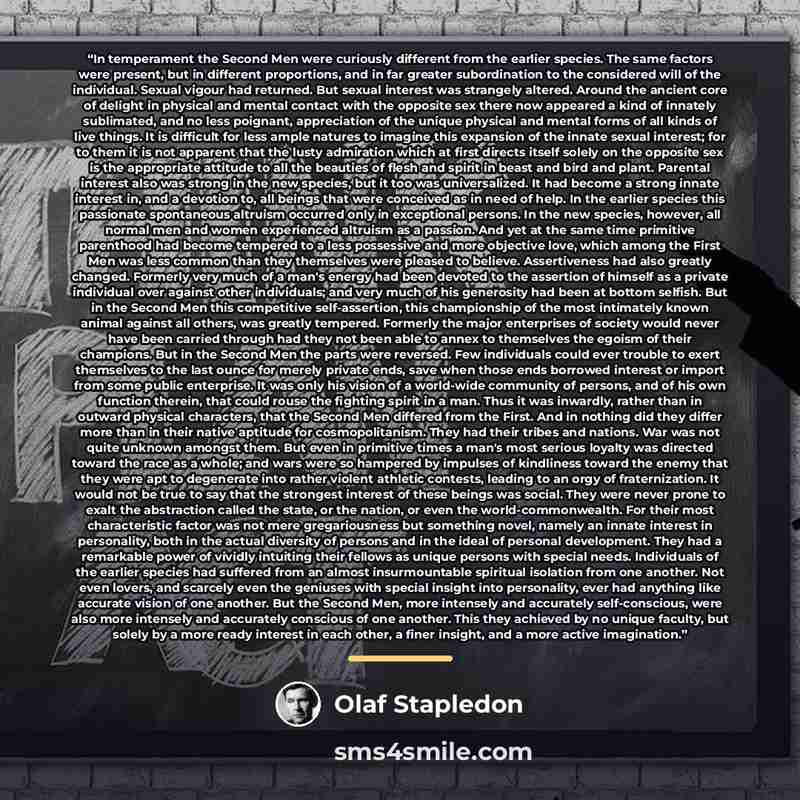
““In temperament the Second Men were curiously different from the earlier species. The same factors were present, but in different proportions, and in far greater subordination to the considered will of the individual. Sexual vigour had returned. But sexual interest was strangely altered. Around the ancient core of delight in physical and mental contact with the opposite sex there now appeared a kind of innately sublimated, and no less poignant, appreciation of the unique physical and mental forms of all kinds of live things. It is difficult for less ample natures to imagine this expansion of the innate sexual interest; for to them it is not apparent that the lusty admiration which at first directs itself solely on the opposite sex is the appropriate attitude to all the beauties of flesh and spirit in beast and bird and plant. Parental interest also was strong in the new species, but it too was universalized. It had become a strong innate interest in, and a devotion to, all beings that were conceived as in need of help. In the earlier species this passionate spontaneous altruism occurred only in exceptional persons. In the new species, however, all normal men and women experienced altruism as a passion. And yet at the same time primitive parenthood had become tempered to a less possessive and more objective love, which among the First Men was less common than they themselves were pleased to believe. Assertiveness had also greatly changed. Formerly very much of a man's energy had been devoted to the assertion of himself as a private individual over against other individuals; and very much of his generosity had been at bottom selfish. But in the Second Men this competitive self-assertion, this championship of the most intimately known animal against all others, was greatly tempered. Formerly the major enterprises of society would never have been carried through had they not been able to annex to themselves the egoism of their champions. But in the Second Men the parts were reversed. Few individuals could ever trouble to exert themselves to the last ounce for merely private ends, save when those ends borrowed interest or import from some public enterprise. It was only his vision of a world-wide community of persons, and of his own function therein, that could rouse the fighting spirit in a man. Thus it was inwardly, rather than in outward physical characters, that the Second Men differed from the First. And in nothing did they differ more than in their native aptitude for cosmopolitanism. They had their tribes and nations. War was not quite unknown amongst them. But even in primitive times a man's most serious loyalty was directed toward the race as a whole; and wars were so hampered by impulses of kindliness toward the enemy that they were apt to degenerate into rather violent athletic contests, leading to an orgy of fraternization. It would not be true to say that the strongest interest of these beings was social. They were never prone to exalt the abstraction called the state, or the nation, or even the world-commonwealth. For their most characteristic factor was not mere gregariousness but something novel, namely an innate interest in personality, both in the actual diversity of persons and in the ideal of personal development. They had a remarkable power of vividly intuiting their fellows as unique persons with special needs. Individuals of the earlier species had suffered from an almost insurmountable spiritual isolation from one another. Not even lovers, and scarcely even the geniuses with special insight into personality, ever had anything like accurate vision of one another. But the Second Men, more intensely and accurately self-conscious, were also more intensely and accurately conscious of one another. This they achieved by no unique faculty, but solely by a more ready interest in each other, a finer insight, and a more active imagination.””
About This Quote
Source Book: Star Maker by Olaf Stapledon, 1937
The passage describes a speculative evolution where humanity (Second Men) develops broader, more universal love and altruism, shifting from self‑centered desire to a compassionate concern for all life.
In simple terms: Humans become caring for all living things, not just each other.
Key Takeaway
Cultivate empathy beyond immediate circles.
Themes
evolution
altruism
sexuality
assertiveness
compassion
Mood
reflective
hopeful
philosophical
Type
analytical
inspirational
When to use this quote
- environmental activism
- animal rights
- community service
- education reform
- interpersonal relationships
Key Concepts
species evolution
innate desire
universal love
self‑transcendence
Questions to Reflect On
- How can we balance universal compassion with personal ambition?
- What limits arise when self‑interest is minimized?
A Different Perspective
Such universal altruism may dilute personal motivation and societal progress.
![“[Pleasure is what suggested] which behaviors, emotions, social patterns and patterns of taste served us well during our evolutionary history. They were experienced as pleasures and encoded into our formative genetic codes . . . deep in the past, from about 100,000 years ago and beyond.” quote by Lionel Tiger](https://sms4smile.com/quotes/img-quotes/41d/lionel-tiger-42821_behavior_pleasure-is-what-suggested-which-behavio_1246259.jpg)

![“No visiting angel, or explorer from another planet, could have guessed that this bland orb [Earth] teemed with vermin, with world-mastering, self-torturing, incipiently angelic beasts.” quote by Olaf Stapledon](https://sms4smile.com/quotes/img-quotes/d65/olaf-stapledon-9950_angel_no-visiting-angel-or-explorer-from-anoth_12107.jpg)

![“[S]ervants of darkness had no lasting joy in their service. In all of them the will for darkness was a perversion of the will for the light. In all but a few maniacs the satisfaction of the will for darkness was at all times countered by a revulsion which the unhappy spirit either dared not…” quote by Olaf Stapledon](https://sms4smile.com/quotes/img-quotes/de9/olaf-stapledon-9950_all-time_s-ervants-of-darkness-had-no-lasting-joy_509336.jpg)