Academia Quote by Neal Stephenson
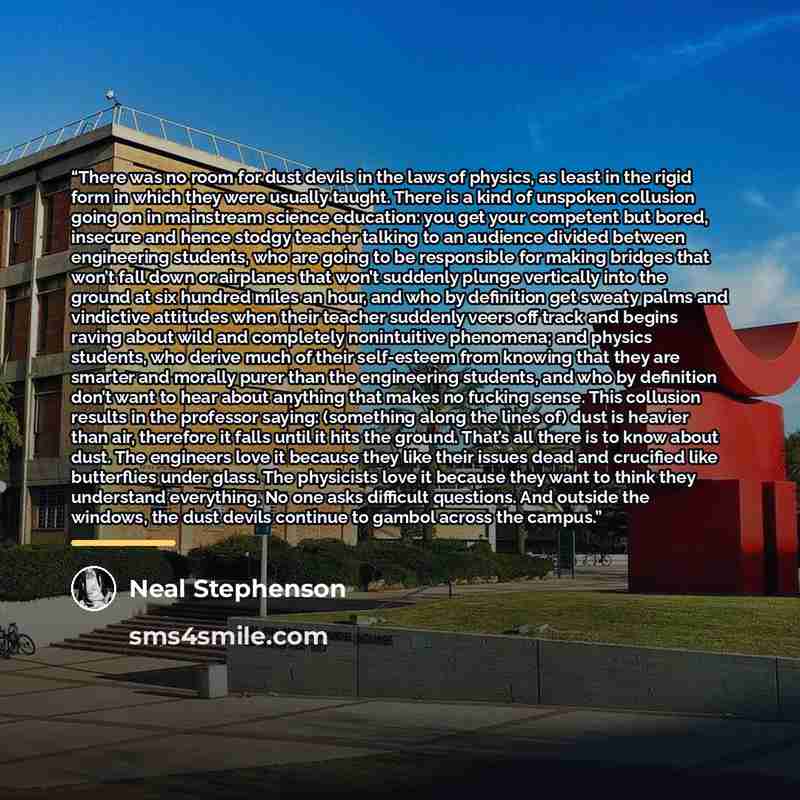
““There was no room for dust devils in the laws of physics, as least in the rigid form in which they were usually taught. There is a kind of unspoken collusion going on in mainstream science education: you get your competent but bored, insecure and hence stodgy teacher talking to an audience divided between engineering students, who are going to be responsible for making bridges that won’t fall down or airplanes that won’t suddenly plunge vertically into the ground at six hundred miles an hour, and who by definition get sweaty palms and vindictive attitudes when their teacher suddenly veers off track and begins raving about wild and completely nonintuitive phenomena; and physics students, who derive much of their self-esteem from knowing that they are smarter and morally purer than the engineering students, and who by definition don’t want to hear about anything that makes no fucking sense. This collusion results in the professor saying: (something along the lines of) dust is heavier than air, therefore it falls until it hits the ground. That’s all there is to know about dust. The engineers love it because they like their issues dead and crucified like butterflies under glass. The physicists love it because they want to think they understand everything. No one asks difficult questions. And outside the windows, the dust devils continue to gambol across the campus.””
About This Quote
Source Novel: Snow Crash by Neal Stephenson, 1992
The quote critiques how education simplifies complex phenomena, promoting rigid, textbook explanations that discourage curiosity and interdisciplinary thinking.
In simple terms: Education often reduces complexity to simple rules, stifling inquiry.
Key Takeaway
Encourage questioning and embrace complexity in teaching.
Themes
education
interdisciplinary
curiosity
rigidity
science
Mood
critical
reflective
Type
pedagogical
critical
reflective
When to use this quote
- engineering curricula
- physics lectures
- science outreach
- curriculum design
Key Concepts
pedagogy
epistemology
disciplinary barriers
Questions to Reflect On
- How can teachers balance clarity with depth?
- What methods foster curiosity across disciplines?
A Different Perspective
Simplified explanations can mislead and limit problem‑solving abilities.


![“[N]early every creationist debater will mention the second law of thermodynamics and argue that complex systems like the earth and life cannot evolve, because the second law seems to say that everything in nature is running down and losing energy, not getting more complex. But that's NOT what the…” quote by Donald R. Prothero](https://sms4smile.com/quotes/img-quotes/e7a/donald-r-prothero-47249_complex-systems_n-early-every-creationist-debater-will-m_881012.jpg)













![“See that the mind is honest, first; the rest may follow or not as God wills. [That] the fundamental treason to the mind ... is the one fundamental treason which the scholar's mind must not allow is the bond uniting all the Oxford people in the last resort.” quote by Dorothy L. Sayers](https://sms4smile.com/quotes/img-quotes/c74/dorothy-l-sayers-738_academia_see-that-the-mind-is-honest-first-the-re_16293.jpg)