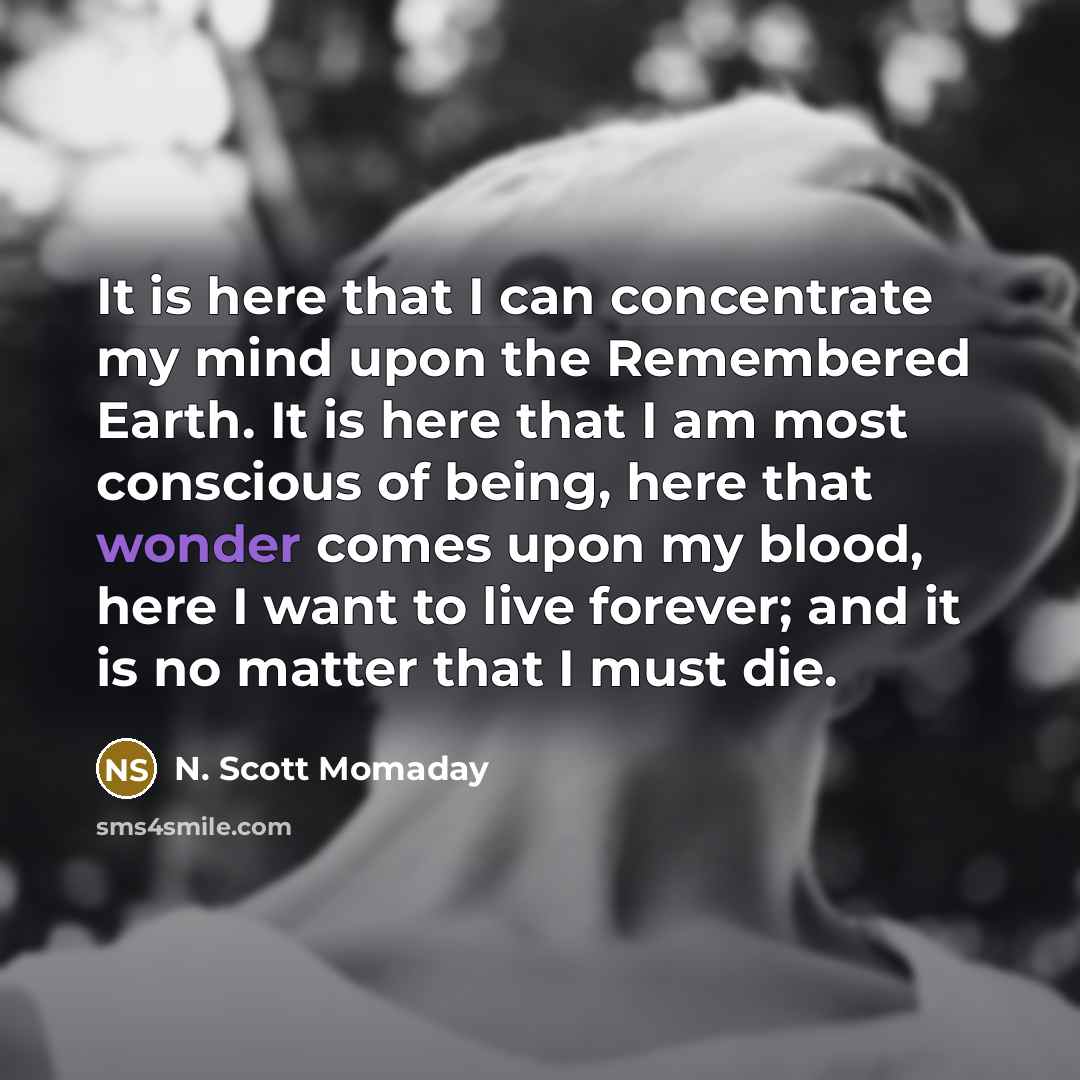
Gettysburg address Quote by N. Scott Momaday
““At first she thought the writing would be easy. She was extremely confident in her ability to dream, to imagine, and she supposed that expressing her dreams in words, in writing, would be entirely natural, like drawing breath. She had read widely from the time she was a child, and she knew how to recognize something that was well written. She admired certain lines and passages so much that she had taken complete possession of them and committed them to memory. She could recite “The Gettysburg Address” and “The Twenty-Third Psalm.” She could recite “Jabberwocky” and Emily Dickinson’s “Further in summer that the birds” and Wallace Stevens’s “Sunday Morning.” She knew by heart the final paragraph of Joyce’s “The Dead,” and if challenged she could say in whole the parts of both Romeo and Juliet. And she knew many Kiowa stories and many long prayers in Navajo. These were not feats of memory in the ordinary sense; it was simply that she attended to these things so closely that they became a part of her most personal experience. She had assumed them, appropriated them to her being. But to write! She discovered that was something else again.””
About This Quote
Source Novel: House Made of Dawn by N. Scott Momaday, 1968
The protagonist believed that extensive reading and memorization would make writing effortless, but discovers that true writing requires personal creation beyond inherited knowledge.
In simple terms: Reading well doesn’t guarantee writing skill; original creation is needed.
Key Takeaway
Cultivate your own voice, not just echo others.
Themes
creativity
identity
learning
literature
Mood
reflective
inquisitive
Type
inspirational
philosophical
When to use this quote
- writing workshops
- college composition
- personal journaling
- creative retreats
Key Concepts
authorship
originality
cultural memory
Questions to Reflect On
- How can you transform memorized material into original work?
- What blocks the transition from reading to writing?
A Different Perspective
Even with deep knowledge, personal expression can feel foreign and challenging.