Environment Quote by Murray Bookchin
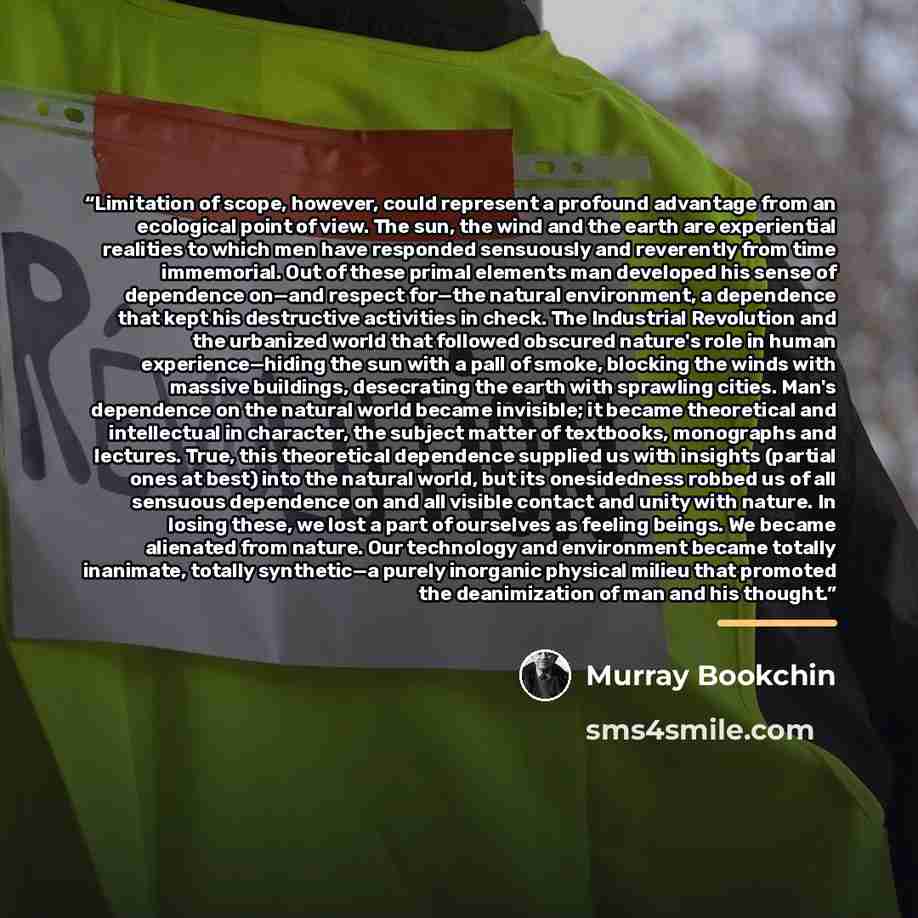
““Limitation of scope, however, could represent a profound advantage from an ecological point of view. The sun, the wind and the earth are experiential realities to which men have responded sensuously and reverently from time immemorial. Out of these primal elements man developed his sense of dependence on—and respect for—the natural environment, a dependence that kept his destructive activities in check. The Industrial Revolution and the urbanized world that followed obscured nature's role in human experience—hiding the sun with a pall of smoke, blocking the winds with massive buildings, desecrating the earth with sprawling cities. Man's dependence on the natural world became invisible; it became theoretical and intellectual in character, the subject matter of textbooks, monographs and lectures. True, this theoretical dependence supplied us with insights (partial ones at best) into the natural world, but its onesidedness robbed us of all sensuous dependence on and all visible contact and unity with nature. In losing these, we lost a part of ourselves as feeling beings. We became alienated from nature. Our technology and environment became totally inanimate, totally synthetic—a purely inorganic physical milieu that promoted the deanimization of man and his thought.””
About This Quote
Source Book: The Rise of Urbanism, Murray Bookchin, 1987
Human disconnection from nature stems from viewing it only intellectually, losing sensory and emotional bonds.
In simple terms: Seeing nature only as theory alienates us.
Key Takeaway
Re‑engage senses with nature.
Themes
environment
alienation
technology
ecology
Mood
reflective
concerned
Type
philosophical
critical
When to use this quote
- urban planning
- education
- personal mindfulness
- community gardening
Key Concepts
sensory dependence
industrial impact
psychological effects
Questions to Reflect On
- How can we restore sensory ties to nature?
- What practices reconnect us to the environment?
A Different Perspective
Theory alone can’t replace lived experience.
![“To him who feels that Nature is lovely, it appears an end in itself, it has the ground of its existence in itself: … the question, Why does it exist? does not arise. … Nature, as it impresses his senses, has indeed had an origin, has been produced, but not created in the religious sense, … [H]e…” quote by Ludwig Feuerbach](https://sms4smile.com/quotes/img-quotes/5c8/ludwig-feuerbach-3406_a-part_to-him-who-feels-that-nature-is-lovely-i_1346912.jpg)
![“As our mother earth is a mere speck in the sunbeam in the illimitable universe, so man himself is but a tiny grain of protoplasm in the perishable framework of organic nature. [This] clearly indicates the true place of man in nature, but it dissipates the prevalent illusion of man's supreme…” quote by Ernst Haeckel](https://sms4smile.com/quotes/img-quotes/ee4/ernst-haeckel-20972_arrogance_as-our-mother-earth-is-a-mere-speck-in-t_1972689.jpg)
![“[The] term 'libertarian' itself, to be sure, raises a problem, notably, the specious identification of an anti-authoritarian ideology with a straggling movement for 'pure capitalism' and 'free trade.' This movement never created the word: it appropriated it from the anarchist movement of the…” quote by Murray Bookchin](https://sms4smile.com/quotes/img-quotes/d1e/murray-bookchin-2587_free-trade_the-term-libertarian-itself-to-be-sure-r_144681.jpg)

![“[W]ithout changing the most molecular relationships in society — notably, those between men and women, adults and children, whites and other ethnic groups, heterosexuals and gays (the list, in fact, is considerable) — society will be riddled by domination even in a socialistic ‘classless’ and…” quote by Murray Bookchin](https://sms4smile.com/quotes/img-quotes/5e4/murray-bookchin-2587_children_w-ithout-changing-the-most-molecular-rel_189100.jpg)
![“The most important thing [anarchists] can do is educate themselves, develop a propaganda machinery in the form of books and periodicals, a literature, engage in discussion groups that are open to a community, to discuss and develop their ideas and to develop networks.” quote by Murray Bookchin](https://sms4smile.com/quotes/img-quotes/d5f/murray-bookchin-2587_anarchist_the-most-important-thing-anarchists-can_190565.jpg)