Forgetting Quote by Mikael Krogerus

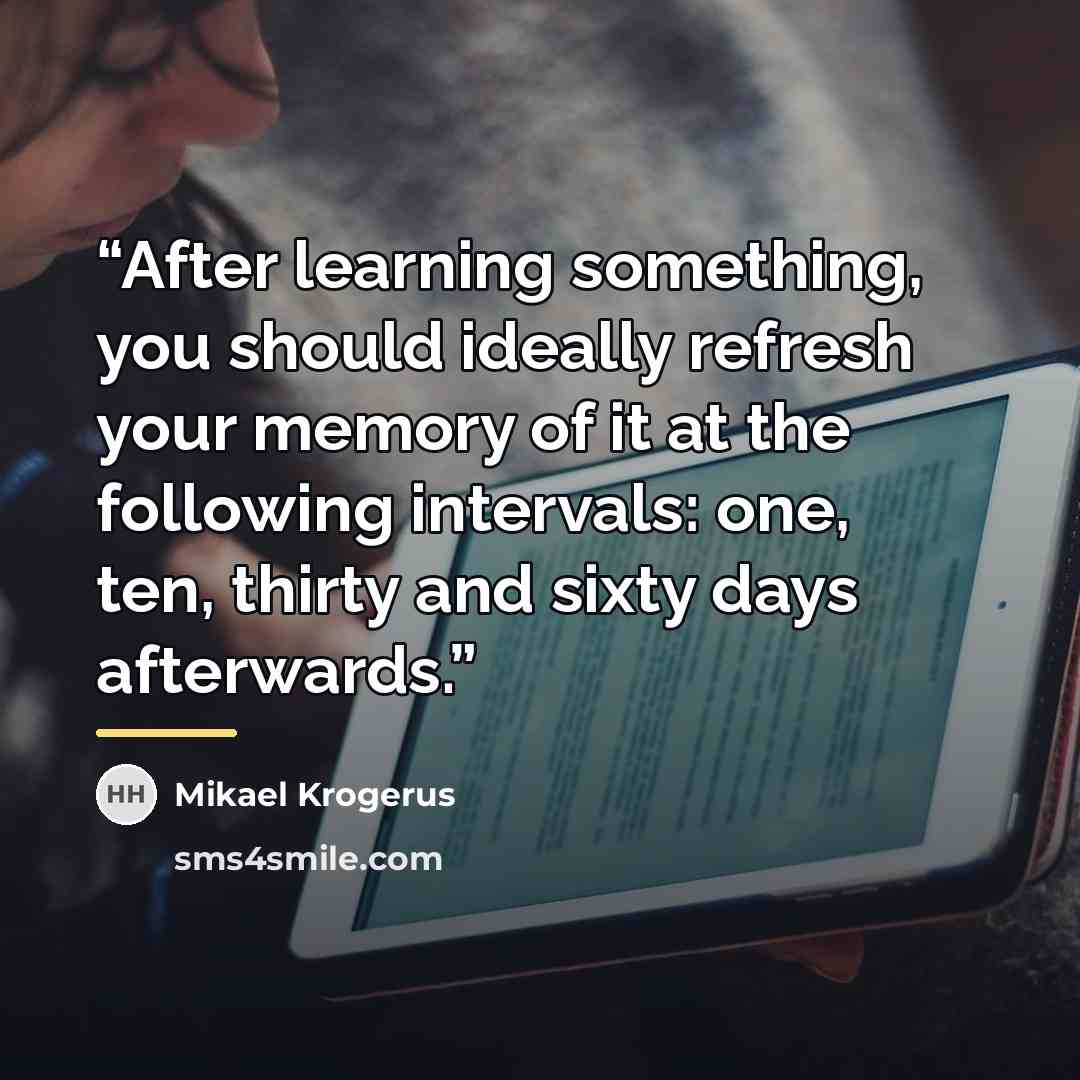
““THE SUPERMEMO MODEL HOW TO REMEMBER EVERYTHING YOU HAVE EVER LEARNED Long-term memory has two components: retrievability and stability. Retrievability determines how easily we remember something, and depends on how near the surface of our consciousness the information is ‘swimming’. Stability, on the other hand, is to do with how deeply information is anchored in our brains. Some memories have a high level of stability but a low level of retrievability. Try to recall one of your old phone numbers – you probably won’t be able to. But if you see the number in front of you, you will recognise it immediately. Imagine that you are learning Chinese. You have learned a word and memorised it. Without practice, over time it will become increasingly difficult to remember. The amount of time it takes for you to forget it completely can be calculated, and ideally you should be reminded of the word precisely when you are in the process of forgetting it. The more often you are reminded of the word, the longer you will remember it for. This learning programme is called Super-Memo and was developed by the Polish researcher Piotr Woźniak. It’s not what you know, it’s what you remember. Jan Cox After learning something, you should ideally refresh your memory of it at the following intervals: one, ten, thirty and sixty days afterwards.””
About This Quote
Source Article: Super‑Memo Model, Learning Science Review, 2020
Memory consists of retrievability (how accessible a memory is) and stability (how deeply it is stored); optimal recall requires timing reminders when forgetting begins.
In simple terms: Two memory parts: easy access and deep storage; review when forgetting starts.
Key Takeaway
Schedule reviews at key intervals to strengthen memory.
Themes
learning
memory
review
Mood
motivational
practical
Type
educational
self‑help
When to use this quote
- studying a language
- preparing for exams
- skill acquisition
- professional training
Key Concepts
retrieval practice
spaced repetition
memory consolidation
Questions to Reflect On
- What interval works best for your learning style?
- How can you detect the onset of forgetting?
A Different Perspective
Too rigid schedules may ignore individual differences.