Anger Quote by Michael S. Kimmel
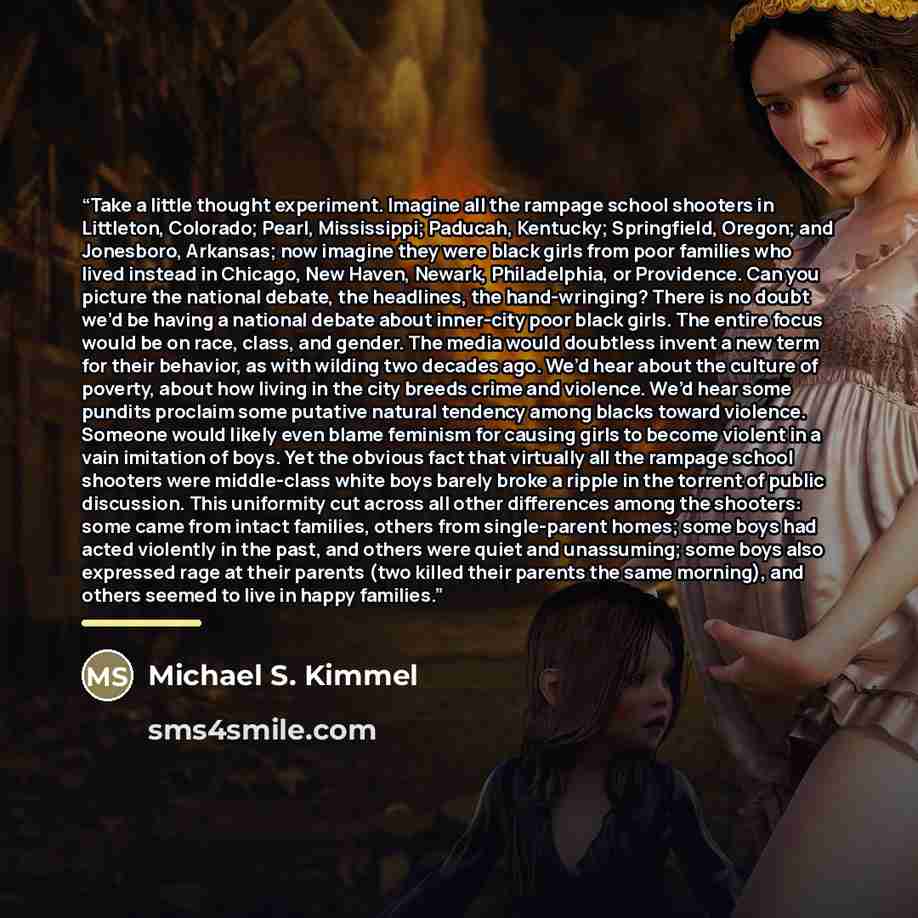
““Take a little thought experiment. Imagine all the rampage school shooters in Littleton, Colorado; Pearl, Mississippi; Paducah, Kentucky; Springfield, Oregon; and Jonesboro, Arkansas; now imagine they were black girls from poor families who lived instead in Chicago, New Haven, Newark, Philadelphia, or Providence. Can you picture the national debate, the headlines, the hand-wringing? There is no doubt we’d be having a national debate about inner-city poor black girls. The entire focus would be on race, class, and gender. The media would doubtless invent a new term for their behavior, as with wilding two decades ago. We’d hear about the culture of poverty, about how living in the city breeds crime and violence. We’d hear some pundits proclaim some putative natural tendency among blacks toward violence. Someone would likely even blame feminism for causing girls to become violent in a vain imitation of boys. Yet the obvious fact that virtually all the rampage school shooters were middle-class white boys barely broke a ripple in the torrent of public discussion. This uniformity cut across all other differences among the shooters: some came from intact families, others from single-parent homes; some boys had acted violently in the past, and others were quiet and unassuming; some boys also expressed rage at their parents (two killed their parents the same morning), and others seemed to live in happy families.””
About This Quote
Source Article: “The Racial Politics of School Shootings” by Michael S. Kimmel, The Atlantic, 2018
The quote highlights how media and public discourse would shift focus to race, class, and gender if perpetrators were black girls, exposing bias in how violence is framed.
In simple terms: Bias changes narrative focus based on perpetrator identity.
Key Takeaway
Recognize and challenge media bias in crime reporting.
Themes
bias
media framing
race
gender
class
violence
Mood
critical
reflective
Type
analytical
commentary
When to use this quote
- policy analysis
- media criticism
- public discourse
- education reform
Key Concepts
intersectionality
media bias
stereotyping
social narrative
Questions to Reflect On
- How does identity shape media narratives?
- What structural factors are ignored in such framing?
A Different Perspective
The argument may oversimplify complex causes of violence beyond identity factors.



![“[G]reater social equality can accompany, or parallel, shifts in economic distribution. In our case, they run at cross-purposes; in other countries, notably in the European Union, greater economic equality has actually accompanied greater social equality. There is no necessary and inevitable…” quote by Michael S. Kimmel](https://sms4smile.com/quotes/img-quotes/53d/michael-s-kimmel-58334_economic-equality_g-reater-social-equality-can-accompany-o_3119517.jpg)