Psychology Quote by Michael Lewis
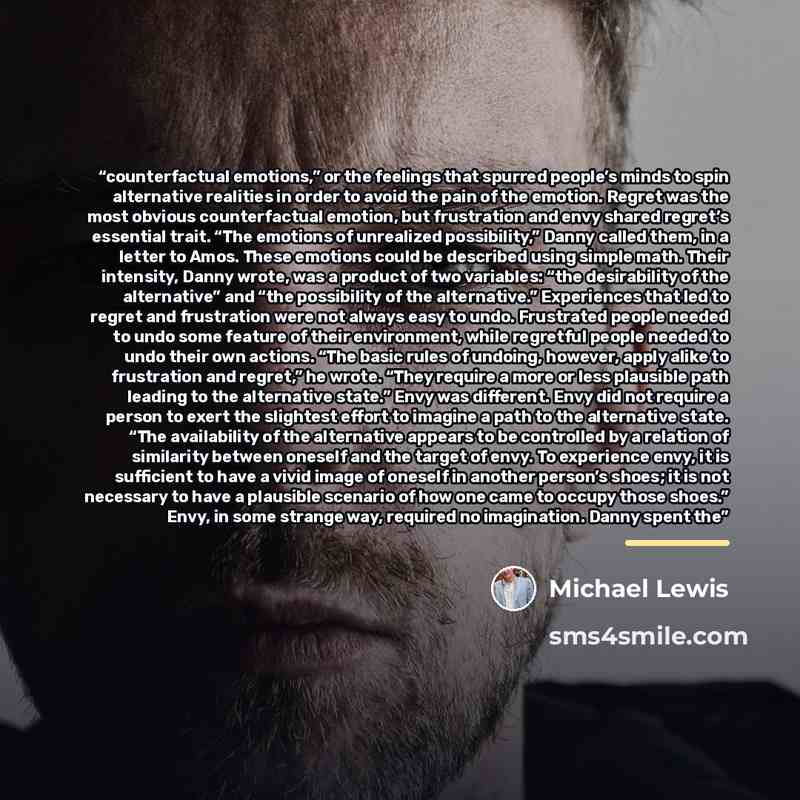
““counterfactual emotions,” or the feelings that spurred people’s minds to spin alternative realities in order to avoid the pain of the emotion. Regret was the most obvious counterfactual emotion, but frustration and envy shared regret’s essential trait. “The emotions of unrealized possibility,” Danny called them, in a letter to Amos. These emotions could be described using simple math. Their intensity, Danny wrote, was a product of two variables: “the desirability of the alternative” and “the possibility of the alternative.” Experiences that led to regret and frustration were not always easy to undo. Frustrated people needed to undo some feature of their environment, while regretful people needed to undo their own actions. “The basic rules of undoing, however, apply alike to frustration and regret,” he wrote. “They require a more or less plausible path leading to the alternative state.” Envy was different. Envy did not require a person to exert the slightest effort to imagine a path to the alternative state. “The availability of the alternative appears to be controlled by a relation of similarity between oneself and the target of envy. To experience envy, it is sufficient to have a vivid image of oneself in another person’s shoes; it is not necessary to have a plausible scenario of how one came to occupy those shoes.” Envy, in some strange way, required no imagination. Danny spent the””
About This Quote
Source Book: The Undoing Project, 2016
Counterfactual emotions arise when we imagine alternative outcomes, driving regret, frustration, or envy, each with distinct mental mechanisms.
In simple terms: Imagining “what if” creates strong emotions.
Key Takeaway
Identify and manage imagined alternatives.
Themes
regret
frustration
envy
counterfactual thinking
Mood
analytical
introspective
Type
educational
philosophical
When to use this quote
- career setbacks
- relationship choices
- financial decisions
Key Concepts
psychology
decision theory
emotion regulation
Questions to Reflect On
- What alternatives do you dwell on?
- How can you shift focus to present reality?
A Different Perspective
Focusing on alternatives can increase distress.





![“The only regret I have in my career, is my managers wanted a big payday, and I wanted four or five more fights before going in with [Larry] Holmes. That would have made all the difference.” quote by Gerry Cooney](https://sms4smile.com/quotes/img-quotes/d63/gerry-cooney-20863_bigs_the-only-regret-i-have-in-my-career-is-m_1534.jpg)

![“Crucial decisions are made, today as thousands of years ago, in terms of the intuitive guesses and preferences of a few men in positions of authority...[it is] quite likely that the fate of entire societies may be sealed by a series of avoidable mistakes committed by their leaders.” quote by Michael Lewis](https://sms4smile.com/quotes/img-quotes/a59/michael-lewis-705_decision-making_crucial-decisions-are-made-today-as-thou_16888.jpg)