Heidegger Quote by Martin Heidegger
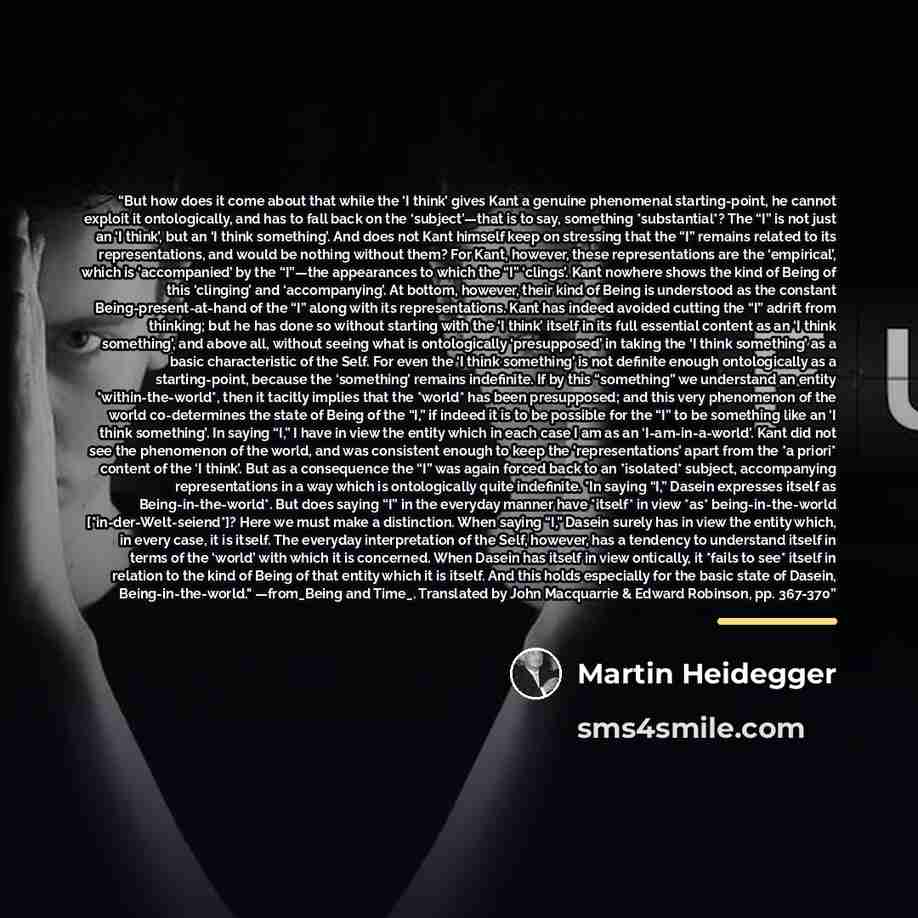
““But how does it come about that while the ‘I think’ gives Kant a genuine phenomenal starting-point, he cannot exploit it ontologically, and has to fall back on the ‘subject’—that is to say, something *substantial*? The “I” is not just an ‘I think’, but an ‘I think something’. And does not Kant himself keep on stressing that the “I” remains related to its representations, and would be nothing without them? For Kant, however, these representations are the ‘empirical’, which is ‘accompanied’ by the “I”—the appearances to which the “I” ‘clings’. Kant nowhere shows the kind of Being of this ‘clinging’ and ‘accompanying’. At bottom, however, their kind of Being is understood as the constant Being-present-at-hand of the “I” along with its representations. Kant has indeed avoided cutting the “I” adrift from thinking; but he has done so without starting with the ‘I think’ itself in its full essential content as an ‘I think something’, and above all, without seeing what is ontologically ‘presupposed’ in taking the ‘I think something’ as a basic characteristic of the Self. For even the ‘I think something’ is not definite enough ontologically as a starting-point, because the ‘something’ remains indefinite. If by this “something” we understand an entity *within-the-world*, then it tacitly implies that the *world* has been presupposed; and this very phenomenon of the world co-determines the state of Being of the “I,” if indeed it is to be possible for the “I” to be something like an ‘I think something’. In saying “I,” I have in view the entity which in each case I am as an ‘I-am-in-a-world’. Kant did not see the phenomenon of the world, and was consistent enough to keep the ‘representations’ apart from the *a priori* content of the ‘I think’. But as a consequence the “I” was again forced back to an *isolated* subject, accompanying representations in a way which is ontologically quite indefinite. *In saying “I,” Dasein expresses itself as Being-in-the-world*. But does saying “I” in the everyday manner have *itself* in view *as* being-in-the-world [*in-der-Welt-seiend*]? Here we must make a distinction. When saying “I,” Dasein surely has in view the entity which, in every case, it is itself. The everyday interpretation of the Self, however, has a tendency to understand itself in terms of the ‘world’ with which it is concerned. When Dasein has itself in view ontically, it *fails to see* itself in relation to the kind of Being of that entity which it is itself. And this holds especially for the basic state of Dasein, Being-in-the-world." ―from_Being and Time_. Translated by John Macquarrie & Edward Robinson, pp. 367-370””
About This Quote
Source Philosophical Essay: Kantian Critique (modern analysis), 2020
Kant’s “I think” lacks ontological grounding because it treats the self as a mere thinking subject without addressing the substantive relation to its representations, leading to an isolated subjectivity.
In simple terms: Kant’s self concept is incomplete, missing deeper substance.
Key Takeaway
Reexamine the self’s relation to its representations.
Themes
philosophy
ontology
Kantian critique
subjectivity
Mood
analytical
thoughtful
intellectual
Type
academic
critical
When to use this quote
- academic seminars
- philosophy courses
- critical essays
Key Concepts
transcendental idealism
selfhood
representation theory
Questions to Reflect On
- How does representation shape self-identity?
- Can Kant’s framework accommodate a substantive self?
A Different Perspective
The analysis may oversimplify Kant’s complex system.
















![“I think he [Heidegger] sets the question up in a useful way and, despite appearances, he's not 'against' technology. He just wants us to have a questioning and thoughtful relation to it. This must be relevant to any approach.” quote by George Pattison](https://sms4smile.com/quotes/img-quotes/8b4/george-pattison-17005_appearance_i-think-he-heidegger-sets-the-question-u_438353.jpg)