But why should a religious person be interested in a work like Heidegger's that many regard as the epitome of nihilism? For… — George Pattison Copy Share Image
I think he [Heidegger] sets the question up in a useful way and, despite appearances, he's not 'against' technology. He just wants… — George Pattison Copy Share Image
In brief, I regard love as a more decisive focus of meaning than death. In terms of Heidegger's argument, this is because… — George Pattison Copy Share Image
Positively, he [Heidegger] shows that the prospect of death doesn't of itself destroy all possibilities of meaning but calls instead for these… — George Pattison Copy Share Image
Of course, if one's reading Kierkegaard for personal interest that's fine - but it's sloppy scholarship just to cherry pick what suits… — George Pattison Copy Share Image
Religious life is about something real in human experience that is not constrained by what Wittgenstein called 'all that is the case'.… — George Pattison Copy Share Image
Every stroke a tennis player plays is different, yet we perceive them as playing in a distinctive and unique way. It's what… — George Pattison Copy Share Image
What it does remind us is that 'God' is not to be separated from the quest for the Kingdom of God and… — George Pattison Copy Share Image
I'm not sure if Cupitt himself still uses this term, but it's useful in suggesting that, actually, there are more choices than the choice… — George Pattison Copy Share Image
When I'm on the operating table, I'm happy for the surgeon to treat me as a machine, but the moment I return to consciousness… — George Pattison Copy Share Image
But why should a religious person be interested in a work like Heidegger's that many regard as the epitome of nihilism? For a start,… — George Pattison Copy Share Image
And perhaps this has to do with what I sense is a turning away from the idea of religion as being about conserving a… — George Pattison Copy Share Image
Perhaps unsurprisingly, there's a paradox here! Kierkegaard's own indirect communication proposes that we start with the experience of those who don't believe and meet… — George Pattison Copy Share Image
I think he [Heidegger] sets the question up in a useful way and, despite appearances, he's not 'against' technology. He just wants us to… — George Pattison Copy Share Image
I still read a lot about teenage angst! Of course, any kind of mourning CAN become pathological and then it 'has to stop', but… — George Pattison Copy Share Image
But my point is that 'the death of God' is not something like the Battle of Waterloo or Magna Charta. It's not a historic… — George Pattison Copy Share Image
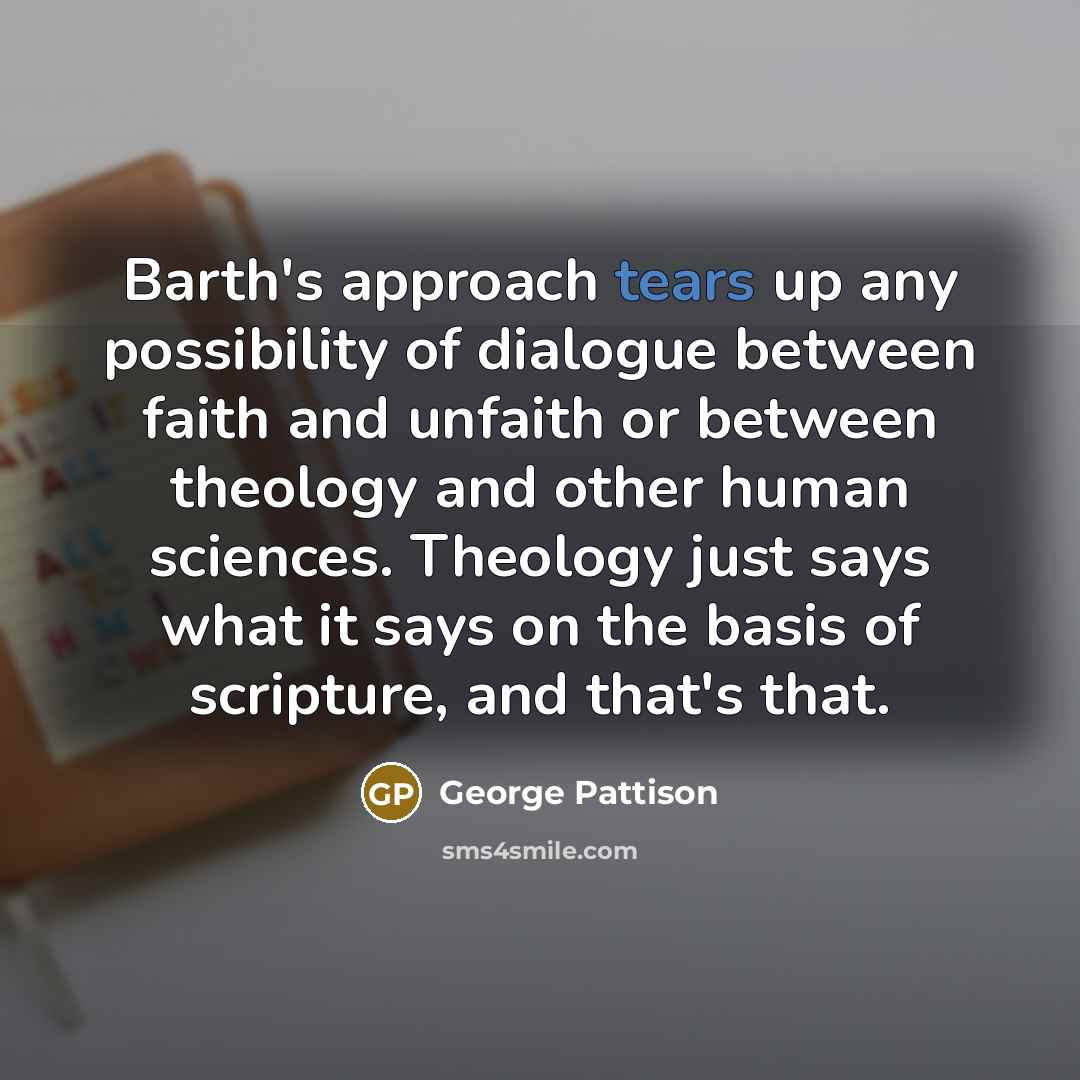
Barth's approach tears up any possibility of dialogue between faith and unfaith or between theology and other human sciences. Theology just says what it… — George Pattison Copy Share Image
But, inevitably, as he [Kierkegaard] approaches what we might call his Christocentric climax many readers drop off. Many scholars just leave that part of… — George Pattison Copy Share Image
Essentially I see the new atheism as largely part of the crisis of the left. Having failed to carry through its agenda in relation… — George Pattison Copy Share Image
In brief, I regard love as a more decisive focus of meaning than death. In terms of Heidegger's argument, this is because I think… — George Pattison Copy Share Image
![“I think he [Heidegger] sets the question up in a useful way and, despite appearances, he's not 'against' technology. He just wants us to have a questioning and thoughtful relation to it. This must be relevant to any approach.” quote by George Pattison](https://sms4smile.com/quotes/img-quotes/8b4/george-pattison-17005_appearance_i-think-he-heidegger-sets-the-question-u_438353.jpg)
![“Positively, he [Heidegger] shows that the prospect of death doesn't of itself destroy all possibilities of meaning but calls instead for these to be relocated from fantasies about a future post-mortem life. However, I don't think he does enough in this work to show that this relocation has - I…” quote by George Pattison](https://sms4smile.com/quotes/img-quotes/31c/george-pattison-17005_believe_positively-he-heidegger-shows-that-the-p_1072326.jpg)

![“But, inevitably, as he [Kierkegaard] approaches what we might call his Christocentric climax many readers drop off. Many scholars just leave that part of his authorship alone.” quote by George Pattison](https://sms4smile.com/quotes/img-quotes/44a/george-pattison-17005_approach_but-inevitably-as-he-kierkegaard-approac_610234.jpg)