History Quote by Marc Hecker
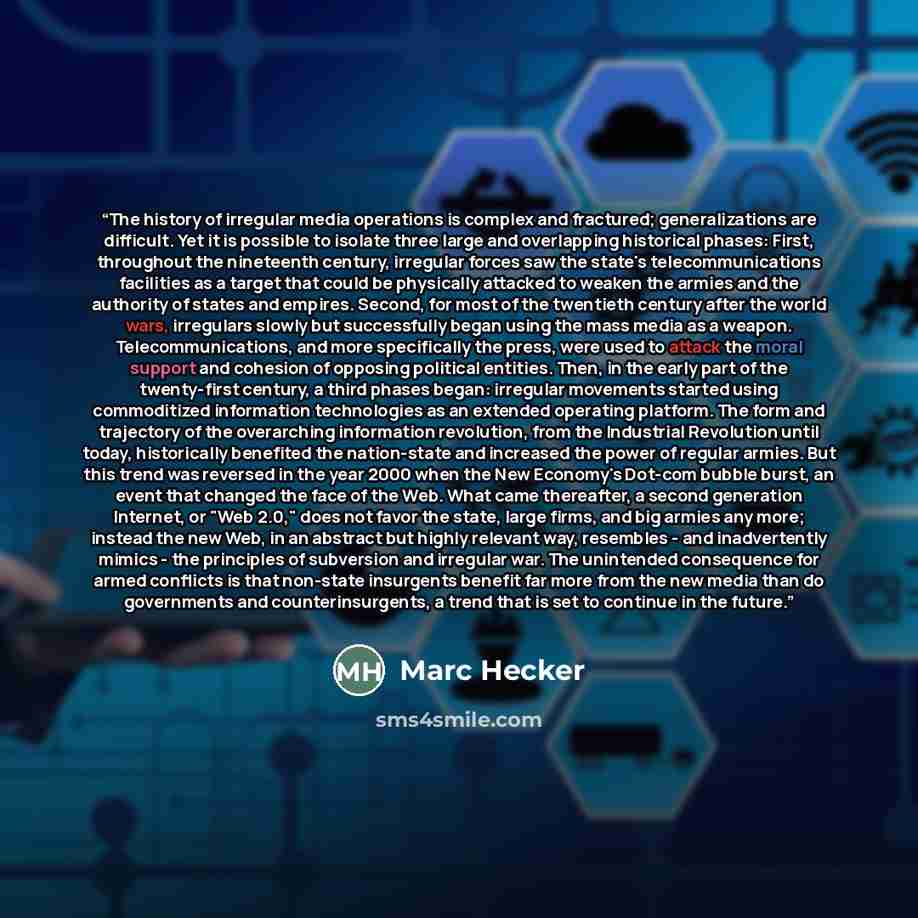
““The history of irregular media operations is complex and fractured; generalizations are difficult. Yet it is possible to isolate three large and overlapping historical phases: First, throughout the nineteenth century, irregular forces saw the state's telecommunications facilities as a target that could be physically attacked to weaken the armies and the authority of states and empires. Second, for most of the twentieth century after the world wars, irregulars slowly but successfully began using the mass media as a weapon. Telecommunications, and more specifically the press, were used to attack the moral support and cohesion of opposing political entities. Then, in the early part of the twenty-first century, a third phases began: irregular movements started using commoditized information technologies as an extended operating platform. The form and trajectory of the overarching information revolution, from the Industrial Revolution until today, historically benefited the nation-state and increased the power of regular armies. But this trend was reversed in the year 2000 when the New Economy's Dot-com bubble burst, an event that changed the face of the Web. What came thereafter, a second generation Internet, or "Web 2.0," does not favor the state, large firms, and big armies any more; instead the new Web, in an abstract but highly relevant way, resembles - and inadvertently mimics - the principles of subversion and irregular war. The unintended consequence for armed conflicts is that non-state insurgents benefit far more from the new media than do governments and counterinsurgents, a trend that is set to continue in the future.””
About This Quote
A three‑phase history of irregular warfare shows how non‑state actors have shifted from targeting physical infrastructure to exploiting mass media and, finally, digital platforms that mirror subversive tactics.
In simple terms: Irregular forces evolved from physical attacks to digital subversion.
Key Takeaway
Technology reshapes conflict power dynamics.
Themes
history
technology
irregular warfare
media
state vs non‑state
Mood
analytical
critical
thoughtful
Type
historical analysis
strategic insight
When to use this quote
- military strategy
- policy analysis
- academic research
- media studies
Key Concepts
telecommunications
mass media
Web 2.0
information warfare
Practical Applications
- strategic planning
- educational curricula
Questions to Reflect On
- How does each new medium alter the balance between state and insurgent power?
- What future technologies could further level the playing field?
A Different Perspective
Some argue that state actors still dominate cyber capabilities, limiting the claim of a complete power shift.