Crime Quote by Louis-Ferdinand Céline
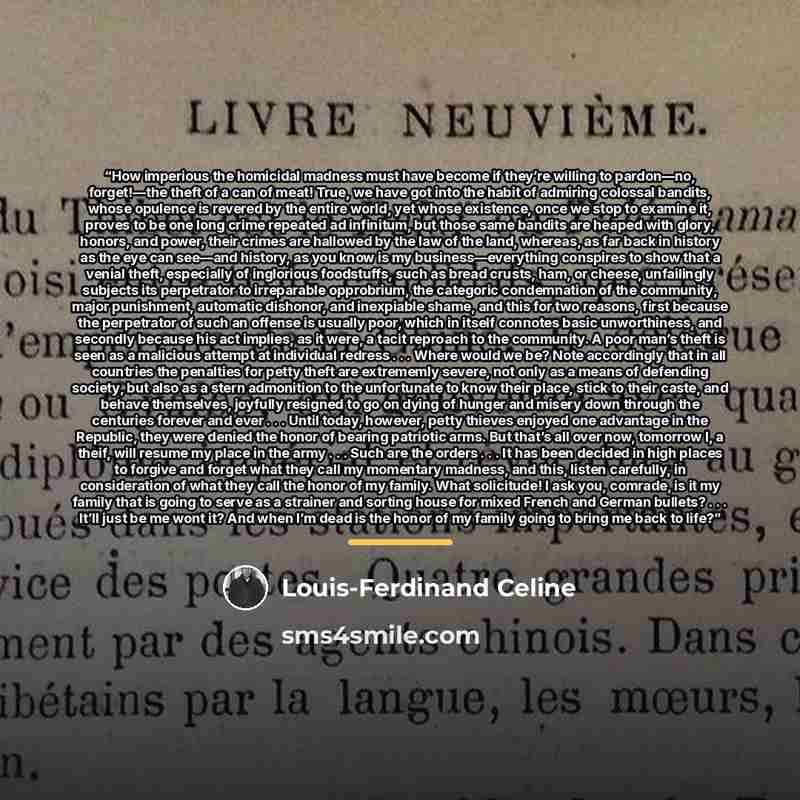
““How imperious the homicidal madness must have become if they’re willing to pardon—no, forget!—the theft of a can of meat! True, we have got into the habit of admiring colossal bandits, whose opulence is revered by the entire world, yet whose existence, once we stop to examine it, proves to be one long crime repeated ad infinitum, but those same bandits are heaped with glory, honors, and power, their crimes are hallowed by the law of the land, whereas, as far back in history as the eye can see—and history, as you know is my business—everything conspires to show that a venial theft, especially of inglorious foodstuffs, such as bread crusts, ham, or cheese, unfailingly subjects its perpetrator to irreparable opprobrium, the categoric condemnation of the community, major punishment, automatic dishonor, and inexpiable shame, and this for two reasons, first because the perpetrator of such an offense is usually poor, which in itself connotes basic unworthiness, and secondly because his act implies, as it were, a tacit reproach to the community. A poor man’s theft is seen as a malicious attempt at individual redress . . . Where would we be? Note accordingly that in all countries the penalties for petty theft are extrememly severe, not only as a means of defending society, but also as a stern admonition to the unfortunate to know their place, stick to their caste, and behave themselves, joyfully resigned to go on dying of hunger and misery down through the centuries forever and ever . . . Until today, however, petty thieves enjoyed one advantage in the Republic, they were denied the honor of bearing patriotic arms. But that’s all over now, tomorrow I, a theif, will resume my place in the army . . . Such are the orders . . . It has been decided in high places to forgive and forget what they call my momentary madness, and this, listen carefully, in consideration of what they call the honor of my family. What solicitude! I ask you, comrade, is it my family that is going to serve as a strainer and sorting house for mixed French and German bullets? . . . It’ll just be me wont it? And when I’m dead is the honor of my family going to bring me back to life?””
About This Quote
Source Novel: Journey Voyage au bout de la nuit, 1932
The passage satirically condemns how societies glorify great criminals while harshly punishing petty thieves, exposing class bias and moral hypocrisy.
In simple terms: Society rewards big crimes, punishes small ones, revealing injustice.
Key Takeaway
Question the fairness of legal and moral standards.
Themes
justice
class
hypocrisy
law
morality
Mood
critical
somber
Type
political
philosophical
When to use this quote
- legal reform
- activism
- education
- media analysis
Key Concepts
social critique
inequality
power dynamics
Questions to Reflect On
- How do we reconcile punishment with social status?
- What reforms could reduce class‑based legal bias?
A Different Perspective
May be overly cynical, ignoring nuance of individual cases.