History books Quote by Kenneth Minogue
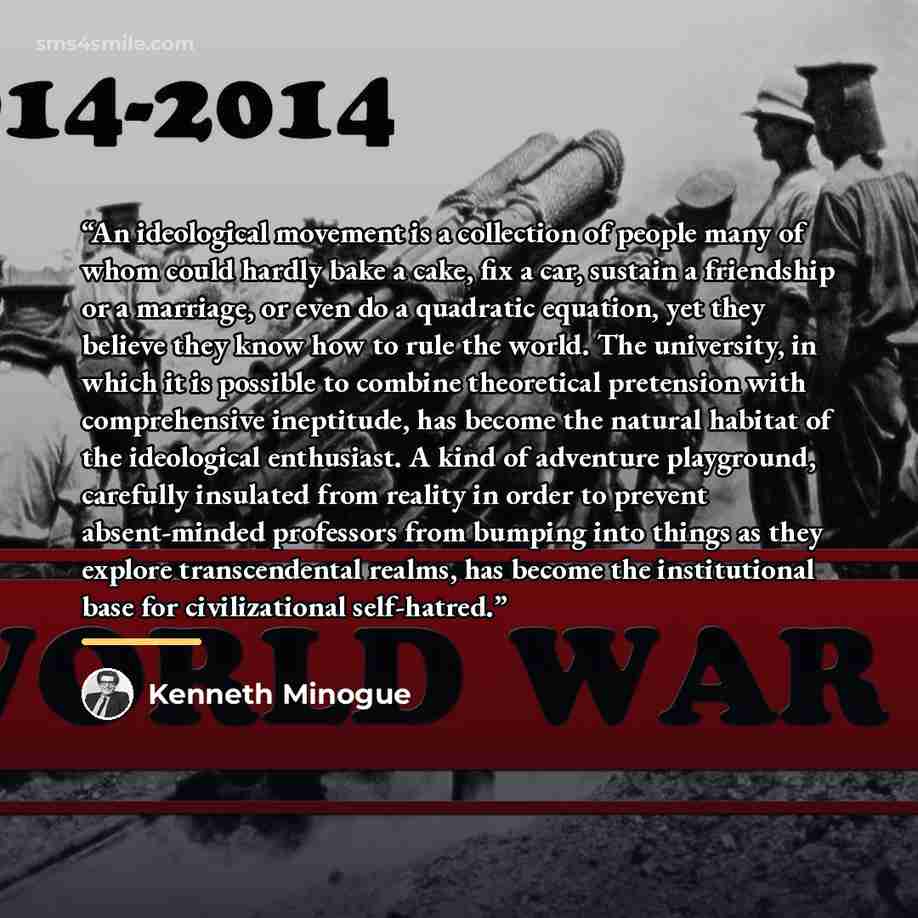
““Have I really been in a battle?” wondered Stendhal’s hero after many hours blundering around the field of Waterloo, and many people today share a similar perplexity. Like Stendhal’s hero, they eat and drink and sustain the business of life, but the meaning of it all depends upon their conviction of contributing to the liberation of workers, women, the colonized, or other varieties of the oppressed. Like Fabrizio del Dongo, they find a regiment and tag along—the Hussars against Patriarchy, the Dragoon Guards of the Proletariat, and so on. Quite where the real battle lies is hotly disputed, but its significance is agreed to be a final end to oppression. (…) My argument, then, is an exploration of the hypothesis that there is a pure theory of ideology, and while from one point of view it is a critique, from another it is a do-it-yourself ideology kit. It begins with some suggestions about how ideology was generated from eighteenth-century social theory. The long central section is an attempt to characterize ideologies as forms of understanding. The last section develops the view that, although ideology must take on political trappings in order to transform the world, its real character is entirely antithetical to the practice of politics. Ideology is to reality, I suggest, as (in Tolstoy’s opinion) the reports of battles are to the concrete experience of individuals in the field. In ideological moods, we think we see in social and political life those clear lines from the history books depicting the battle order of the antagonists in massed array. They have neat, clear names like bourgeois and proletarian, colonialist and national, city-dweller and producer, in a word, oppressor and oppressed. The actual reality, however, is messy. Things change all the time, and it becomes impossible to keep any clear and distinct identities in focus. Confronting the arguments of ideology, we are forced to transform the Stendhalian question: Is it really a battle that we are in?””
About This Quote
Source Book: Ideology and Political Theory, Kenneth Minogue, 1978
The text questions whether ideological battles are real conflicts or mental constructs, suggesting ideology frames reality but often oversimplifies complex social dynamics.
In simple terms: Ideology frames reality but oversimplifies complexity.
Key Takeaway
Recognize nuance beyond binary categories.
Themes
politics
ideology
philosophy
history
social theory
Mood
critical
analytical
inquisitive
Type
philosophical
theoretical
critical
When to use this quote
- academic debate
- political activism
- education
- media analysis
Key Concepts
binary thinking
social construction
historical materialism
Questions to Reflect On
- How do you identify when ideology simplifies reality?
- What strategies reveal hidden complexities?
A Different Perspective
Ideology can be used to justify oppression if unexamined.

![“He [Bilbo] fought the real battle in the tunnel alone, before he ever saw the vast danger that lay in wait.” quote by J. R. R. Tolkien](https://sms4smile.com/quotes/img-quotes/fd2/j-r-r-tolkien-2-1316_battle_he-bilbo-fought-the-real-battle-in-the-t_2538907.jpg)
![“Their [realists'] concern is that utopian aspirations towards a new peaceful world order will simply absolutize conflicts and make them more intractable. National interests are in some degree negotiable; rights, in principle, are not. International organizations such as the United Nations have not…” quote by Kenneth Minogue](https://sms4smile.com/quotes/img-quotes/93f/kenneth-minogue-28215_bringing-peace_their-realists-concern-is-that-utopian-a_516332.jpg)
![“But the participants [in war] never forgot the details of their experience, and like the Wandering Jew, they were condemned to remain their own history books, each containing a story they could not pass on to others and from which no one would learn anything of value.” quote by James Lee Burke](https://sms4smile.com/quotes/img-quotes/320/james-lee-burke-2289_book_but-the-participants-in-war-never-forgot_31146.jpg)