Hegel Quote by Karl R. Popper
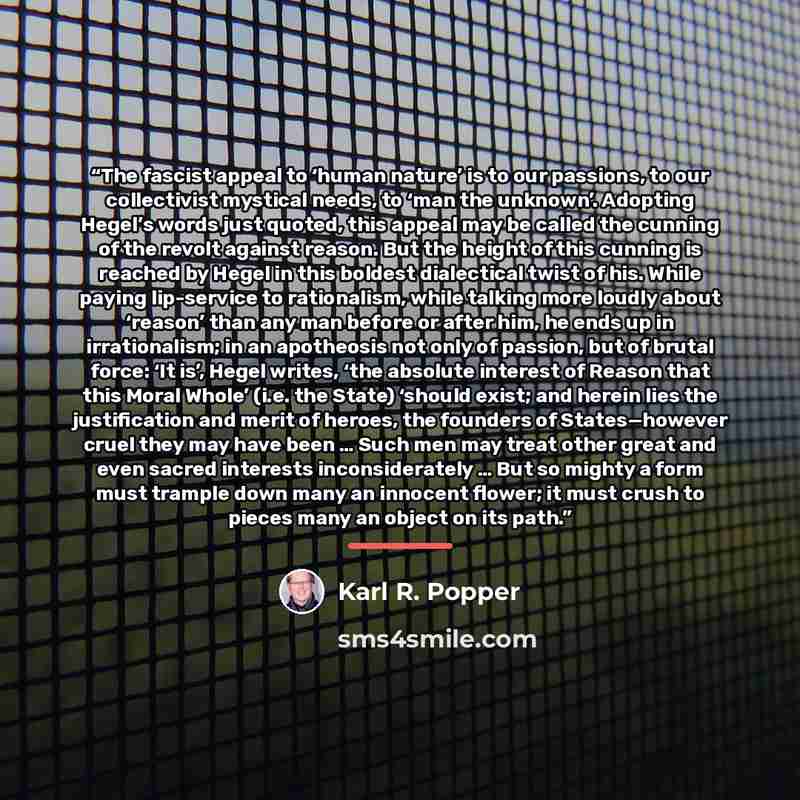
““The fascist appeal to ‘human nature’ is to our passions, to our collectivist mystical needs, to ‘man the unknown’. Adopting Hegel’s words just quoted, this appeal may be called the cunning of the revolt against reason. But the height of this cunning is reached by Hegel in this boldest dialectical twist of his. While paying lip-service to rationalism, while talking more loudly about ‘reason’ than any man before or after him, he ends up in irrationalism; in an apotheosis not only of passion, but of brutal force: ‘It is’, Hegel writes, ‘the absolute interest of Reason that this Moral Whole’ (i.e. the State) ‘should exist; and herein lies the justification and merit of heroes, the founders of States—however cruel they may have been … Such men may treat other great and even sacred interests inconsiderately … But so mighty a form must trample down many an innocent flower; it must crush to pieces many an object on its path.””
About This Quote
Source Book: The Open Society and Its Enemies, Karl R. Popper, 1945
Popper warns that appealing to vague human nature can mask irrational, violent politics, using Hegel as an example.
In simple terms: Rationalism can hide brutal power.
Key Takeaway
Question the moral justification of authority.
Themes
politics
philosophy
reason
power
irrationality
Mood
critical
analytical
Type
philosophical
political.
When to use this quote
- political speeches
- policy debates
- academic critiques
- public protests
Key Concepts
dialectic
moral philosophy
state theory
Questions to Reflect On
- What drives societies to accept irrational authority?
- How can reason be protected from manipulation?
A Different Perspective
Popper’s view may oversimplify Hegel’s complex ideas.

![“Yet mere membership as a matter of duty is not enough for Hegel, given the grandeur of the state’s divine historical purpose: “One must worship the state as a terrestrial divinity.”[211]” quote by Stephen R.C. Hicks](https://sms4smile.com/quotes/img-quotes/371/stephen-r-c-hicks-12692_hegel_yet-mere-membership-as-a-matter-of-duty_229759.jpg)