Memories Quote by Juliann Garey
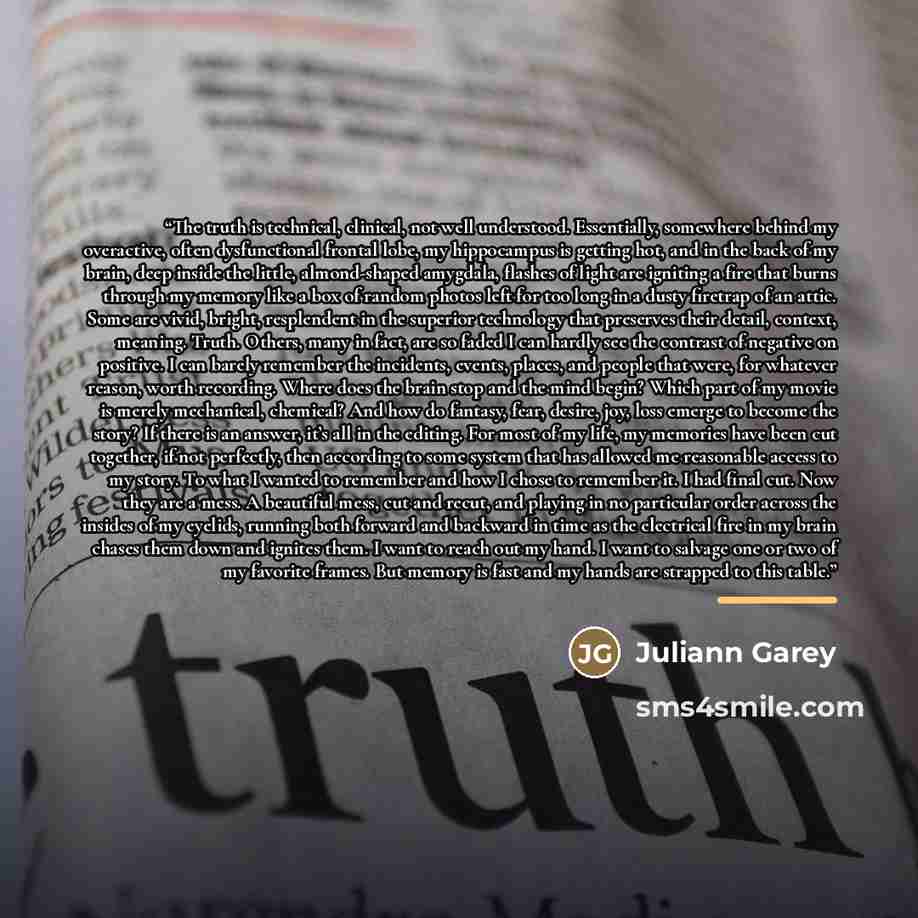
““The truth is technical, clinical, not well understood. Essentially, somewhere behind my overactive, often dysfunctional frontal lobe, my hippocampus is getting hot, and in the back of my brain, deep inside the little, almond-shaped amygdala, flashes of light are igniting a fire that burns through my memory like a box of random photos left for too long in a dusty firetrap of an attic. Some are vivid, bright, resplendent in the superior technology that preserves their detail, context, meaning. Truth. Others, many in fact, are so faded I can hardly see the contrast of negative on positive. I can barely remember the incidents, events, places, and people that were, for whatever reason, worth recording. Where does the brain stop and the mind begin? Which part of my movie is merely mechanical, chemical? And how do fantasy, fear, desire, joy, loss emerge to become the story? If there is an answer, it’s all in the editing. For most of my life, my memories have been cut together, if not perfectly, then according to some system that has allowed me reasonable access to my story. To what I wanted to remember and how I chose to remember it. I had final cut. Now they are a mess. A beautiful mess, cut and recut, and playing in no particular order across the insides of my eyelids, running both forward and backward in time as the electrical fire in my brain chases them down and ignites them. I want to reach out my hand. I want to salvage one or two of my favorite frames. But memory is fast and my hands are strapped to this table.””
About This Quote
The speaker describes how fragmented, vivid, and faded memories arise from brain processes, questioning where neural activity ends and personal narrative begins, and how editing shapes self‑story.
In simple terms: Memory is a mix of vivid and faded images shaped by brain chemistry and personal editing.
Key Takeaway
Recognize and curate the narratives you keep.
Themes
memory
identity
neuroscience
storytelling
perception
Mood
reflective
melancholic
curious
Type
analytical
philosophical
When to use this quote
- therapy sessions
- creative writing
- personal reflection
- film editing
- journalism
Key Concepts
cognitive neuroscience
psychology
memory consolidation
Questions to Reflect On
- How do you decide which memories to keep?
- What role does emotion play in shaping recall?
A Different Perspective
Memory is unreliable and can be distorted by emotion and bias.