Construction Quote by Joyce Carol Oates
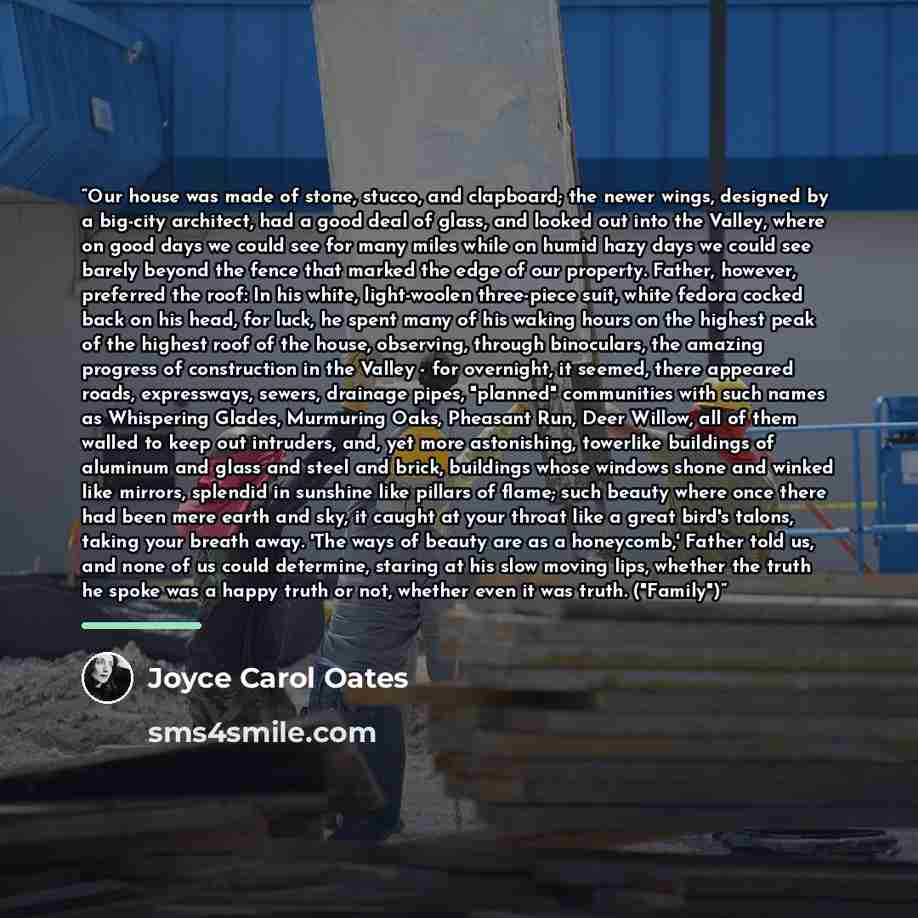
““Our house was made of stone, stucco, and clapboard; the newer wings, designed by a big-city architect, had a good deal of glass, and looked out into the Valley, where on good days we could see for many miles while on humid hazy days we could see barely beyond the fence that marked the edge of our property. Father, however, preferred the roof: In his white, light-woolen three-piece suit, white fedora cocked back on his head, for luck, he spent many of his waking hours on the highest peak of the highest roof of the house, observing, through binoculars, the amazing progress of construction in the Valley - for overnight, it seemed, there appeared roads, expressways, sewers, drainage pipes, "planned" communities with such names as Whispering Glades, Murmuring Oaks, Pheasant Run, Deer Willow, all of them walled to keep out intruders, and, yet more astonishing, towerlike buildings of aluminum and glass and steel and brick, buildings whose windows shone and winked like mirrors, splendid in sunshine like pillars of flame; such beauty where once there had been mere earth and sky, it caught at your throat like a great bird's talons, taking your breath away. 'The ways of beauty are as a honeycomb,' Father told us, and none of us could determine, staring at his slow moving lips, whether the truth he spoke was a happy truth or not, whether even it was truth. ("Family")””
About This Quote
Source Short Story: “Family” by Joyce Carol Oates, 1995
The narrator describes a father obsessed with observing the rapid, artificial development of the valley, seeing beauty in the constructed environment while questioning its truthfulness.
In simple terms: A man watches the valley change, marveling at its beauty yet doubting its authenticity.
Key Takeaway
Observe change, but question its deeper meaning.
Themes
urbanization
beauty
truth
family
observation
Mood
reflective
nostalgic
critical
Type
narrative
descriptive
philosophical
When to use this quote
- family dinner
- urban planning
- personal reflection
- architectural critique
Key Concepts
environmental transformation
subjective perception
illusion
Questions to Reflect On
- How does rapid development affect personal identity?
- What defines true beauty in a changing landscape?
A Different Perspective
The father’s view may romanticize development, ignoring its social costs.


![“The scenery was very beautiful. But I did not see The Great Wall [of China].” quote by Yang Liwei](https://sms4smile.com/quotes/img-quotes/291/yang-liwei-287721_beautiful_the-scenery-was-very-beautiful-but-i-did_139992.jpg)







![“I'm telling you, I could teach at a university, [George] Carlin, a whole semester. The construction and deconstruction of the words, the language, the order.” quote by Jay Mohr](https://sms4smile.com/quotes/img-quotes/af2/jay-mohr-4777_construction_i-m-telling-you-i-could-teach-at-a-unive_29549.jpg)