Point of view Quote by Jostein Gaarder
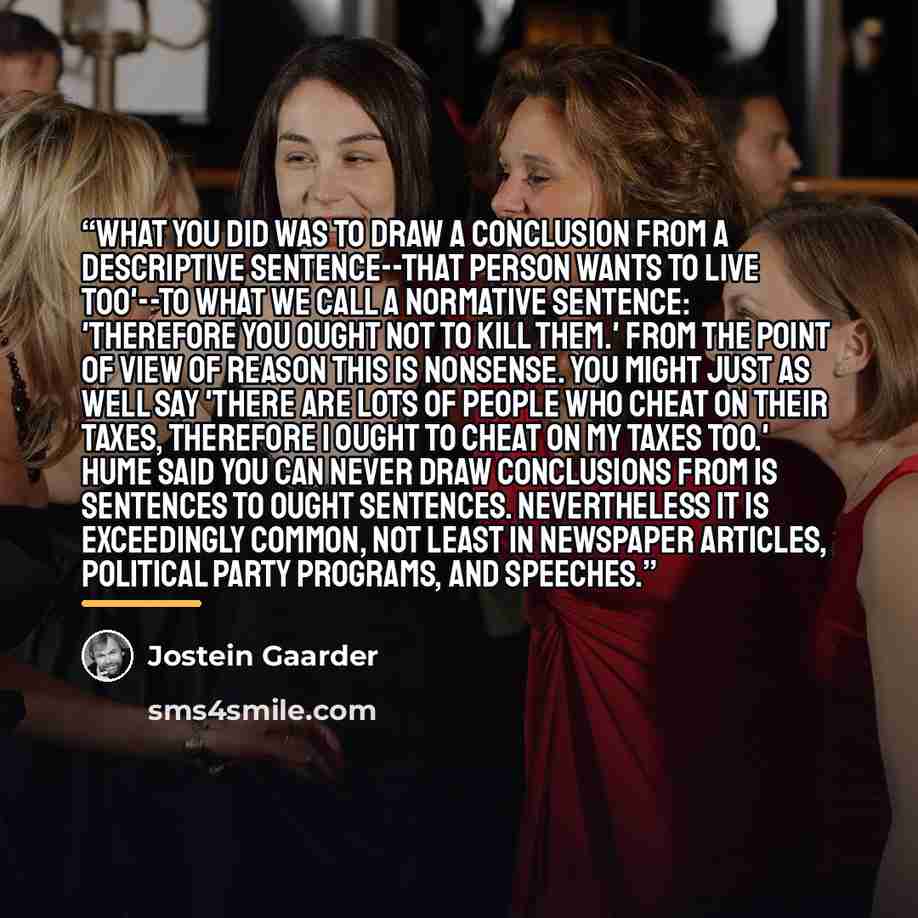
““What you did was to draw a conclusion from a descriptive sentence--That person wants to live too'--to what we call a normative sentence: 'Therefore you ought not to kill them.' From the point of view of reason this is nonsense. You might just as well say 'There are lots of people who cheat on their taxes, therefore I ought to cheat on my taxes too.' Hume said you can never draw conclusions from is sentences to ought sentences. Nevertheless it is exceedingly common, not least in newspaper articles, political party programs, and speeches.””
About This Quote
The passage explains the logical fallacy of deriving an "ought" from an "is," arguing that factual statements cannot directly dictate moral prescriptions without additional reasoning.
In simple terms: You can't base moral rules solely on facts.
Key Takeaway
Separate descriptive facts from normative judgments.
Themes
philosophy
logic
ethics
Mood
inquisitive
critical
skeptical
Type
philosophical
educational
When to use this quote
- legal reasoning
- public policy
- media commentary
- academic debate
Key Concepts
is‑ought problem
Hume's law
Questions to Reflect On
- What extra premises are needed to move from fact to duty?
- Can any factual claim ever justify a moral rule?
A Different Perspective
Moral conclusions often need extra premises beyond facts.









![“[The Dalai Lama] told me some years ago, "I've made every concession to China, and I've been as open and tolerant as I could, and still things get worse in Tibet." If you look at it from one point of view, as he himself says, his monastic position of forbearance and nonviolence hasn't reaped any…” quote by Pico Iyer](https://sms4smile.com/quotes/img-quotes/9fe/pico-iyer-1252_benefits_the-dalai-lama-told-me-some-years-ago-i_678.jpg)