Hermeneutics Quote by Jonathan Rosen
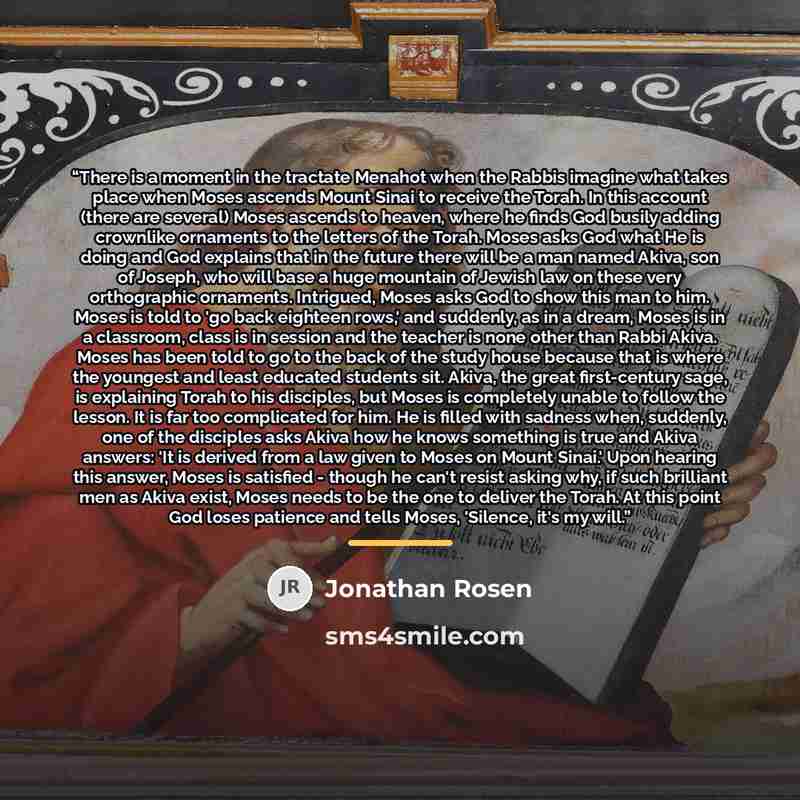
““There is a moment in the tractate Menahot when the Rabbis imagine what takes place when Moses ascends Mount Sinai to receive the Torah. In this account (there are several) Moses ascends to heaven, where he finds God busily adding crownlike ornaments to the letters of the Torah. Moses asks God what He is doing and God explains that in the future there will be a man named Akiva, son of Joseph, who will base a huge mountain of Jewish law on these very orthographic ornaments. Intrigued, Moses asks God to show this man to him. Moses is told to 'go back eighteen rows,' and suddenly, as in a dream, Moses is in a classroom, class is in session and the teacher is none other than Rabbi Akiva. Moses has been told to go to the back of the study house because that is where the youngest and least educated students sit. Akiva, the great first-century sage, is explaining Torah to his disciples, but Moses is completely unable to follow the lesson. It is far too complicated for him. He is filled with sadness when, suddenly, one of the disciples asks Akiva how he knows something is true and Akiva answers: 'It is derived from a law given to Moses on Mount Sinai.' Upon hearing this answer, Moses is satisfied - though he can't resist asking why, if such brilliant men as Akiva exist, Moses needs to be the one to deliver the Torah. At this point God loses patience and tells Moses, 'Silence, it's my will.””
About This Quote
Source Talmud: Menahot (Tractate) by Jewish sages, c. 3rd century CE
Moses witnesses divine embellishment of Torah letters, foreseeing Rabbi Akiva’s massive legal system, yet feels inadequate compared to later scholars, highlighting the evolving depth of interpretation over time.
In simple terms: Moses sees God adding ornaments to Torah letters, foresees Akiva’s huge legal mountain, feels his own teachings are insufficient.
Key Takeaway
Recognize that each generation builds on previous insight.
Themes
tradition
interpretation
humility
Mood
reverent
inquisitive
Type
historical
theological
educational
When to use this quote
- religious study
- teacher‑student dynamics
- spiritual revelation
- historical continuity
Key Concepts
Jewish mysticism
legal exegesis
Questions to Reflect On
- How do we honor past teachings while embracing new understandings?
- What role does humility play in scholarly growth?
A Different Perspective
Moses’ frustration shows that even foundational figures may feel eclipsed by later scholars.