Goals Quote by John R.W. Stott
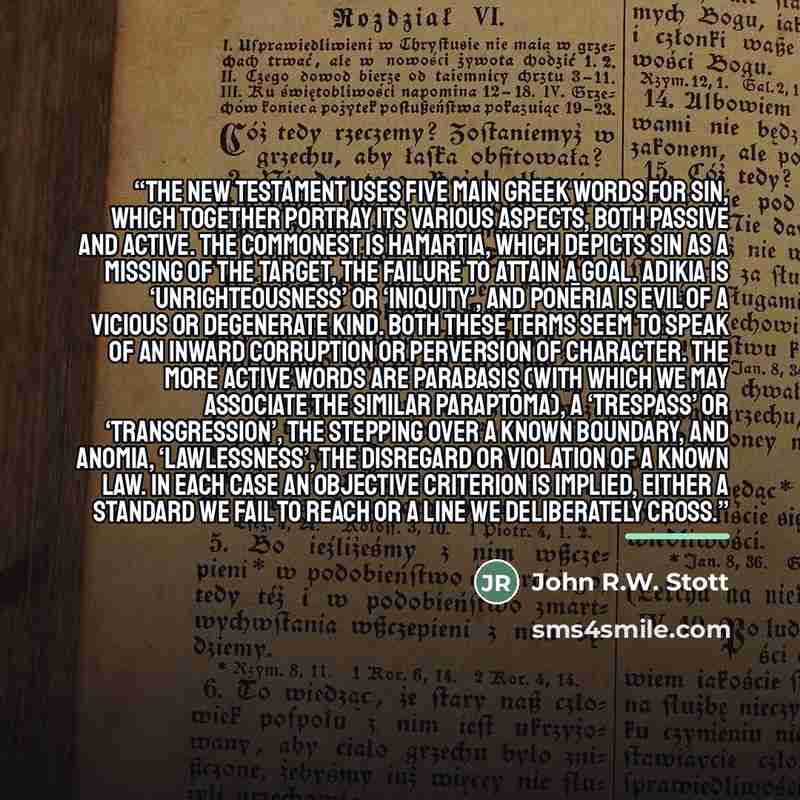
““The New Testament uses five main Greek words for sin, which together portray its various aspects, both passive and active. The commonest is hamartia, which depicts sin as a missing of the target, the failure to attain a goal. Adikia is ‘unrighteousness’ or ‘iniquity’, and ponēria is evil of a vicious or degenerate kind. Both these terms seem to speak of an inward corruption or perversion of character. The more active words are parabasis (with which we may associate the similar paraptōma), a ‘trespass’ or ‘transgression’, the stepping over a known boundary, and anomia, ‘lawlessness’, the disregard or violation of a known law. In each case an objective criterion is implied, either a standard we fail to reach or a line we deliberately cross.””
About This Quote
The passage explains that the New Testament distinguishes several Greek terms for sin, each highlighting a different facet—missed targets, moral corruption, and deliberate violations of known standards.
In simple terms: Greek sin terms show varied dimensions of wrongdoing.
Key Takeaway
Sin is both missing the mark and breaking rules.
Themes
theology
language
ethics
biblical studies
semantics
Mood
thoughtful
analytical
inquisitive
Type
expository
interpretive
scholarly
When to use this quote
- preaching
- academic study
- personal reflection
- interfaith dialogue
- ethical counseling
Key Concepts
hamartia
adikia
poneria
parabasis
anomia
Practical Applications
- teaching biblical ethics
- informing theological research
Questions to Reflect On
- How do these distinctions affect moral responsibility?
- What implications do they have for modern ethical frameworks?