Storytelling Quote by John Gardner
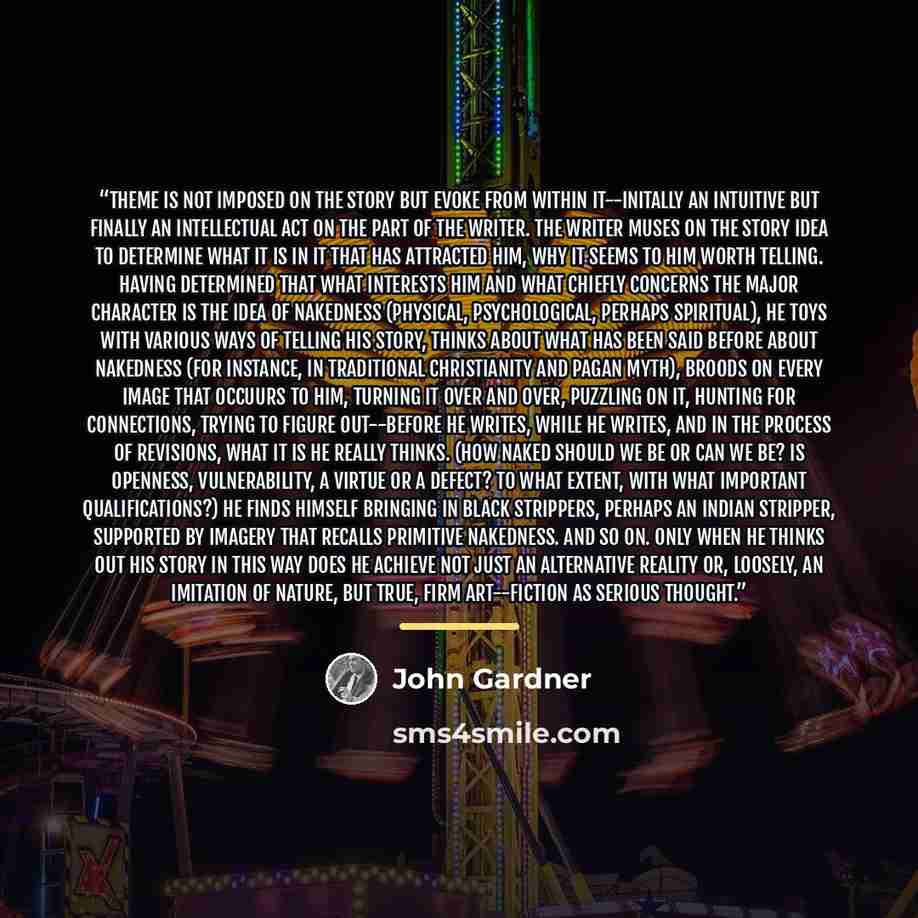
““Theme is not imposed on the story but evoke from within it--initally an intuitive but finally an intellectual act on the part of the writer. The writer muses on the story idea to determine what it is in it that has attracted him, why it seems to him worth telling. Having determined that what interests him and what chiefly concerns the major character is the idea of nakedness (physical, psychological, perhaps spiritual), he toys with various ways of telling his story, thinks about what has been said before about nakedness (for instance, in traditional Christianity and pagan myth), broods on every image that occuurs to him, turning it over and over, puzzling on it, hunting for connections, trying to figure out--before he writes, while he writes, and in the process of revisions, what it is he really thinks. (How naked should we be or can we be? Is openness, vulnerability, a virtue or a defect? To what extent, with what important qualifications?) He finds himself bringing in black strippers, perhaps an Indian stripper, supported by imagery that recalls primitive nakedness. And so on. Only when he thinks out his story in this way does he achieve not just an alternative reality or, loosely, an imitation of nature, but true, firm art--fiction as serious thought.””
About This Quote
Source Essay: The Art of Fiction, John Gardner, 1975
A writer must discover themes from within the story, exploring ideas like nakedness through intuition and intellect, to create authentic art.
In simple terms: Themes emerge from the story itself, not imposed.
Key Takeaway
Explore the story’s core ideas before writing.
Themes
creativity
introspection
theme development
fiction writing
Mood
reflective
inquisitive
Type
literary
creative
When to use this quote
- novel writing
- screenwriting
- creative workshops
Key Concepts
intuition
intellectual analysis
vulnerability
Questions to Reflect On
- How does personal vulnerability affect your storytelling?
- What balance between intuition and analysis works for you?
A Different Perspective
The process may be too introspective for writers needing external inspiration.