Bubbles Quote by John D. Barrow
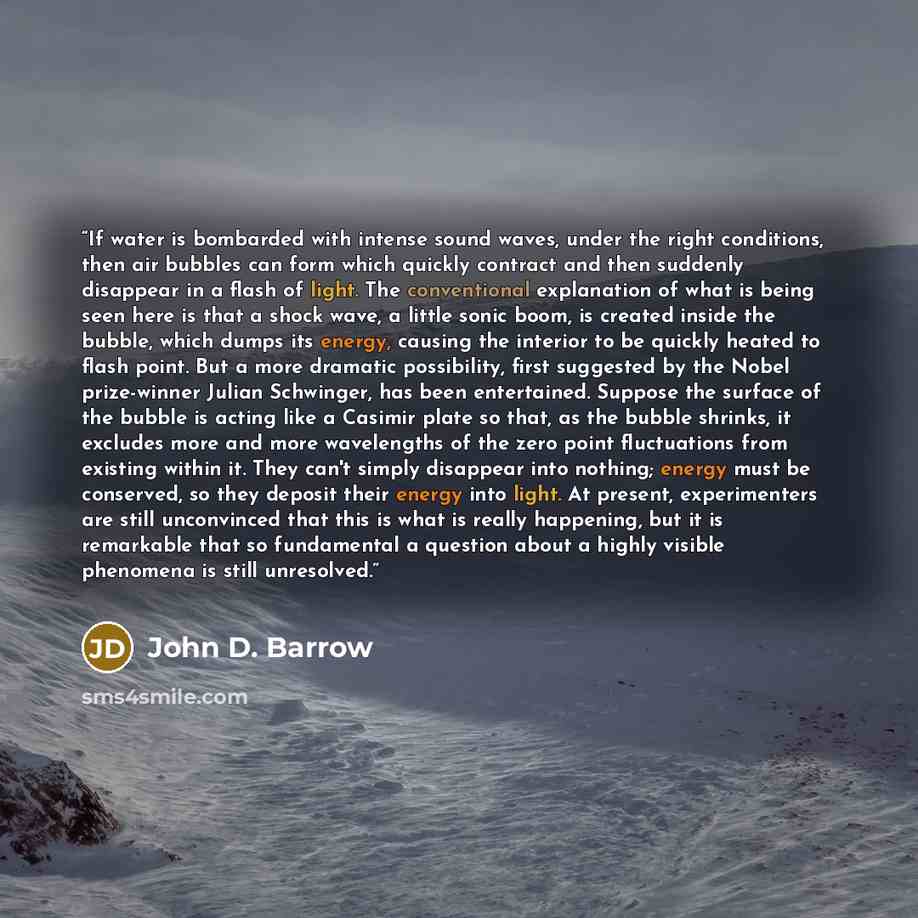
““If water is bombarded with intense sound waves, under the right conditions, then air bubbles can form which quickly contract and then suddenly disappear in a flash of light. The conventional explanation of what is being seen here is that a shock wave, a little sonic boom, is created inside the bubble, which dumps its energy, causing the interior to be quickly heated to flash point. But a more dramatic possibility, first suggested by the Nobel prize-winner Julian Schwinger, has been entertained. Suppose the surface of the bubble is acting like a Casimir plate so that, as the bubble shrinks, it excludes more and more wavelengths of the zero point fluctuations from existing within it. They can't simply disappear into nothing; energy must be conserved, so they deposit their energy into light. At present, experimenters are still unconvinced that this is what is really happening, but it is remarkable that so fundamental a question about a highly visible phenomena is still unresolved.””
About This Quote
Source Speech: Public lecture on sonoluminescence, 1995
The quote describes competing explanations for light emission from collapsing bubbles, highlighting a speculative quantum vacuum (Casimir) mechanism versus a conventional shock‑wave heating model, and notes ongoing scientific debate.
In simple terms: Two ideas explain bubble light: shock heating or quantum vacuum energy release.
Key Takeaway
Consider both classical and quantum explanations.
Themes
science
physics
sonoluminescence
quantum theory
Mood
curious
analytical
skeptical
Type
explanatory
speculative
When to use this quote
- laboratory research
- acoustic experiments
- theoretical modeling
- peer review
Key Concepts
Casimir effect
zero‑point energy
shock wave
energy conversion
Questions to Reflect On
- What evidence would confirm a quantum vacuum contribution?
- How can experiments distinguish between heating and Casimir effects?
A Different Perspective
The Casimir hypothesis is difficult to test experimentally, and alternative mechanisms may dominate.