Art Quote by Jewel Spears Brooker
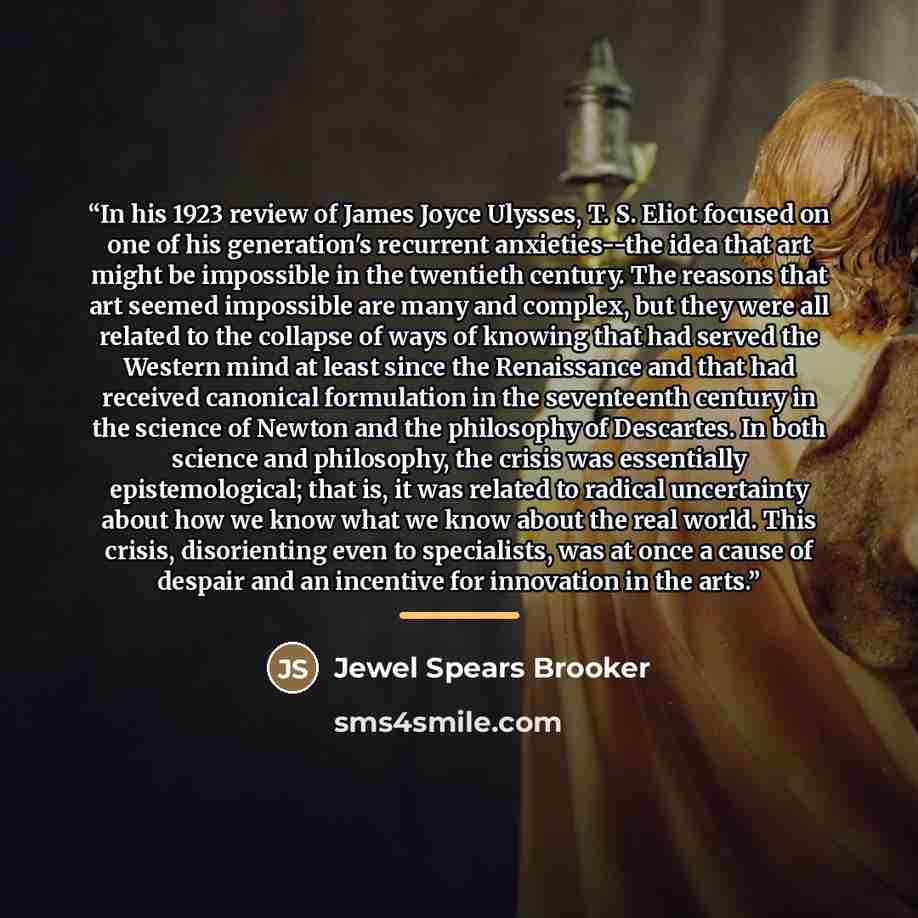
““In his 1923 review of James Joyce Ulysses, T. S. Eliot focused on one of his generation's recurrent anxieties--the idea that art might be impossible in the twentieth century. The reasons that art seemed impossible are many and complex, but they were all related to the collapse of ways of knowing that had served the Western mind at least since the Renaissance and that had received canonical formulation in the seventeenth century in the science of Newton and the philosophy of Descartes. In both science and philosophy, the crisis was essentially epistemological; that is, it was related to radical uncertainty about how we know what we know about the real world. This crisis, disorienting even to specialists, was at once a cause of despair and an incentive for innovation in the arts.””
About This Quote
Source Essay: Review of James Joyce Ulysses, 1923, by T. S. Eliot (cited by Jewel Spears Brooker)
The modernist crisis questioned whether art could exist amid collapsing epistemic foundations, leading both to despair and creative innovation.
In simple terms: Modernism doubted art’s relevance, sparking both gloom and new ideas.
Key Takeaway
Embrace uncertainty as a catalyst for artistic experimentation.
Themes
modernism
epistemology
artistic innovation
crisis
despair
creativity
Mood
reflective
inquisitive
hopeful
Type
critical
inspirational
When to use this quote
- academic research
- creative writing
- visual arts
- musical composition
- philosophical debate
Key Concepts
Newtonian physics
Cartesian philosophy
epistemic collapse
modernist literature
Questions to Reflect On
- How can uncertainty fuel your creative process?
- What new forms might emerge from current epistemic challenges?
A Different Perspective
The view may overstate the uniformity of the crisis across all artistic fields.