Quote by James John Courtenay Download Open image ““The home of the historic Semites was Arabia.”” — James John Courtenay ★ ★ ★ ★ ★ 3.0 out of 5 (8 ratings) Copy quoteShare
“The Semite had avenged himself for the conquest of his country by the northern mountaineers centuries before. They no longer formed a barrier which… — A. H. SAYCE Copy Share Image
“There is no clear connexion between Arabia and the primitive Semitic element in Babylonia.” — James John Courtenay Copy Share Image
“All the great Semitic migrations had their starting-place in Arabia.” — James John Courtenay Copy Share Image
“The Hebrew tribes no doubt moved out of Arabia with some of the earlier migrations from the great Semitic reservoir.” — James John Courtenay Copy Share Image
“All Semitic languages are perhaps ultimately traceable to Arabia.” — James John Courtenay Copy Share Image
“The great Hittite stronghold on the Euphrates, which had been for so many centuries the visible sign of their power and southern conquests, became once more the possession of a Semitic people. The long struggle that had been carried on between the Hittites and the Semites was at an end; the Semite had triumphed, and the Hittite was driven back… — A. H. SAYCE Copy Share
“A new voice haild me of an old friend when, first returned from the Peninsula, I paced again in that long street of Damascus which is called Straight; and suddenly taking me wondering by the hand, 'Tell me (said he), since thou art here again in the peace and assurance of Ullah, and whilst we walk, as in the former… — Charles Montagu Doughty Copy Share
“A few found a haven beyond the borders of the great empires in the harsh desert of the Arabian Peninsula.” — Phyllis Goldstein Copy Share Image
“Laban spoke the language which came with that great Semitic migration from Arabia.” — James John Courtenay Copy Share Image
“On their invasion of Babylonia the Semites fell absolutely under Sumerian influence, and, although they eventually conquered and absorbed the Sumerians, their civilization remained… — Leonard William King Copy Share Image
“The Arabic language has had a great history, and in many respects is more remarkable than any other Semitic speech.” — James John Courtenay Copy Share Image
“There was probably a larger admixture of Greek in Galilee than in any other Palestinian province.” — James John Courtenay Copy Share Image
“The Samaritans were conservative in the matter of script, preserving the Phoenician type after Judaea and Galilee had accepted the Aramaic character.” — James John Courtenay Copy Share Image
“There is some evidence that the Canaanites lived together with the Babylonians for a longer period than did the Aramaeans ... It is found… — James John Courtenay Copy Share Image
“In its classical form Arabic is of later date than Hebrew, but in its ancient form akin to Hebrew and Aramaic, certainly as old,… — James John Courtenay Copy Share Image
“It is doubtful whether the vernacular of Palestine admitted any Greek element prior to the Christian era. Even in the Greek form of the… — James John Courtenay Copy Share Image
“When Aramaeans became Christians, their name was often confounded with 'heathen', hence they called their land by the Greek name 'Syria', themselves by the… — James John Courtenay Copy Share Image
“The books of the Old Testament, as we know them, do not represent the language of Palestine as spoken at any one time or… — James John Courtenay Copy Share Image
“Mandaean ... letter-forms resemble the older Syriac ... Estrangelo character ... considerably coloured by Arabic ... likeness to Nabataean and the Babylonian Talmud.” — James John Courtenay Copy Share Image
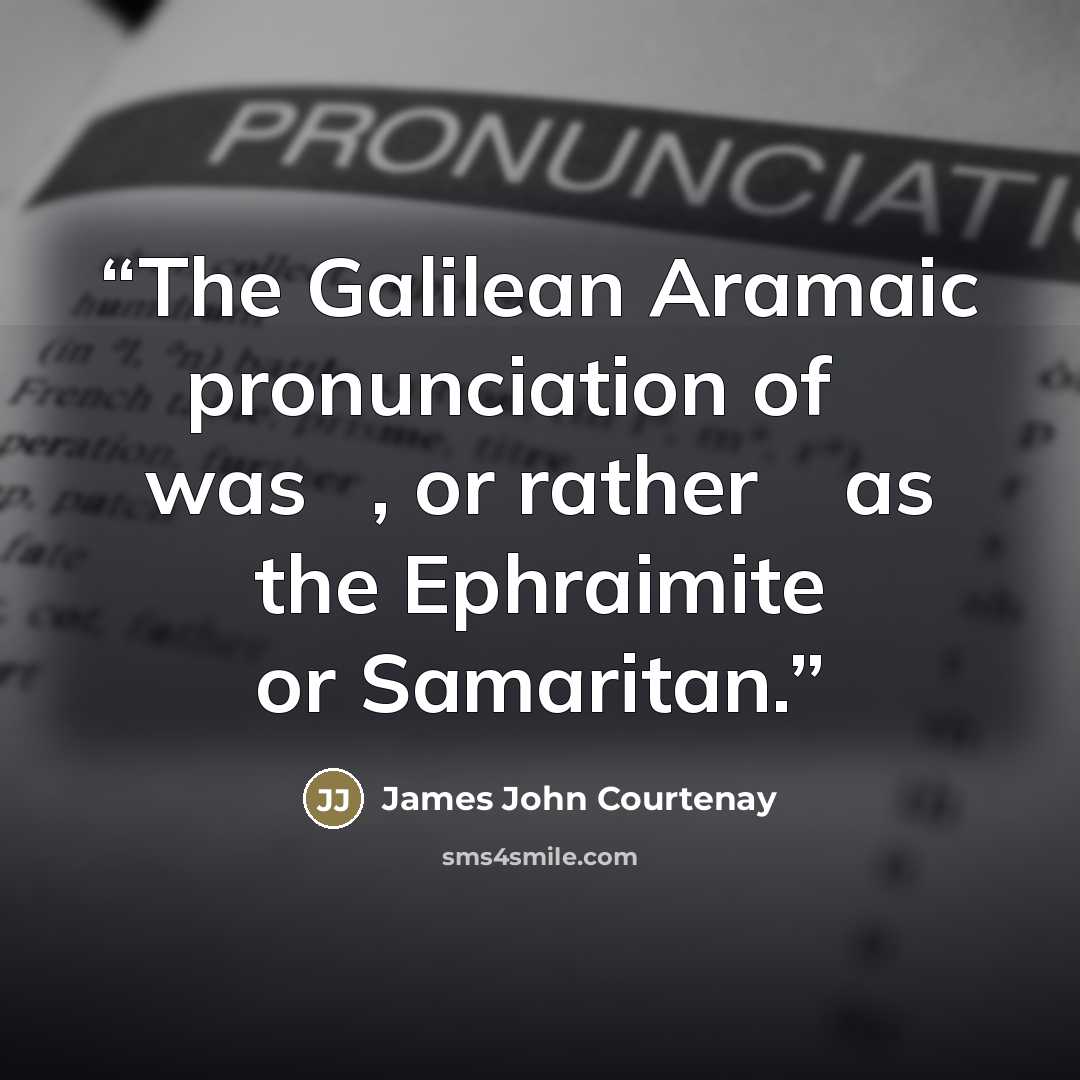
“The Galilean Aramaic pronunciation of שׁ was שׂ, or rather ס as the Ephraimite or Samaritan.” — James John Courtenay Copy Share Image
“With the progress of the Greek arms cam the decline of the Greek language.” — James John Courtenay Copy Share Image