Freedom Quote by Immanuel Kant
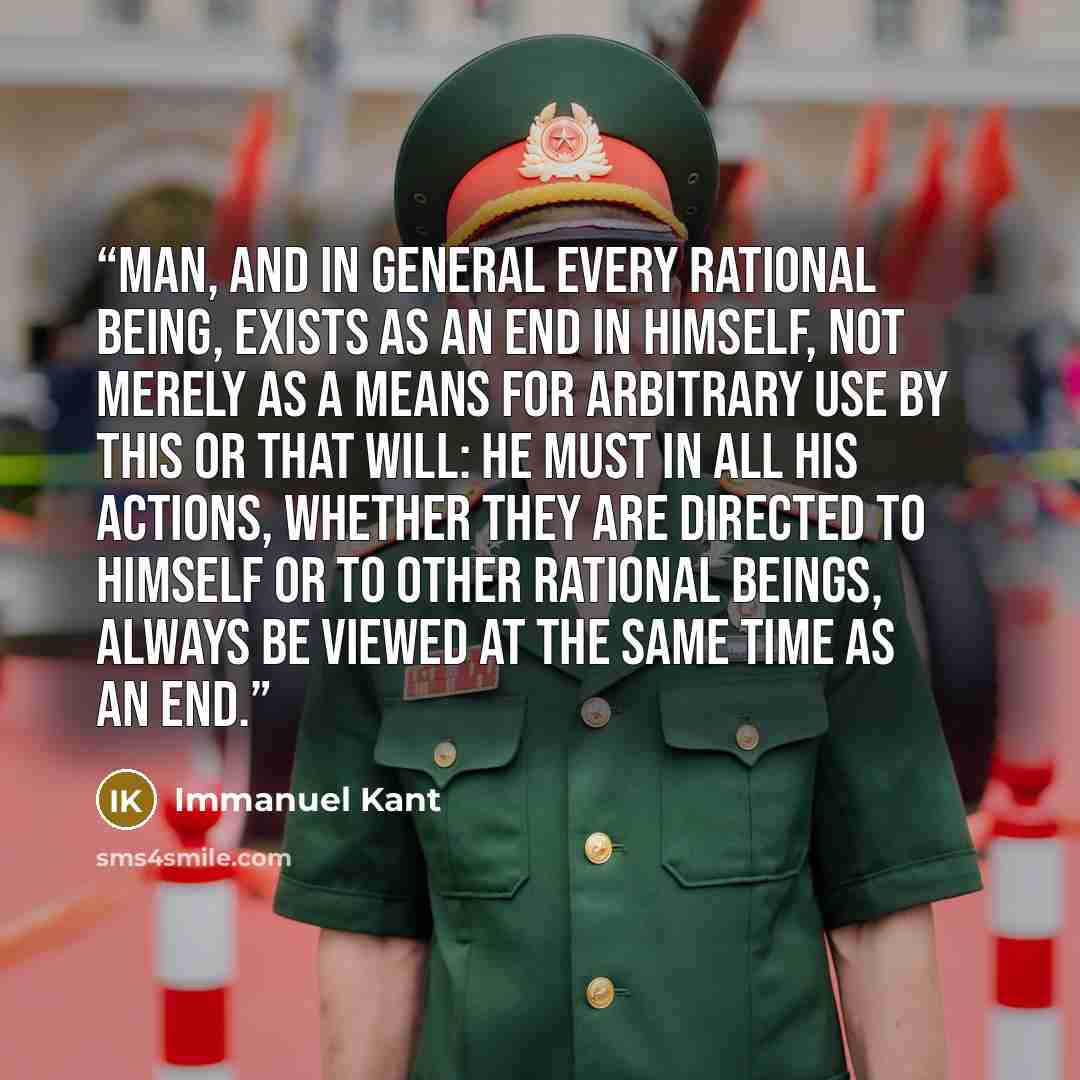
![“...[M]an and generally any rational being exists as an end in himself, not merely as a means to be arbitrarily used by this or that will, but in all his actions, whether they concern himself or other rational beings, must always be regarded at the same time as an end... [R]ational beings... are…” quote by Immanuel Kant](https://sms4smile.com/quotes/img-quotes/5ff/immanuel-kant-532_freedom_m-an-and-generally-any-rational-being-ex_892667.jpg)
““...[M]an and generally any rational being exists as an end in himself, not merely as a means to be arbitrarily used by this or that will, but in all his actions, whether they concern himself or other rational beings, must always be regarded at the same time as an end... [R]ational beings... are called persons, because their very nature points them out as ends in themselves, that is, as something which must not be used merely as means, and so far therefore restricts freedom of action (and is an object of respect).””
About This Quote
Source Philosophy: Groundwork of the Metaphysics of Morals, 1785
Human beings must be treated as ends in themselves, never merely as tools for others' purposes, which imposes moral limits on how we act toward them.
In simple terms: People are ends, not means.
Key Takeaway
Respect others’ inherent dignity.
Themes
ethics
human dignity
respect
Mood
thoughtful
serious
Type
ethical
philosophical
When to use this quote
- making decisions
- conflict resolution
- leadership
- lawmaking
Key Concepts
Kantianism
categorical imperative
autonomy
Questions to Reflect On
- How do you ensure you treat others as ends?
- When might respecting autonomy clash with collective welfare?
A Different Perspective
May conflict with utilitarian goals that prioritize outcomes over individual rights.
![“...[F]reedom... is a property of all rational beings.” quote by Immanuel Kant](https://sms4smile.com/quotes/img-quotes/267/immanuel-kant-532_equality_f-reedom-is-a-property-of-all-rational-b_3178868.jpg)


![“It [bourgeoisie] has resolved personal worth into exchange value, and in place of the numberless indefeasible chartered freedoms, has set up that single, unconscionable freedom – Free Trade.” quote by Karl Marx](https://sms4smile.com/quotes/img-quotes/4c0/karl-marx-399_bourgeoisie_it-bourgeoisie-has-resolved-personal-wor_617408.jpg)