Fallibility Quote by Immanuel Kant
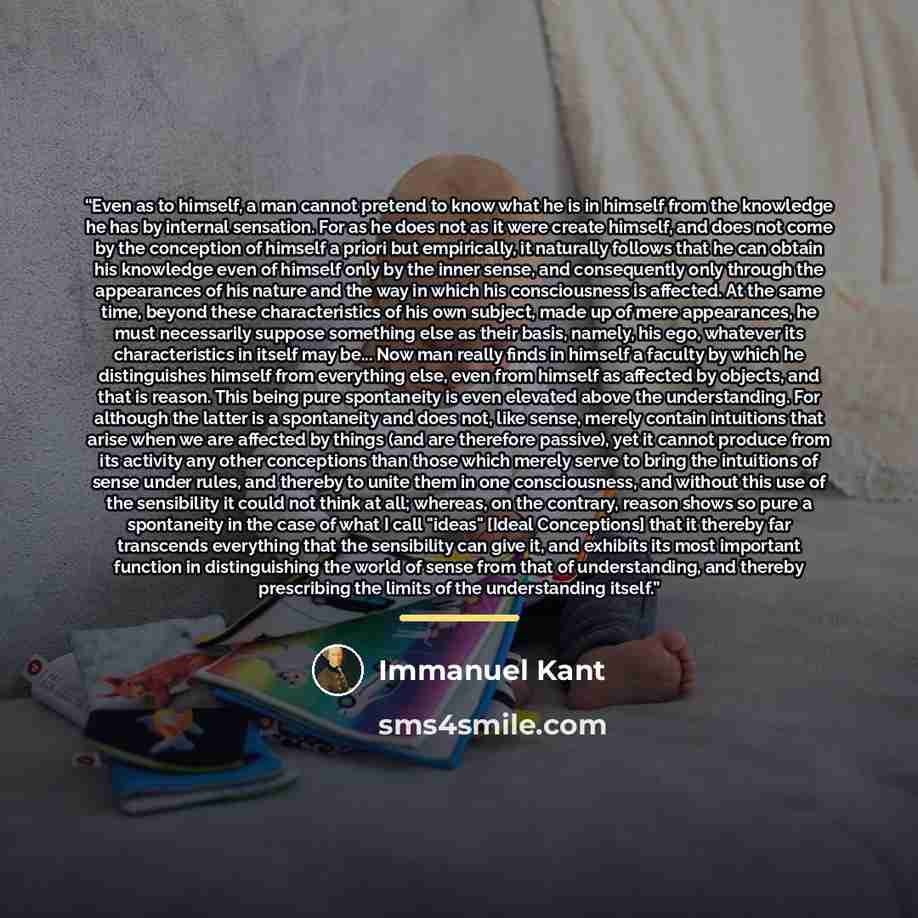
““Even as to himself, a man cannot pretend to know what he is in himself from the knowledge he has by internal sensation. For as he does not as it were create himself, and does not come by the conception of himself a priori but empirically, it naturally follows that he can obtain his knowledge even of himself only by the inner sense, and consequently only through the appearances of his nature and the way in which his consciousness is affected. At the same time, beyond these characteristics of his own subject, made up of mere appearances, he must necessarily suppose something else as their basis, namely, his ego, whatever its characteristics in itself may be... Now man really finds in himself a faculty by which he distinguishes himself from everything else, even from himself as affected by objects, and that is reason. This being pure spontaneity is even elevated above the understanding. For although the latter is a spontaneity and does not, like sense, merely contain intuitions that arise when we are affected by things (and are therefore passive), yet it cannot produce from its activity any other conceptions than those which merely serve to bring the intuitions of sense under rules, and thereby to unite them in one consciousness, and without this use of the sensibility it could not think at all; whereas, on the contrary, reason shows so pure a spontaneity in the case of what I call "ideas" [Ideal Conceptions] that it thereby far transcends everything that the sensibility can give it, and exhibits its most important function in distinguishing the world of sense from that of understanding, and thereby prescribing the limits of the understanding itself.””
About This Quote
Source Book: Critique of Pure Reason, 1781
Kant argues that self‑knowledge arises from inner sense and reason, not from innate concepts; reason distinguishes mind from objects and sets limits on understanding.
In simple terms: We know ourselves through inner experience and rational thought, not innate ideas.
Key Takeaway
Use inner reflection and rational analysis to understand yourself.
Themes
self‑knowledge
reason
consciousness
limits of understanding
Mood
contemplative
analytical
introspective
Type
philosophical
educational
reflective
When to use this quote
- personal introspection
- philosophical study
- psychology
- education
- spiritual practice
Key Concepts
phenomenology
transcendental idealism
inner sense
ideas
Questions to Reflect On
- How does inner sense differ from external perception?
- What role does reason play in shaping self‑identity?
A Different Perspective
Reason alone cannot fully capture the unconscious aspects of the self.






![“Crucial decisions are made, today as thousands of years ago, in terms of the intuitive guesses and preferences of a few men in positions of authority...[it is] quite likely that the fate of entire societies may be sealed by a series of avoidable mistakes committed by their leaders.” quote by Michael Lewis](https://sms4smile.com/quotes/img-quotes/a59/michael-lewis-705_decision-making_crucial-decisions-are-made-today-as-thou_16888.jpg)

![“The trait [Morey] looked for was awareness that they were seeking answers to questions with no certain answers--that they were inherently fallible. "I always ask them, 'Who did you miss?'" he said. Which future superstar had they written off, or which future bust had they fallen in love with? "If…” quote by Michael Lewis](https://sms4smile.com/quotes/img-quotes/9e0/michael-lewis-705_fallibility_the-trait-morey-looked-for-was-awareness_146196.jpg)