Cases Quote by Henry Clay
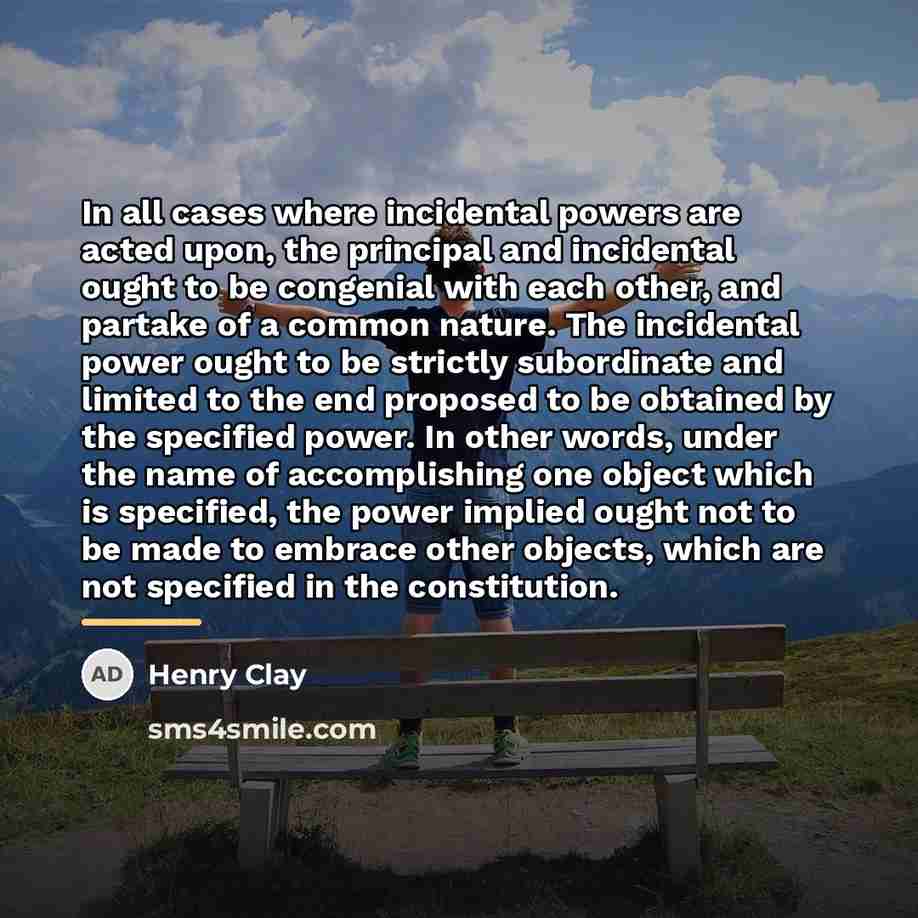
“In all cases where incidental powers are acted upon, the principal and incidental ought to be congenial with each other, and partake of a common nature. The incidental power ought to be strictly subordinate and limited to the end proposed to be obtained by the specified power. In other words, under the name of accomplishing one object which is specified, the power implied ought not to be made to embrace other objects, which are not specified in the constitution.”
About This Quote
Source Treat: The American Constitution, 1824
Incidental powers must align with and be limited by the primary authority, avoiding overreach beyond the intended purpose.
In simple terms: Secondary powers should stay within the main goal.
Key Takeaway
Keep auxiliary powers narrowly focused.
Themes
law
government
authority
limits
Mood
cautious
analytical
Type
legal
political
When to use this quote
- legislative drafting
- policy implementation
- judicial review
- executive action
Key Concepts
constitutional law
separation of powers
Questions to Reflect On
- How do we ensure incidental powers remain truly subordinate?
- What safeguards prevent mission creep?
A Different Perspective
If incidental powers are too broadly defined, they can erode intended limits.



![“Creating senates, the French critics said, implied that there was another social order besides the people represented in the houses of representatives. [John] Adams actually agreed with that implication and argued that the aristocracy and the people had to have separate houses; this was the only…” quote by Gordon S. Wood](https://sms4smile.com/quotes/img-quotes/9a7/gordon-s-wood-13199_aristocracy_creating-senates-the-french-critics-said_349374.jpg)


















![“[As in the case of] alcohol prohibition, illegality has driven organized crime, sent countless people to jail, and killed many thousands. Repression does not work.” quote by Sam Branson](https://sms4smile.com/quotes/img-quotes/212/sam-branson-36458_alcohol_as-in-the-case-of-alcohol-prohibition-il_8703.jpg)