Poverty Quote by Guy Standing
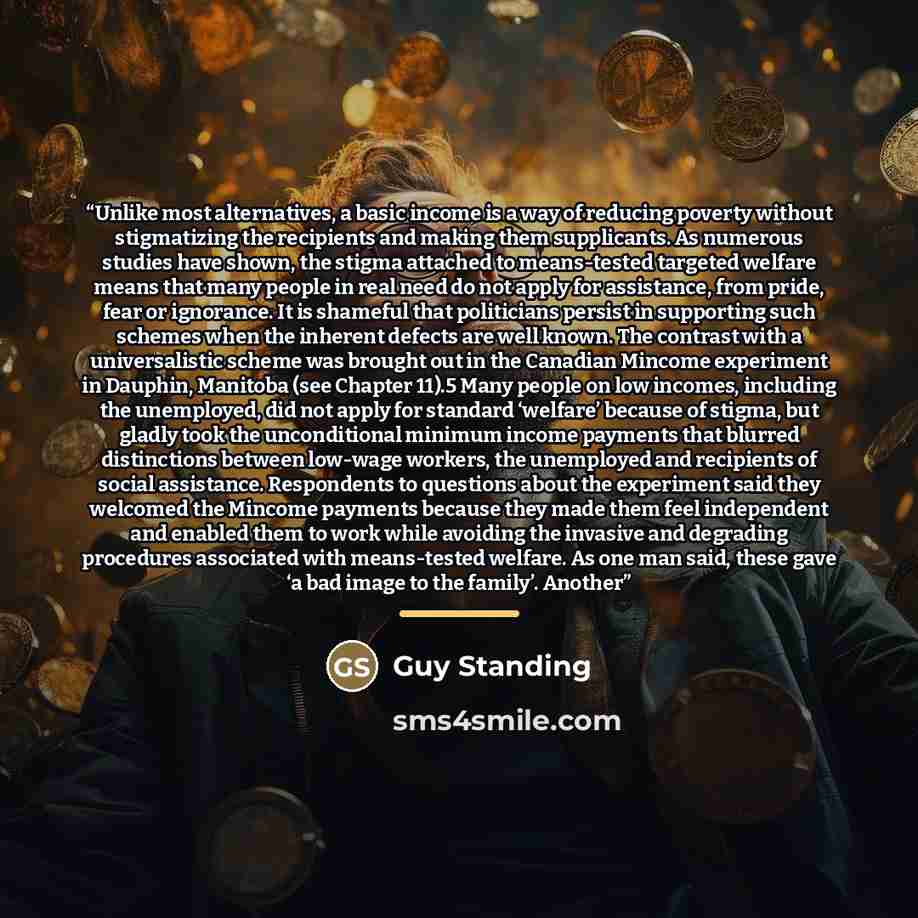
““Unlike most alternatives, a basic income is a way of reducing poverty without stigmatizing the recipients and making them supplicants. As numerous studies have shown, the stigma attached to means-tested targeted welfare means that many people in real need do not apply for assistance, from pride, fear or ignorance. It is shameful that politicians persist in supporting such schemes when the inherent defects are well known. The contrast with a universalistic scheme was brought out in the Canadian Mincome experiment in Dauphin, Manitoba (see Chapter 11).5 Many people on low incomes, including the unemployed, did not apply for standard ‘welfare’ because of stigma, but gladly took the unconditional minimum income payments that blurred distinctions between low-wage workers, the unemployed and recipients of social assistance. Respondents to questions about the experiment said they welcomed the Mincome payments because they made them feel independent and enabled them to work while avoiding the invasive and degrading procedures associated with means-tested welfare. As one man said, these gave ‘a bad image to the family’. Another””
About This Quote
Source Book: Basic Income: A Radical Proposal for a Free Society, Guy Standing, 2017
Universal basic income reduces poverty without shame by providing unconditional support, unlike means‑tested welfare that deters needy people.
In simple terms: UBI offers stigma‑free aid.
Key Takeaway
Support unconditional aid.
Themes
poverty
stigma
social policy
economics
Mood
critical
analytical
Type
policy
economic
When to use this quote
- policy design
- social programs
- public opinion
- political advocacy
Key Concepts
universal basic income
welfare reform
Questions to Reflect On
- What are the main obstacles to UBI?
- How can stigma be reduced in welfare?
A Different Perspective
UBI may be costly and politically contentious.