Freedom Quote by Guy Standing

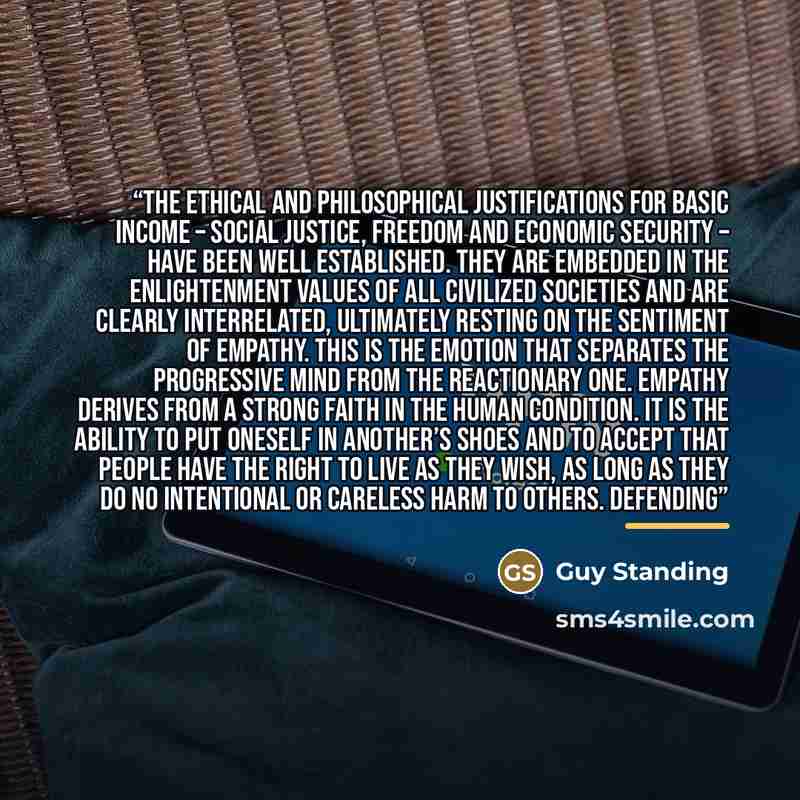
““The ‘republican’ variant is that freedom must mean non-domination. Stemming from Aristotle, republican freedom requires freedom from potential domination as well as from actual domination by figures, institutions or processes of unaccountable domination.12 In other words, to the extent that authority figures or institutions could, if they wished, ‘arbitrarily interfere’ with a person’s ability to act or think (or develop), republican freedom is compromised.13 This view is linked to the argument, derived in part from the philosophy of Jean-Jacques Rousseau, that the very existence of property can destroy or compromise such freedom. After all, if a few families own all the land, to talk of everyone having freedom would be absurd. Robust republican freedom could be said to exist if everyone in society could avoid or escape from unwanted interference, and also from the rational fear of it. To be free, a person must be free of the will of others. If I fear rationally and reasonably that, were I to offend someone, my freedom would be lost, I am not free. By contrast with libertarianism, which sees all government as compromising freedom, republican freedom requires and depends on government. But it must be government that is democratically accountable and geared to the promotion of full freedom, defined primarily as the ability of the most vulnerable in society to avoid domination. Republican freedom also requires government to ensure that the choices of the powerful cannot block others from making choices themselves. If””
About This Quote
Source Book: The Precariat: The New Dangerous Class, Guy Standing, 2011
Republican freedom means being free from domination, both actual and potential, requiring accountable government that protects the vulnerable from arbitrary interference.
In simple terms: Freedom from domination, not just interference.
Key Takeaway
Ensure democratic institutions prevent arbitrary power over individuals.
Themes
political theory
freedom
government
domination
equality
Mood
critical
reflective
Type
philosophical
political
When to use this quote
- policy design
- civil rights advocacy
- community organizing
- legal reform
- public administration
Key Concepts
republicanism
social justice
democratic accountability
Questions to Reflect On
- How can societies balance necessary authority with protection from domination?
- What mechanisms best prevent the powerful from blocking others' choices?
A Different Perspective
Republican freedom still depends on power structures that may become oppressive if not carefully checked.
![“The thirst after happiness is never extinguished in the heart of [woman]. —JEAN-JACQUES ROUSSEAU” quote by Sarah Ban Breathnach](https://sms4smile.com/quotes/img-quotes/829/sarah-ban-breathnach-833_happiness_the-thirst-after-happiness-is-never-exti_69822.jpg)