Books Quote by Gunter Grass
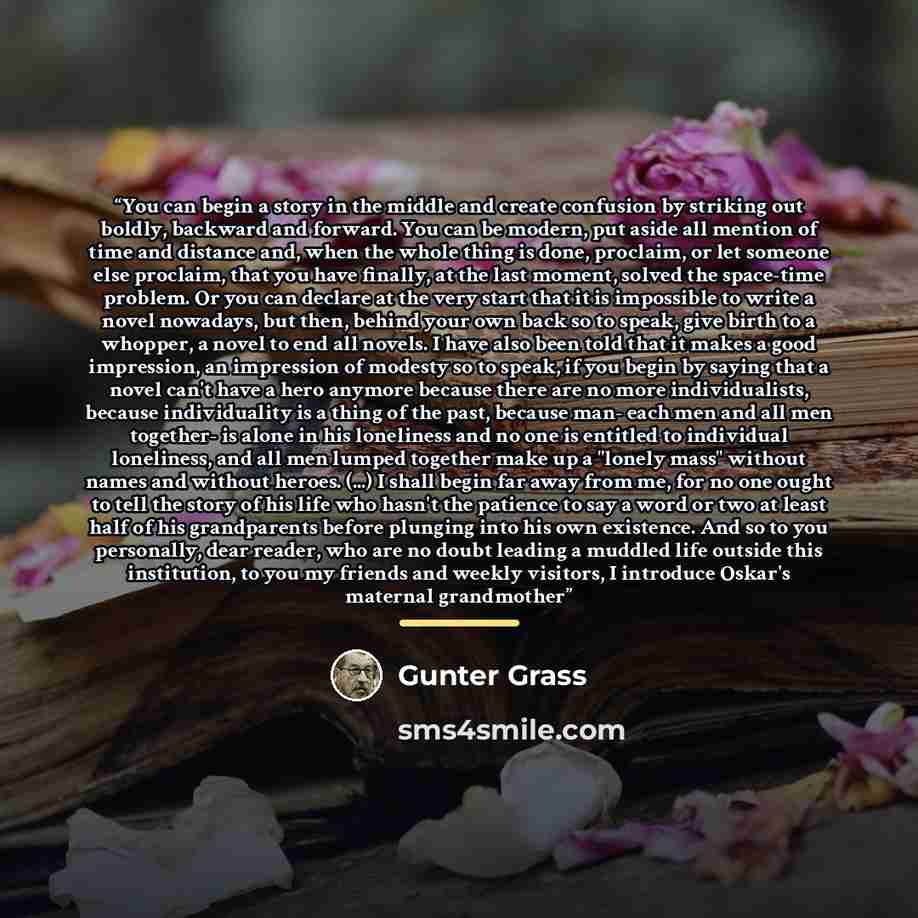
““You can begin a story in the middle and create confusion by striking out boldly, backward and forward. You can be modern, put aside all mention of time and distance and, when the whole thing is done, proclaim, or let someone else proclaim, that you have finally, at the last moment, solved the space-time problem. Or you can declare at the very start that it is impossible to write a novel nowadays, but then, behind your own back so to speak, give birth to a whopper, a novel to end all novels. I have also been told that it makes a good impression, an impression of modesty so to speak, if you begin by saying that a novel can't have a hero anymore because there are no more individualists, because individuality is a thing of the past, because man- each men and all men together- is alone in his loneliness and no one is entitled to individual loneliness, and all men lumped together make up a "lonely mass" without names and without heroes. (...) I shall begin far away from me, for no one ought to tell the story of his life who hasn't the patience to say a word or two at least half of his grandparents before plunging into his own existence. And so to you personally, dear reader, who are no doubt leading a muddled life outside this institution, to you my friends and weekly visitors, I introduce Oskar's maternal grandmother””
About This Quote
Source Novel: The Tin Drum, Günter Grass, 1959
The passage critiques conventional storytelling, urging experimental forms that defy linear time and heroic norms, while reflecting on modern alienation and the difficulty of authentic self‑representation.
In simple terms: Storytelling can break rules, but modern life feels lonely and hero‑less.
Key Takeaway
Embrace experimental narratives to confront alienation.
Themes
experimental storytelling
modern alienation
heroic absence
literary critique
self‑representation
Mood
reflective
critical
introspective
Type
literary
philosophical
experimental
When to use this quote
- writing workshops
- literature courses
- creative retreats
- personal memoirs
- philosophical essays
Key Concepts
postmodernism
narrative fragmentation
existential loneliness
identity crisis
Questions to Reflect On
- How can narrative chaos reveal deeper truths?
- Can a story without a hero still inspire?
A Different Perspective
Experimental forms may alienate readers accustomed to clear plots and heroes.









![“[To be an artist,] this desire to conquer all with images.” quote by Gunter Grass](https://sms4smile.com/quotes/img-quotes/00d/gunter-grass-3046_art_to-be-an-artist-this-desire-to-conquer-a_378010.jpg)