Editing Quote by George Saunders
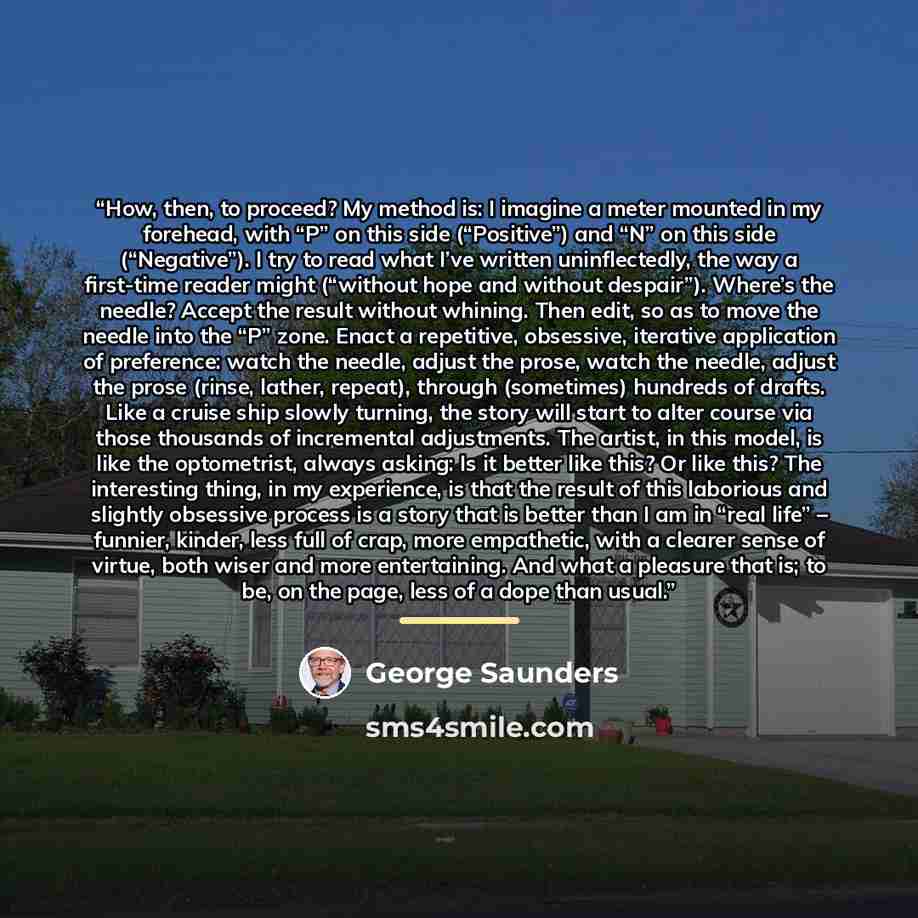
““How, then, to proceed? My method is: I imagine a meter mounted in my forehead, with “P” on this side (“Positive”) and “N” on this side (“Negative”). I try to read what I’ve written uninflectedly, the way a first-time reader might (“without hope and without despair”). Where’s the needle? Accept the result without whining. Then edit, so as to move the needle into the “P” zone. Enact a repetitive, obsessive, iterative application of preference: watch the needle, adjust the prose, watch the needle, adjust the prose (rinse, lather, repeat), through (sometimes) hundreds of drafts. Like a cruise ship slowly turning, the story will start to alter course via those thousands of incremental adjustments. The artist, in this model, is like the optometrist, always asking: Is it better like this? Or like this? The interesting thing, in my experience, is that the result of this laborious and slightly obsessive process is a story that is better than I am in “real life” – funnier, kinder, less full of crap, more empathetic, with a clearer sense of virtue, both wiser and more entertaining. And what a pleasure that is; to be, on the page, less of a dope than usual.””
About This Quote
Source Interview: The New Yorker, “George Saunders on Writing”, 2015
A disciplined, iterative editing process using a mental positive‑negative meter improves writing by making incremental adjustments until the work feels more virtuous and empathetic.
In simple terms: Repeatedly adjust prose toward positivity.
Key Takeaway
Use a mental meter to guide revisions.
Themes
writing
self‑improvement
creativity
discipline
Mood
reflective
determined
optimistic
Type
advice
process
inspirational
When to use this quote
- drafting
- novel writing
- short story polishing
- personal growth
- editing workshops
Key Concepts
incremental editing
self‑reflection
optometry metaphor
Questions to Reflect On
- How do you balance editing with original voice?
- When does refinement hinder authenticity?
A Different Perspective
May become overly obsessive, stifling spontaneity.
![“[from a reader] I hope she learns to look for the joy in life instead of picking out negatives - it will change her life for the better.” quote by Amy Dickinson](https://sms4smile.com/quotes/img-quotes/dfa/amy-dickinson-8789_books_from-a-reader-i-hope-she-learns-to-look_1623021.jpg)