Committed Quote by George Mason
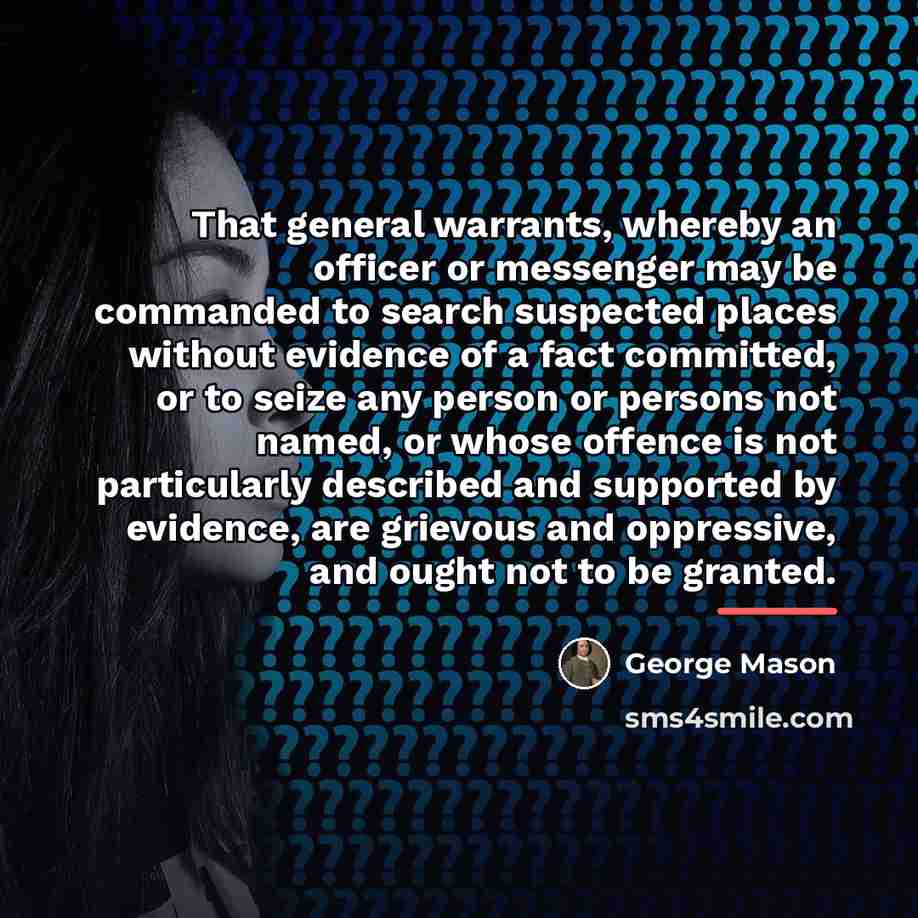
“That general warrants, whereby an officer or messenger may be commanded to search suspected places without evidence of a fact committed, or to seize any person or persons not named, or whose offence is not particularly described and supported by evidence, are grievous and oppressive, and ought not to be granted.”
About This Quote
Source Document: Virginia Declaration of Rights, 1776
The quote condemns the practice of allowing searches and seizures without concrete evidence, calling it abusive and unjust.
In simple terms: Unjust searches without evidence are oppressive.
Key Takeaway
Demand legal safeguards against arbitrary searches.
Themes
justice
rights
government
law
civil liberties
Mood
critical
defiant
Type
political
legal
When to use this quote
- law enforcement
- courtroom
- policy making
- civil rights activism
Key Concepts
due process
constitutional rights
state power
Questions to Reflect On
- How can societies balance security and liberty?
- What safeguards prevent misuse of search powers?
A Different Perspective
Such powers can be justified in emergencies, risking abuse.









![“I'd say that [Louis] Brandeis practiced a kind of a "living originalism," to use the title of Jack Balkin's great book. He said you start with the paradigm case, which in the case of the Fourth Amendment was these general warrants or writs of assistance, but you define it at a level of abstraction…” quote by Jeffrey Rosen](https://sms4smile.com/quotes/img-quotes/aeb/jeffrey-rosen-13180_abstraction_i-d-say-that-louis-brandeis-practiced-a_73138.jpg)
![“This cold weather has set all the young Folks to providing Bedfellows. I have signed two or three Licences every Day [as a Fairfax Justice of the Peace] since I have been at Home. I wish I knew where to get a good one myself; for I find cold Sheets extreamly disagreeable.” quote by George Mason](https://sms4smile.com/quotes/img-quotes/b92/george-mason-8435_bedfellows_this-cold-weather-has-set-all-the-young_3953.jpg)

![“I charge [my sons] never to let the motives of private interest or ambition to influence them to betray, nor the terrors of poverty and disgrace, or the fear of danger or of death deter them from asserting the liberty of their country, and endeavoring to transmit to their posterity those sacred…” quote by George Mason](https://sms4smile.com/quotes/img-quotes/de1/george-mason-8435_ambition_i-charge-my-sons-never-to-let-the-motive_184620.jpg)