Executive branch Quote by Garrett Epps
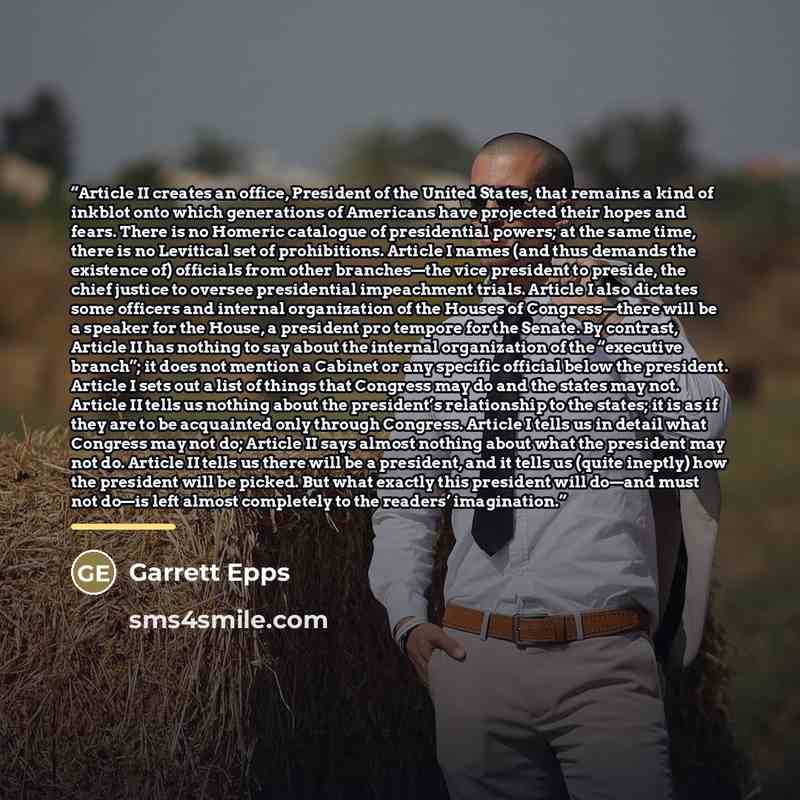
““Article II creates an office, President of the United States, that remains a kind of inkblot onto which generations of Americans have projected their hopes and fears. There is no Homeric catalogue of presidential powers; at the same time, there is no Levitical set of prohibitions. Article I names (and thus demands the existence of) officials from other branches—the vice president to preside, the chief justice to oversee presidential impeachment trials. Article I also dictates some officers and internal organization of the Houses of Congress—there will be a speaker for the House, a president pro tempore for the Senate. By contrast, Article II has nothing to say about the internal organization of the “executive branch”; it does not mention a Cabinet or any specific official below the president. Article I sets out a list of things that Congress may do and the states may not. Article II tells us nothing about the president’s relationship to the states; it is as if they are to be acquainted only through Congress. Article I tells us in detail what Congress may not do; Article II says almost nothing about what the president may not do. Article II tells us there will be a president, and it tells us (quite ineptly) how the president will be picked. But what exactly this president will do—and must not do—is left almost completely to the readers’ imagination.””
About This Quote
Source Essay: Constitutional Structure, 2020
The Constitution outlines presidential powers loosely, leaving many actions to interpretation and tradition.
In simple terms: Presidential powers are vague, leaving room for interpretation.
Key Takeaway
Recognize the flexibility and limits of executive authority.
Themes
government
constitution
presidential power
interpretation
law
Mood
critical
cautious
Type
political
legal
When to use this quote
- policy making
- legal analysis
- civic education
- media commentary
- academic research
Key Concepts
constitutional law
separation of powers
political theory
Questions to Reflect On
- What safeguards should limit presidential overreach?
- How does ambiguity affect democratic accountability?
A Different Perspective
Over‑reliance on vague provisions can lead to power abuse.

![“I take the Constitution very seriously. The biggest problems that we're facing right now have to do with [the president] trying to bring more and more power into the executive branch and not go through Congress at all. And that's what I intend to reverse when I'm President of the United States of…” quote by Barack Obama](https://sms4smile.com/quotes/img-quotes/ec6/barack-obama-17_america_i-take-the-constitution-very-seriously-t_95034.jpg)