Lawlessness Quote by G.K. Chesterton
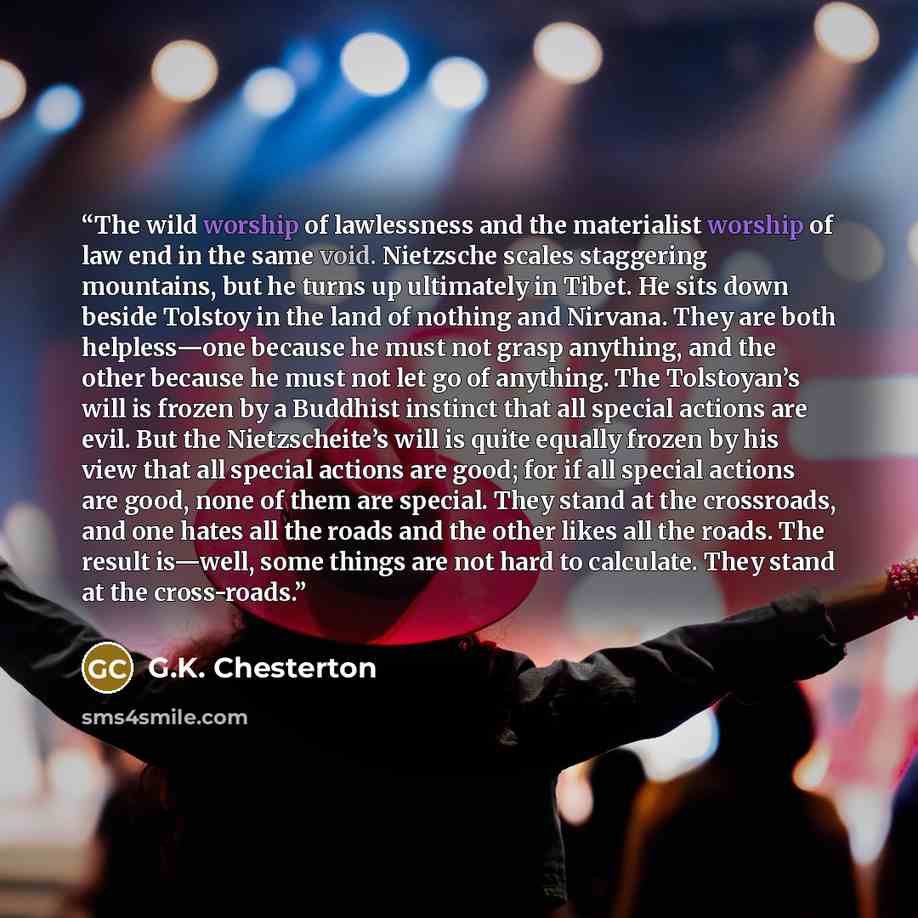
““The wild worship of lawlessness and the materialist worship of law end in the same void. Nietzsche scales staggering mountains, but he turns up ultimately in Tibet. He sits down beside Tolstoy in the land of nothing and Nirvana. They are both helpless—one because he must not grasp anything, and the other because he must not let go of anything. The Tolstoyan’s will is frozen by a Buddhist instinct that all special actions are evil. But the Nietzscheite’s will is quite equally frozen by his view that all special actions are good; for if all special actions are good, none of them are special. They stand at the crossroads, and one hates all the roads and the other likes all the roads. The result is—well, some things are not hard to calculate. They stand at the cross-roads.””
About This Quote
Source Essay: The Man Who Was Thursday, 1908
The passage contrasts Nietzsche’s radical freedom with Tolstoy’s moral restraint, showing both extremes lead to emptiness.
In simple terms: Extreme philosophies can end in nihilism.
Key Takeaway
Avoid absolute positions.
Themes
philosophy
nihilism
ethics
Mood
contemplative
critical
Type
philosophical
literary
When to use this quote
- personal reflection
- academic debate
- spiritual practice
Key Concepts
existentialism
moral absolutism
spiritual emptiness
Questions to Reflect On
- How can one balance freedom and restraint?
- What middle path offers meaning?
A Different Perspective
Both extremes ignore nuance and practical middle ground.
![“In good company one must never want to be entirely and solely right, which is what all pure logic wants [...].” quote by Friedrich Nietzsche](https://sms4smile.com/quotes/img-quotes/5ca/friedrich-nietzsche-15_business_in-good-company-one-must-never-want-to-b_30586.jpg)