Character Quote by G.K. Chesterton
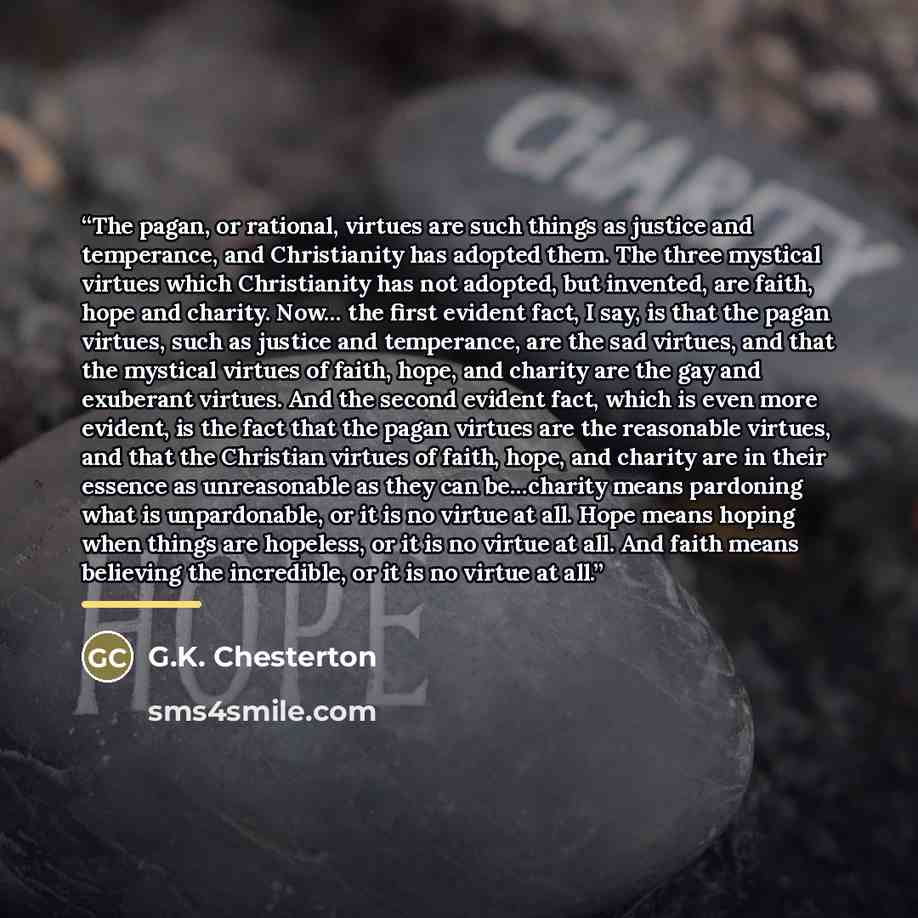
““The pagan, or rational, virtues are such things as justice and temperance, and Christianity has adopted them. The three mystical virtues which Christianity has not adopted, but invented, are faith, hope and charity. Now… the first evident fact, I say, is that the pagan virtues, such as justice and temperance, are the sad virtues, and that the mystical virtues of faith, hope, and charity are the gay and exuberant virtues. And the second evident fact, which is even more evident, is the fact that the pagan virtues are the reasonable virtues, and that the Christian virtues of faith, hope, and charity are in their essence as unreasonable as they can be…charity means pardoning what is unpardonable, or it is no virtue at all. Hope means hoping when things are hopeless, or it is no virtue at all. And faith means believing the incredible, or it is no virtue at all.””
About This Quote
Chesterton contrasts rational, civic virtues (justice, temperance) with the Christian mystical virtues (faith, hope, charity), arguing the latter are emotionally vibrant but irrational, while the former are sober and logical.
In simple terms: Rational vs. mystical virtues
Key Takeaway
Christian virtues are irrational yet exuberant
Themes
virtue ethics
Christian theology
rationalism
emotion
contradiction
moral philosophy
Mood
thoughtful
critical
inquisitive
Type
philosophical
theological
critical
When to use this quote
- theological debate
- moral education
- philosophical analysis
- literary criticism
- personal reflection
Key Concepts
justice
temperance
faith
hope
charity
Practical Applications
- exploring moral frameworks
- teaching virtue distinctions
Questions to Reflect On
- How do we balance rational and mystical virtues in modern life?
- Can irrational virtues be ethically valuable?
A Different Perspective
Some argue that faith, hope, and charity can be rationally justified through pragmatic benefits and communal cohesion, challenging the claim of pure irrationality.