Quiet man Quote by G.K. Chesterton
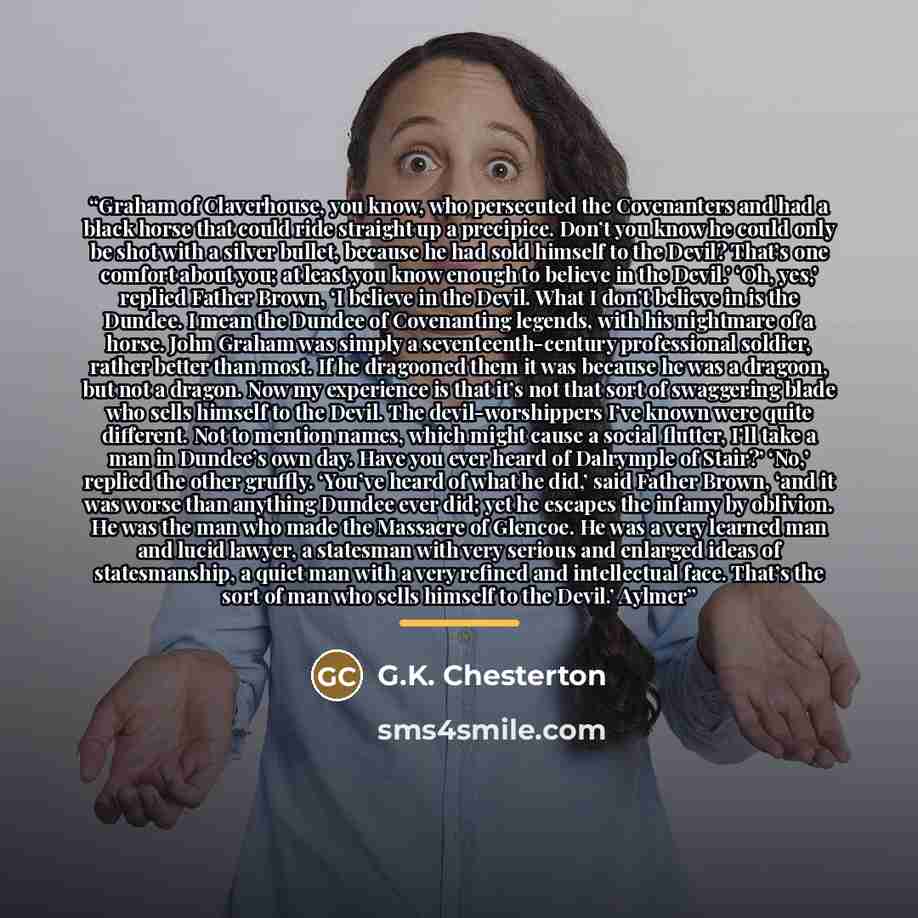
““Graham of Claverhouse, you know, who persecuted the Covenanters and had a black horse that could ride straight up a precipice. Don’t you know he could only be shot with a silver bullet, because he had sold himself to the Devil? That’s one comfort about you; at least you know enough to believe in the Devil.’ ‘Oh, yes,’ replied Father Brown, ‘I believe in the Devil. What I don’t believe in is the Dundee. I mean the Dundee of Covenanting legends, with his nightmare of a horse. John Graham was simply a seventeenth-century professional soldier, rather better than most. If he dragooned them it was because he was a dragoon, but not a dragon. Now my experience is that it’s not that sort of swaggering blade who sells himself to the Devil. The devil-worshippers I’ve known were quite different. Not to mention names, which might cause a social flutter, I’ll take a man in Dundee’s own day. Have you ever heard of Dalrymple of Stair?’ ‘No,’ replied the other gruffly. ‘You’ve heard of what he did,’ said Father Brown, ‘and it was worse than anything Dundee ever did; yet he escapes the infamy by oblivion. He was the man who made the Massacre of Glencoe. He was a very learned man and lucid lawyer, a statesman with very serious and enlarged ideas of statesmanship, a quiet man with a very refined and intellectual face. That’s the sort of man who sells himself to the Devil.’ Aylmer””
About This Quote
Father Brown contrasts mythic villainy with historical reality, showing that true moral corruption is often bureaucratic and legalistic rather than flamboyant supernatural.
In simple terms: Historical evil is bureaucratic, not mythic.
Key Takeaway
Moral corruption can be institutional, not just legendary.
Themes
myth vs history
moral ambiguity
institutional evil
historical revisionism
religious skepticism
literary dialogue
Mood
ironic
skeptical
reflective
Type
dialogue
historical commentary
When to use this quote
- discussing historical figures
- analyzing literary characters
- debating moral responsibility
- teaching history
- examining folklore
Key Concepts
devil symbolism
political power
legal authority
cultural memory
Practical Applications
- critical essays on historical mythmaking
- lecture on moral complexity in literature
Questions to Reflect On
- How does myth shape our perception of historical figures?
- What responsibilities do scholars have when separating legend from fact?
A Different Perspective
Some may argue that the legend of the black horse serves as a useful moral allegory, even if historically inaccurate.